
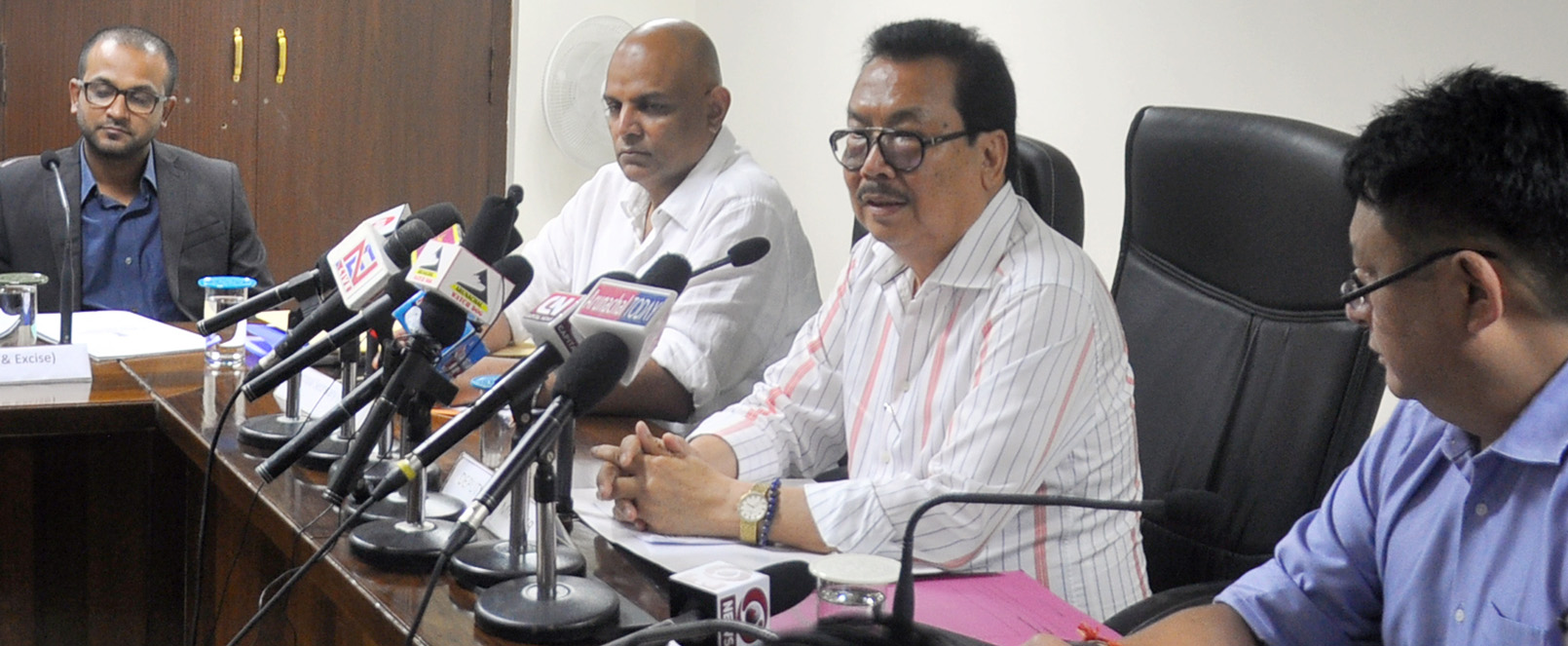
ITANAGAR, Sept 30: Terming Prime Minister Narendra Modi’s decision to make India a USD 5 trillion economy from present USD 2.7 trillion by 2024 historic, Deputy Chief Minister Chowna Mein, who holds Finance portfolio, told media persons here on Monday that Finance Minister Nirmala Sitharaman on Sept 20 last announced many steps to achieve the goal.
Her announcements included corporate tax slashed to 22% from 30% and 15% tax optional for new domestic manufacturing Cos formed on or after 01.19.19 for fresh investment to augment India’s manufacturing sector as it would encourage foreign and domestic companies to invest in India which would generate more employment, Mein said.
Housing sector: External commercial borrowing guidelines to be relaxed to facilitate finance for home buyers are eligible under Pradhan Mantri Awas Yojana in consultation with RBI to facilitate affordable and middle income groups.
Agri sector: Agents operating under agriculture produce market committees exempted from 2% TDS on cash payments over Rs one crore to avoid inconvenience to all stakeholders including farmers.
CSR: The GoI has okayed companies to place 2% CSR funds for research in incubation centres of colleges under central or state Govt varsities or PSU companies to speed up field research not only to build new India but to offer Cos scope to upgrade their products and services.
Banking: Merging of 10 PSU banks to form four to reduce their number from 27 (in 2017) to 12 which would help raising current savings accounts and make them profitable without hampering activities. The merger included – (Punjab National Bank, Oriental Bank of Commerce & United Bank) = one; Canara & Syndicate bank = one; Union Bank, Andhra Bank & corporation = one and Indian bank + Allahabad Bank = one. The GoI has advanced Rs 70,000 crore to PSU banks to benefit corporate, retail borrowers, micro, small & medium enterprises (MSME) & small traders.
Moreover, EMI of housing loans, auto and other retail loans reduced; working capital loans for industries cheaper; surcharge withdrawn by long & short term capital gains received from transfer of the equity shares/units to promote investment in capital market for stabilization.
IT Deptt to function online to serve all notices, summons, orders etc. through a centralized computer system to end harassment of taxpayers.
Exports: Duty exemption on goods exported to boost exports; input tax credit in GST is fully automatic and electronic; export credit insurance scheme scope to increase with banks lending for exports getting more insurance cover; additional to be released for export credit under priority sector; special plan by December to reduce export time.
GST modifications: No GST on hotel rooms below Rs 1,000; GST reduced from 18% to 12% for hotel rooms (Rs 1,000 to Rs. 7,500) & 18% instead of 28% for above Rs. 7,500; rate for outdoor catering up to Rs. 7,50 reduced to 5% with ITC from 18% & 18% for above Rs. 7,501, GST on diamond job work reduced from 5% to 1.5%; machine job supply reduced from18% to 12%.
Warehousing: Perishable food like pulses, rice, tea, coffee, nuts, spices etc. exempted according to their storage time.
Electric vehicles: Rate on electric vehicles reduced from 12% to 5%; on electric vehicle charger & charging point reduced from 18% to 5%; local booking of electric vehicles with 12 passengers exempted.
Returns/Annual returns: New return system to be introduced from April 2020 instead of October next to give opportunity to taxpayers and the system to adapt; annual return form GSTR 9A for composition taxpayers for 2017-18 and 2018-19 waived off; annual return form GSTR 9 for taxpayers with aggregate turnover up to Rs. 2 crore made optional for 2017-18 and 2018-19.
Refunds: All pending GST payment refund till now of MSME to be made within 30 days and future payment to be resolved within 60 days; integrated refund system with disbursal by single authority introduced from 26.09.19.
GST introduced in India on 01.07.17 while Goods & Services Tax was introduced in Arunachal which helped revenue growth. The GST collection for FY 2018-19 f was Rs 569.41 Cr, almost 111% growth in comparison with nine months’ previous FY, Mein said, adding Arunachal is one of the few states to record positive growth since GST implementation. The state topped the list in current FY 2019-20 (April-August) too with Rs. 304.74 Cr collection.
Thus, it is not entitled to receive compensation from GoI and other States are Mizoram, Manipur, Nagaland and Sikkim.
The most striking feature of GST implementation in this state has been an exponential growth with registration of more dealers. Sustained efforts for widening of tax base through outreach programmes, market surveys in a 140% growth in base of assessees. The tax net considerably widened to effectively capture transactions of assesses and deepening of tax base to yield higher revenue.
Assessee base prior to GST (under VAT regime) was 6,102 which rose to 14,625 under GST, Mein said to justify the effective role played by the department.


 20

