
By Pradeep Kumar
ITANAGAR, Oct 23: The 57-memebr NCC cadets who will represent NE region in Republic Day celebration on January 26 next in national capital Delhi will be symbolized by serenity, bravery and patriotism as shown in the picture.
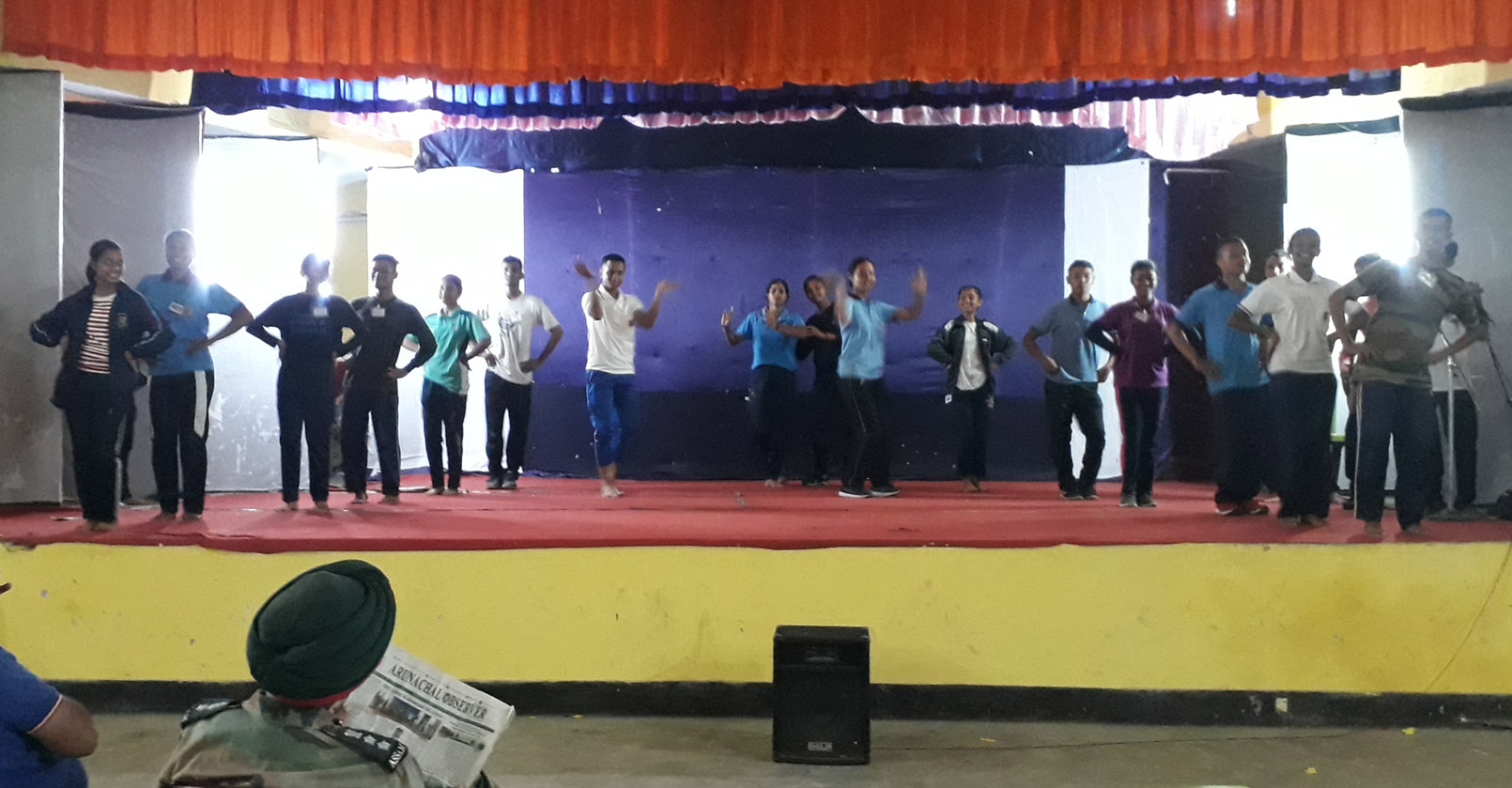
“It was a painstaking process in preparing our symbol manually. It took one day to draw, two days in painting with husks before spraying gulal to colour it, said Lt Palvinder Singh, who will escort the team to attend the annual Republic Day Contingent camp. The team is making through preparation now in Rajiv Gandhi Govt Polytechnic and DNGC here.
The lush green high mountains and numerous perennial rivers and streams reflect serenity of NE region for which it is one of the biodiversity hotspots of the world while rich socio-cultural philosophy of Srimanta Shankaradev, Assamese polymath, a saint-scholar, poet, playwright and social-religious reformer, still prevails in the social strata of the region.

The symbol showcases the glorious past of NE region, pre-independence heroes and paramilitary force Assam Rifles proactive in the region.
The region is known for its bravery and patriotism since British days. The best example is Lachi Barphukan, chief commander of Ahom Army, of present-day Assam, who is known for his leadership in 1671 Battle of Saraighat that thwarted a drawn-out attempt by Mughal forces to take back Ahom kingdom.
Kanaklata Barua, also called Birbala and Shaheed, during the Quit India Movement had joined had joined death squad (Mrityu Bahini), comprising groups of youth from Gohpur sub-division of Assam. After deciding to hoist tri-colour at Gohpur police station on 20.09.42, a procession of unarmed villagers begun led by her. The police warned of dire consequences, but the undeterred Bahini continued to march ahead when the police fired and 17-year-old Kanaklata attained martyrdom.
The Fast Patrol Vessel ICGS Kanak Lata Barua of Indian Cost Guard, commissioned in 1997, is named after her. A life size statue of hers was unveiled at Gauripur in 2011. Her impassioned speech before death remains a source of inspiration even today as she had laid down her life for the freedom of the country. Her story was replicated in director Chandra Mudoi’s film, Epaah Phulil Epaah Xoril. The Hindi version of the movie, titled Purab Ki Awaz, was also released to reach a wider audience.
The Assam Rifles is the oldest paramilitary force of India, which traces its lineage back to a paramilitary police force that was formed under the British in 1835 called Cachar Levy. Since then the Assam Rifles have undergone a number of name changes -the Assam Frontier Police (1883), the Assam Military Police (1891) and Eastern Bengal and Assam Military Police (1913), before finally becoming the Assam Rifles in 1917. Over the course of its history, the Assam Rifles and its predecessor units have served in a number of roles, conflicts and theatres including World War-I when they served in Europe and the Middle East and World War-II when they served mainly in Burma (present Myanmar).
It is under the control of Union MoHA and work in maintaining internal security, conduct counter-insurgency operations under the control of the Army and border security operations, aid to the civilians during emergency, and help in communications, medical assistance and education in remote areas. The Assam Rifles has been guarding the Indo-Myanmar border since 2002 as per the GoI policy ‘one border one force’. It plays a major role in Arunachal Pradesh which also shares 1,643-km Indo-Myanmar border by deploying its 25 battalions to guard the border.


 20
