
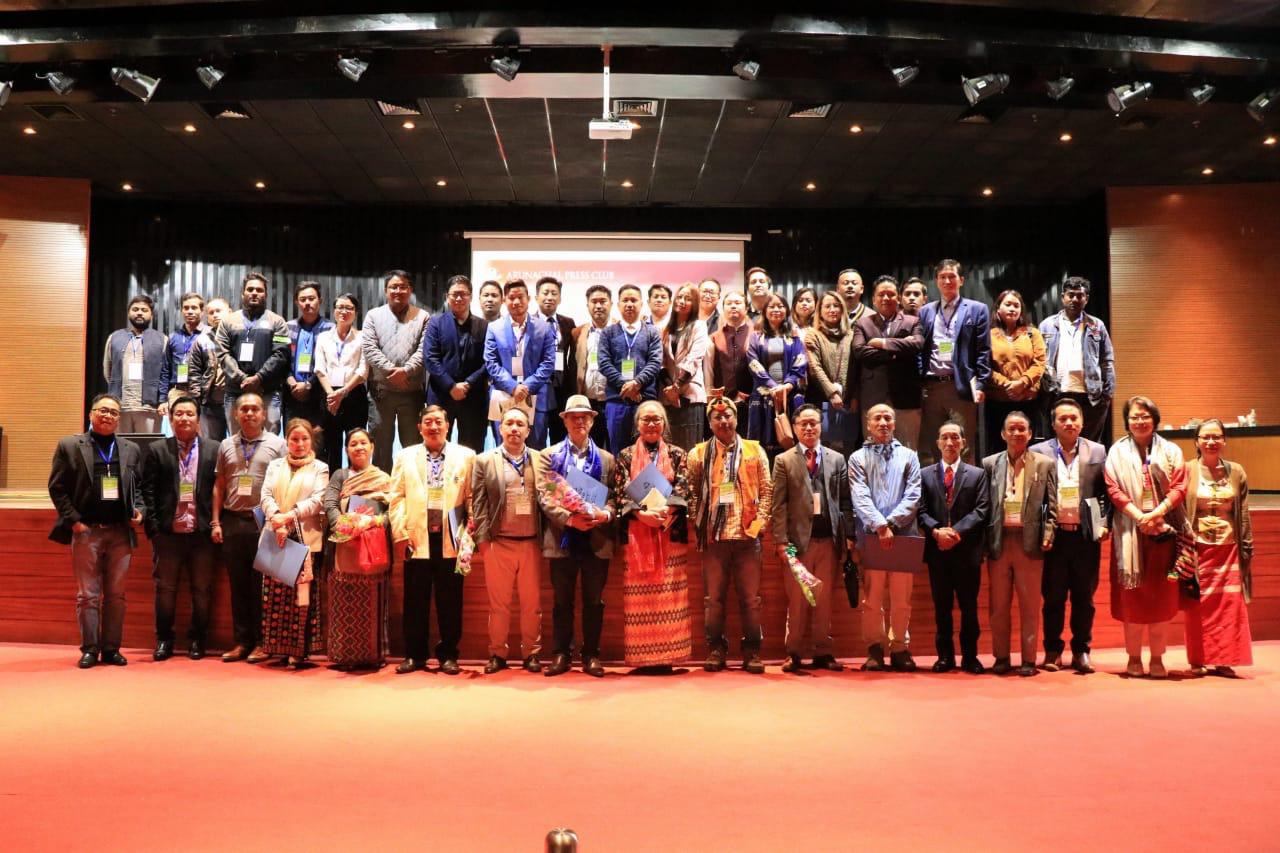
ITANAGAR, Dec 05: ‘Face to Face,’ a day-long symposium, organized by Arunachal Press Club (APC) has on topic ‘Should panchayat election be held along party lines or without party lines’ at Dorjee Khandu Auditorium of state assembly here on Thursday, saw thought provoking participation of panelists from various fields.
New Delhi-based Institute of Social Sciences director Dr George Mathew, in his keynote address, said that democratization of a society is very important for a healthy democracy as well as the PR system to be successful. Democratization is not possible without involvement of political parties, he reasoned.
“The motto of PR is to give power to the people, power to those who are in the villages of our country. This was a dream of Mahatma Gandhi. He wanted all villages to grow into a republic, a village republic, become Swaraj,” Dr Mathew said. He opined that if political parties can fight Parliament and assembly elections, then they should keep the option of contesting elections for local governance (PR) open. He also called for granting more power to PRI in the states.
North East Social Trust (NEST) chairperson T A Husain, in his address, said that PR polls should be held along partly line claiming that if there is involvement of parties in election, the people can question the leader and also the ones in the centre if any discrepancies arrive. When political parties are involved in PR polls there will be an opposition and for a healthy democracy we need a strong opposition, he said.
The symposium was divided into three sessions while the first one was on topic ‘political perspective’: views of the representatives of political parties.
APCC general secretary Bengia Hashi, also in-charge of Arunachal Pradesh Rajiv Gandhi Panchayati Raj Sanghatan (APRGPRS), advocated party based elections. He said ‘there would be chaos if the elections are not fought on party line.’ However, he added that if it is held without party line, then the Govt must come up with a resolution or law which will bar the election winners from joining any political party in future.
PPA chairman Kamen Ringu said ‘if PR election is held on party line people will be under the command of the ruling elites and will not be allowed to take independent decisions.’ He alleged that both BJP and Congress have been using PR as a tool to gain political mileage.
“Let the people decide who rule them, not the political parties,” he added. Ringu also called upon the Govt to re-build and re-introduce the PR system without any political influence or interventions. There is no wrong in experimenting if it is in greater interest of the people. ‘Let the people fight the election without any party symbols,’ he said.
NPP MLA Mutchu Mithi said ‘if election is held along party lines sometimes people with good leadership qualities miss out if he/she fails to get the party ticket.’
Talking about the ruling party phobia in Arunachal, Mithi said that 90% of MLA candidates were voted to power only because they represented the ruling party. This, he said, has to change and it can start from the village level through the PR elections by not involving any political parties in it, he added.
JD (U) MLA Hayeng Mangfi said that money culture and horse trading are killing democratic principles in Arunachal Quality of leadership is very limited in the state and there are very less legislatures who actually know the pulse of the people and speak of pan-Arunachal, he added.
Speaking on 33% reservation for women in PR polls, Mangfi said that the number of capable women who can contest is very less. The state is not mature enough to fight elections on political lines, so making it non-political is more feasible, he opined.
Palin’s Govt College principal P G Tago and Future Generations Arunachal project consultant Dr Tage Kanno, in their opinions during second session, said that involvement of political parties cannot be ignored as it was required. The status quo be maintained and polls held along the party line, they advocate.
Arunachal Chamber of Commerce & Industry secretary general Toko Tatung, in his deliberation, urged everyone instead of discussing whether the PR polls should be held along party lines or not, the discussion should be held if PR system has been successful in Arunachal. He highlighted how PR bodies are not given any power and fund in the state.
“We must focus on infighting that is happening in our families because of PR elections. Villages are in chaos because of this. We are fighting against each other and losing our essence,” he said.
Questioning failure of the GoAP in conducting PR polls though due since May 2018, prominent social activist Jarjum Ete alleged that it amounted to breakdown of Constitution. She also questioned whether the 33% reservation for women will be applicable if the election is not held on party lines.
She also opined that if election is not held along the party lines, then many deserving candidates/leaders will not find space as influential clans and families will have the final say. “If it is on party basis, one or the other party may give them a platform and nomination,” she added.
APRGPRS convenor Jaya Joram said that not only the PR but the assembly election also should be held on non political line. There must be a discussion on why the PR system has not been successful so far in the state, she said, adding that though the PRIs are trained and told about their roles and power, they get nothing when they demand for the same. There is no power given to the PR leaders, she added.
Speaking against party based election, former Poma panchayat ASM Techi Ana said that a lot of money has to be invested to get a political party ticket and once the elections are over the parties hardly bother about the PRI leaders.
“We have to go right from the block to state level for a ticket and spend lot of money but after the elections are over there is no interventions from the party,” she said.
Papum Pare Capital Complex District Bar Association former president, advocate Tarh Eha said there should be more discussion on devolution of powers to the PRI. Most of the state PR leaders are not aware of their rights, he said. Speaking against party based election, Eha said the political parties have become like middlemen and divide families and people during PR election.
AAPSU debate-symposium secretary Marli Kamki, in his deliberation, said that if there is no involvement of political parties in PR elections there will be chaos in grassroots politics. He raised concern that if PR election is held without party line, then it will be done on clan basis and in such situation people hailing from bigger clans will win the election.
Kamki was of the opinion that discussion should also be on the minimum qualification required for candidates intending to fight PR polls.
There was also interactive session where participants showed panelists with queries.
Yachuli Govt College assistant professor Nending Ommo, RGU Prof Jumyir Basar and The Independent Review copy editor Karpu Chisi moderated the sessions.


 20
