
BJP taught a lesson: Tuki
Congratulating voters of Jharkhand and winners for teaching the ruling BJP a lesson, Arunachal Pradesh Congress Committee president-cum-former chief minister Nabam Tuki applauded party leaders Sonia and Rahul Gandhi, JMM and RJD leaders for the spectacular victory and expressed confidence that the people would be assured of good governance.
- JMM 30
- INC 15
- RJD 01
- BJP 25
- JVM 03
- AJSU 03
- Oth 04
Total 81
By Pradeep Kumar
ITANAGAR, Dec 23: Trumping the BJP, the Jharkhand Mukti Morcha (JMM) has emerged as the single-largest party in the 81-member Jharkhand Assembly elections with party leader Hemant Soren set to stake claim to power in Monday as the JMM-Congress alliance has comfortably crossing the majority mark of 41.
The state saw a six-way battle in five phases with the ruling BJP and opposition Congress battling it out, with the smaller regional parties, like JMM, AJSU, Id Vikas Morcha (Prajatantrik) and Rashtriya Janata Dal trying to play their roles. The BJP won 25 seats, opposition alliance comprising the JMM and the Congress captured 46. In the outgoing Assembly, the BJP had 37 and its ally AJSU five seats.
Exuding confidence that the INC-JMM alliance will form the Govt with Hemant Soren as chief minister, AICC in-charge for Jharkhand RPN Singh said, “We will form the Govt as we fought the elections for the state people by raising issues that affect their lives and livelihoods. PM Narendra Modi and Home Minister Amit Shah tried to divert the attention of the people away from fundamental issues but the people did not get swayed.” Reiterating that JMM’s Soren will be the chief minister as declared earlier, Singh said the Jharkhand results are a defeat of BJP’s “arrogance and diversionary tactics”.“Jharkhand people have demolished the arrogance of Modiji, Amit Shah and the BJP. Democracy has won,” said NCP spokesman Nawab Malik while Leader of Opposition in Lok Sabha Mallikarjun Kharge of Congress said: “This is good result and the people’s anger shown towards the BJP Govt.”
In 2014, the JMM’s tally stood at 19, the Congress’s six and the Babulal Marandi-led JVM eight seat. Six of the JVM’s eight MLAs later switched loyalty to the BJP.
The BJP and the AJSU parted company this time, while the JMM-Congress-RJD stitched an alliance against the ruling dispensation led by Chief Minister Raghubar Das. The BJP’s possible loss, ironically, comes in the wake of the party’s sterling performance in Lok Sabha elections, in which it had won 11 of 14 parliamentary seats in the tribal-dominated state.
All parties in the opposition alliance look set to make handsome gains in the new Assembly. The JMM’s numbers are likely to go up from 19 in 2014 to anywhere between 25 and 30 seats. The Congress is expected to win 12-18 constituencies, up from six. The RJD may also open its account. The vote share of BJP is 34% up from 31% in 2014 while of JMM 36%.
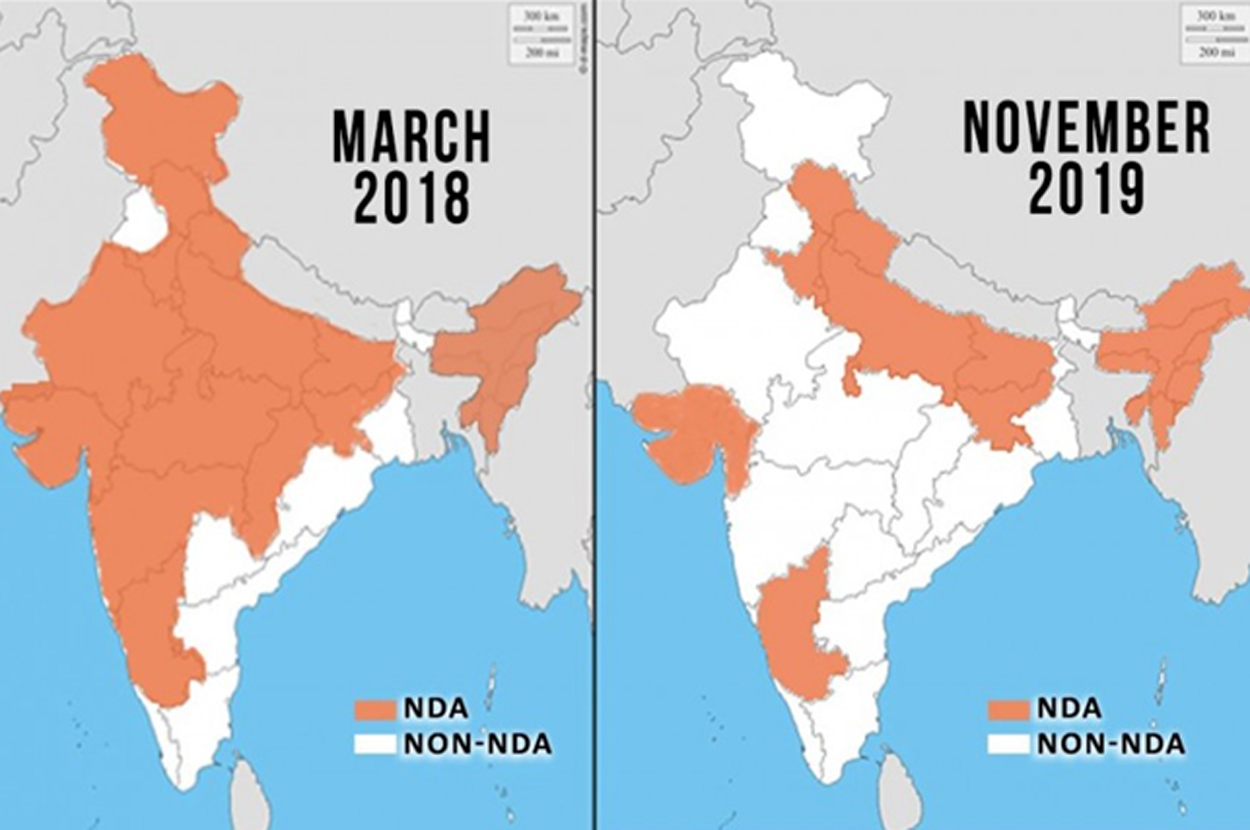
The shrinking saffron hues is visible in India’s map with Jharkahnd, the latest but 5th state after Maharashtra, Chhattisgarh, Rajasthan, Madhya Pradesh in past 12 months slipping out of hands of the BJP, which once commanded over 71% of India at the state level. The BJP has been riding a roller coaster of political triumphs and defeats for the past five years. From holding power in only seven state assemblies in 2014 to a staggering 22 by 2018, the BJP swept the nation with the Modi wave.
When the BJP with support of NCP leader Ajit Pawar formed the Govt in Maharashtra at 5.45 am (never seen in the past) on Nov 23, the intent was to recover from the setbacks the party had suffered in other states in last three years. With the fall of BJP’s 4-day-old Maharashtra Govt, causing worries for party bigwigs Prime Minister Manredrsa Modi and Chanakya Amit Shah.
The BJP had swooped up states after states after 2014, when it first came to power at the Centre. From commanding just seven states, it won the assembly elections in 21 states by 2018 by riding the Modi wave. In 2014, BJP ruled over Gujarat, MP, Rajasthan, Chhattisgarh, Goa and Arunachal Pradesh – directly or with alliance partners. By Sept 2018, the only states BJP did not rule were Tamil Nadu (AIADMK), Kerala (LDF), Karnataka, Mizoram & Punjab (Congress), Odisha (BJD), West Bengal (Trinamool Congress) and Telangana (TRS).
The graph was slow and steady, from seven in 2014 to 13 in 2015, 15 in 2016, 19 in 2017 and then 21 in 2018. But the buck stopped there. Even though BJP continued to score victories and topple Govts in most unexpected corners of India, such as Mizoram, it started losing in its bastions like MP, Rajasthan and Chhattisgarh. Alliance partner TDP broke off, taking Andhra out of BJP-led NDA’s hands. Jammu and Kashmir was lost to President’s Rule by December last.
The BJP’s luck did not shine in 2019 too though the Modi Govt made historic comeback in 2019 Lok Sabha elections. The BJP faced acid test in state-level politics. While the BJP’s BS Yediyurappa managed a coup in Karnataka and formed the Govt after a dramatic political turmoil, a similar situation trumped the BJP in Maharashtra. Home to the saffron ideologue RSS’s home, Maharashtra slipped through the BJP’s hands after they lost a game of chess with Shiv Sena as well as NCP.
After Devendra Fadnavis’s resignation on Tuesday (Nov 26), the BJP was reduced to 17 states. The number may not seem very disheartening but geographically, the BJP has lost big states while winning smaller ones. The region ruled by the BJP, with or without allies, has fallen from 71& in 2017 to 40% by Nov 26.


 20
