By Pradeep Kumar
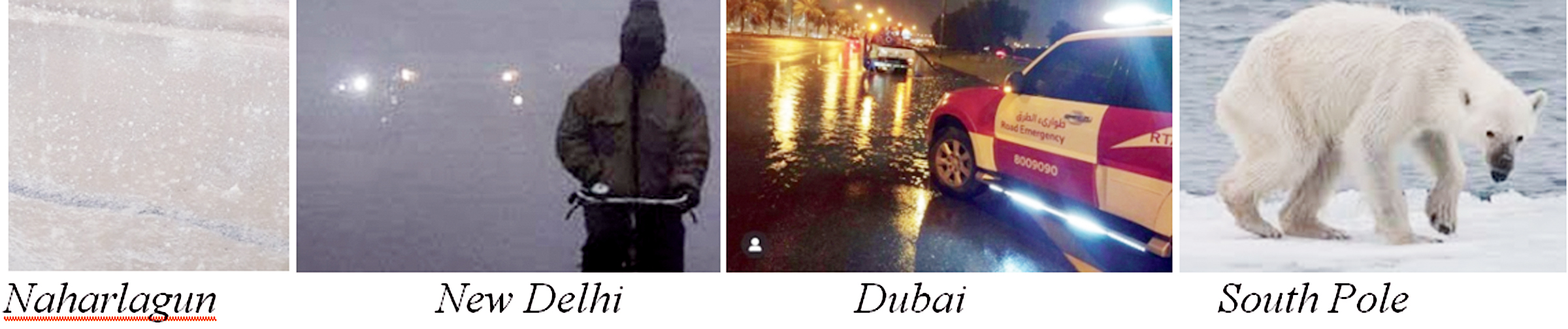
NAHARLAGUN, Jan 19: Thunder showers with hailstones lashed Capital Complex for 15 minutes since 12 noon on Sunday and likely in 24-hour as predicted by Skymet weather as was highlighted in this daily’s Sunday edition – Good rains in Arunachal & Assam predicted.
The guard wire of an electric pole along NH-415 near SBI was damaged disrupting supply of two lower transmission line to few sectors including E. However, power house staff led by JE Tana Tokur Tara rushed to restore supply immediately. However, there was no report of any other loss. This was repetition almost after over a year as Arunachal Pradesh had witnessed thunder showers on 14-15 February, 2018 also predicted by Skymet weather.
However, this Himalayan state has been recording extreme cold not experienced in almost over three decades. This thunder showers would undoubtedly intensify coldness as impact of presumed climate change, said climate expert and former state PCCF K D Singh, when contacted.
Pointing out that the global temperature record shows temperature fluctuations of the atmosphere and the oceans through various spans of time he said most detailed information has been kept only since 1850, when methodical thermometer-based records began. There are numerous estimates of temperatures since the end of the Pleistocene glaciations, particularly during current Holocene epoch. Older time periods are studied by paleocimatology, he said.
He cited examples worst temperature fluctuation of New Delhi in 119 years, hot desert Dubai located in Arabian Peninsula but a trade hub of Western Asia saw record breaking flood by heavy rains on January 12 last which was cleared by 3,100 workers supervised by more than 600 engineers and inspectors to work 24/7 while millions of polar bears have been starving due to impacts of global warming as proved by heart-wrenching videos shot by Paul Nicklen and Cristina Mittermeier of Sea Legay NGO.
However, he said that it would be wrong to attribute such phenomenon to climate change as it could be climate cycle or oscillation reflecting recurring cyclical oscillation within global or regional climate pattern or due to three-dimensional up and down drifting of Earth’s orbit known as “precession of the ecliptic” or “planetary precession”
Hail is a form of solid precipitation consisting of balls or irregular lumps of ice, each of which is called a hailstone. Hail is possible within most thunderstorms as it is produced by cumulonimbus and within 2 nmi (3.7 km) of the parent storm.
Hail formation requires environments of strong, upward motion of air with the parent thunderstorm (similar to tornadoes) and lowered heights of the freezing level. In the mid-latitudes hail forms near the interiors of continents, while in the tropics, it tends to be confined to high elevations.
Hailstones generally fall at higher speeds as they grow in size, though complicating factors such as melting, friction with air, wind, and interaction with rain and other hailstones can slow their descent through Earth’s atmosphere.


 20