
By Pradeep Kumar
ITANAGAR, Jan 30: This Himalayan state known as ‘Last Sagri La on Earth’ wouold be known to the world slowly but steadily with bold initiatives of present Arunachal Pradesh Govt headed by Chief Minister Pema Khandu, said Tourism Minister Nakap Nalo.
Nalo was interacting with Mumbai-based Auto Furze Travel Solution managing direcor N Shriram Nijsure and technical director Subhash Pawase, when the duo called for giving a new thrust to tourism sector to showcase the unique heritage, culture and historic monuments of the state, like unparallel Jawaharlal Nehru State Museum, Sidhartha Vihar Gompa and Itafort ruins, among the numerous such monuments.
India adopted Atithi Devo Bhava (The guest is god) concept to revering guests with same respect as god, in 2003 which prescribee going out of the way to treat guests with reverence goes even beyond the Indian common greeting of namaste (I bow to the divinity in you) used for everyone. This host-guest dynamic relationship embodies the traditional Hindu-Buddhist philosophy found in Taittiriya Upanishad, Shikshavalli I.11.2 that says: matrudevo bhava, pitrudevo bhava, acharyadevo bhava, atithidevo bhava (be one for whom the Mother is God, be one for whom the Father is God, be one for whom the Teacher is God, be one for whom the guest is God).
“This mantra has been indivisible part of Arunachal culture since time immemorial as Arunachalees protect their guests more than their lives, offer free food and accommodation while none even the SPG could touch the guests…that is Arunachal,” Nalo said without mincing any words.
“What you saw in Itanagar is a glimpse of the iceberg but have to travel to interior parts of this hilly sate and stay in Home Stay with locals to gain firsthand experience. Tourism officers posted at Guwahati, Kolkata and Delhi would extend all help to reach your at your desired destinations with all possible support,” he said.
Lack of required infrastructures while tourism not considered an industry about few decades ago in India, .were the greatest hurdles for this land-locked state to draw attention of tourists, he said, adding things are moving in right direction now with CM Khandu paving the way to put the state on global tourism map for his in-depth knowledge of the sector for managing the department as Minister in the past.
“The Itafort after which the state capital has been named was reportedly extension of Assam Kingdom boundary by Ahom King though there is no historical record. But how the Itafort was ruined whether by earthquake or by some other factors is not known. The half-bricks indicate that it could have been built during British period,” he reasoned.
The tourists are keen to see unseen places according to present global trend, the duo, both GIS and GPS experts working in 50 nations, said and suggested to tune tourism spots in tune with this trend as Arunachal has many unique little explored places to suit this requirement.
True to what the duo said, it is high time for the GoAP to project uniqueness of this state to woo global tourists.
The little unknown historical aspects that would draw tourists, historians and researchers, according to me, are:
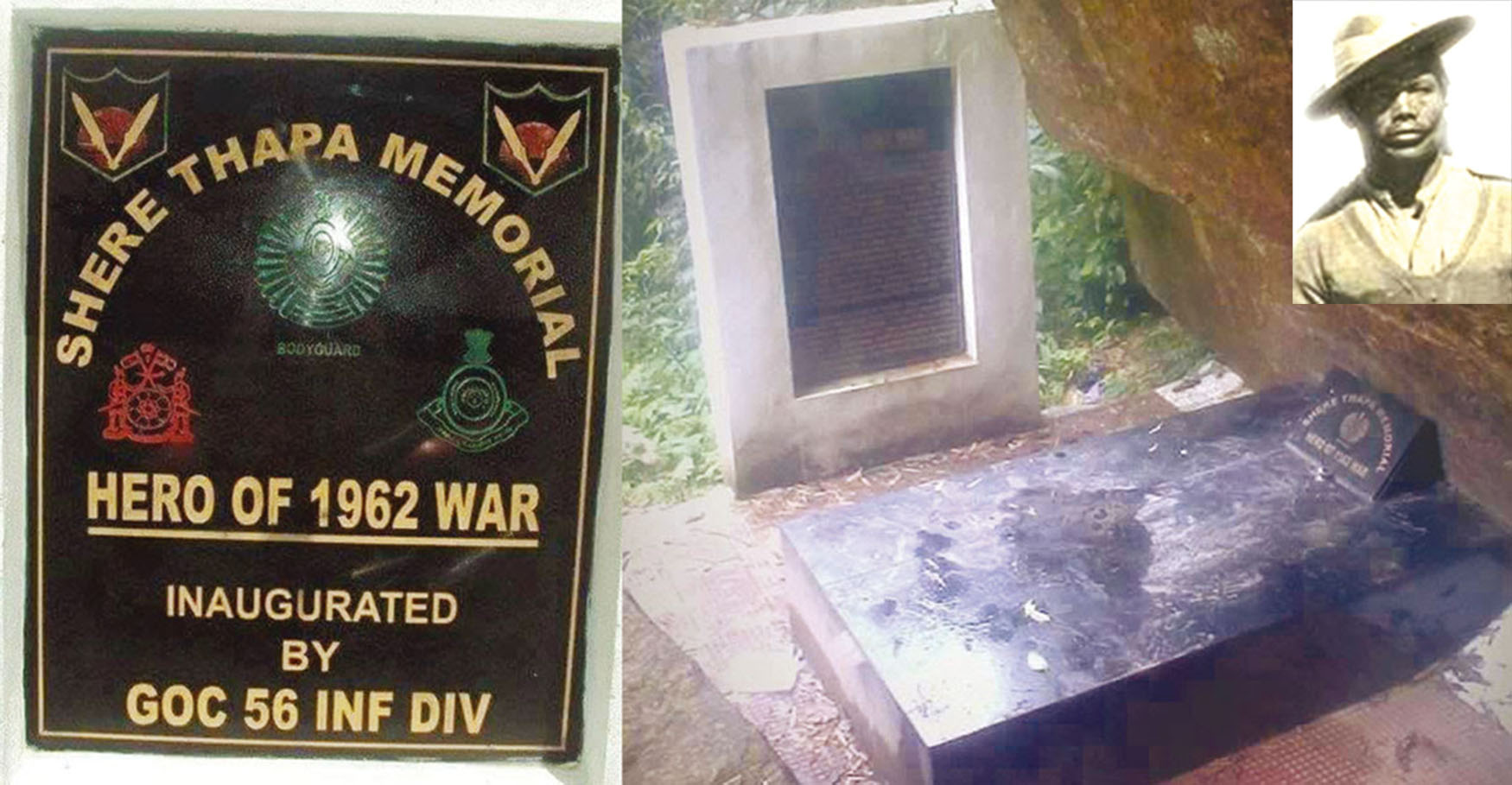
1962 martyr Army havildar Shere Thapa buried history traced:After visiting Taksing in helicopter with senior leader Tanga Byaling, I broke the news about Sino-India war hero Shere Thapa through ANI on 19.10.12 for the world to know about the unknown and forgotten great hero who had sacrificed his life for the cause of his motherland. He had killed 160 PLA jawans in Tama Chung Chung ridge in Middle sector of Sino-India border under Upper Subansiri district on 18.10.1962. The PLA jawans after killing him had buried his mortal remains with honour. His mortal remains were brought by Lemiking villagers, his last rites performed and a memorial was built by them with great respect.
I managed to get his picture through a senior Army from 2 J&K Rifles, about renovation of the memorial and the renovated memorial was inaugurated by Army’s 56 Infantry Division GoC in 2016 had placed a wreath on the memorial in recognition his bravely. Though All Arunachal Pradesh Gorkha Youth Welfare Association (AAPGYWA) pitched in support but still the biography of Thapa remained in mystery.
Thapa born in Nepal on 27.12.1928, was enrolled in to Indian Army on 01.01.57 (No 13710603W), served with J&K Special Force during 27.12.45 to 31.12.56, underwent training on MR-I, ACE-I &TTT-1, promoted as havildar on 01.05.62, before being deployed in Tama Chung area and died on 18.11.62. His wife is Dilli (82), daughters – Dhanisara (68), Syani (65) and Nurma (62). Neither his qualification nor his address was available in official record.
Even, Thapa’s gallantry was vouched on 24.06.19 by Nacho MLA-cum-Tourism Minister Nakap Nalo as he hails from Orak village under Lemiking circle, where Thapa’s memorial stands tall today. Alas ….Thapa’s monumental patriotism went unrecognized.
Lord Jawa: Diety of more than 700-year-old Tserteng Gompa, located in Lumpo village at 10,000 feet above sea level very close to Sino-India border in Tawang district, is hardly in public domain.
During my visit in December 2012, courtesy loal MLA Jambey Tasi, I saw the 15-feet tall statue of Lord Jowa, the other name of Lord Buddha, made up of brass with gold coat all over bore the brunt of 1962 Chinese aggression. The bullet shot by one of the PLA soldiers hit the chin of the statue but could not pierce it, instead hit the rock wall. The action of the soldier was undoubtedly influenced by Mao Zedung’s philosophy – Religion is poison -, but the solider fainted in the gonpa premises while other soldiers fled away. I had flashed it on 16.12.12 for the first time globally through Asia News International – PLA did not spare even Lord Buddha in 1962, is India ready for a trial of strength?.
Built by Lama Sang Hridhar with the support of Lumpo villagers, the gonpa stands tall today as witness to the sea changes the area has undergone since then. But the 1962 conflict has embedded a deep wound in the hearts of all security personnel guarding the frontier.
Hidden Land Pemakod, Heart of the World, is regarded as one of the most sacred places in the world,where Guru Padmasambhava’s blessings radiate and any accumulation of merit is said to multiply many times over.
Pemakod was very much cherished by Guru Padmasambhava. In many texts, which he refers it as ‘King of all other 16 of his hidden lands’. In the Tsa Sum Gongdus, he said: “In this hidden land, all mountains are like blooming flowers. All rivers spontaneously recite mantras and flow with nectar; rainbows are arched on trees and bushes. All the oath-bound protectors watch closely and protect true practitioners and punish those who merely pretend to be. Those who practice sincerely will attain enlightenment in this lifetime. Pure samadhi will spontaneously arise just by being in this land.
“One session of practice in this blessed land is equal to a year of practice in other places. Those who make three prostrations here will never take lower rebirth. Those who die after seven steps taken with the intention of arriving here will definitely be reborn in this land. Those who build stupas & temples and perform other works of virtue in this land are my messengers. Therefore, my fortunate sons and daughters, keep devotion to this land. You will soon realize its significance.”


 20
