
NEW DELHI, Mar 18: BJP Lok Sabha member Tapir Gao on Wednesday demanded that the Henderson Brooks-Bhagat report should be tabled in Parliament and made public. The report by Lieutenant General Henderson Brooks and Brigadier General Premindra Singh Bhagat on the 1962 India-China war remains a classified document.
Raising the issue during the Zero Hour, Gao said it has been 58 years since the 1962 India-China war but it has not been made public so far. It should be tabled in Parliament and made public, as it will help in learning lessons from the war, Gao added.
1962 War report to unfold many unsung heros like Shere Thapa
By Pradeep Kumar
ITANAGAR, Mar 18: Correct information on 1962 Indo-China War is still shrouded in mystery, but conclusive evidences are proof of the pitch battle, beyond Tawang and Walong (Tibet-Burma-India tri-junction) sectors, which I have been highlighting.
Villagers inhabiting the Indo-China border claim that the PLA had sent its troops through passes, including Taksing, Mechuka, Anini, etc where the forces camped waiting for orders. Had the war prolonged, China would have launched a multi-pronged attack but withdrew its forces after cessation of firing, following 29 days (Oct 18 to Nov 16, 1962) of fierce battle, leading to the humiliating defeat of the Indian Army.
Due to lack of political understanding on 3,225-km disputed territory along Himalayan border between India and China, Chinese had launched simultaneous offensives in Ladak and across the McMahon Line on 20 October 1962 which is known as Indo-China War.
Chinese troops (PLA) had advanced over Indian forces in both theatres, capturing Rezang La in Chushul in western theatre and Tawang in eastern theatre. Much of the battle took place in forcing large-scale combat at altitudes of over 14,000 feet but without deploying air force by both sides. The war ended when China declaring ceasefire on 20 November 1962 and simultaneously announced its withdrawal to its claimed ‘line of actual control’.
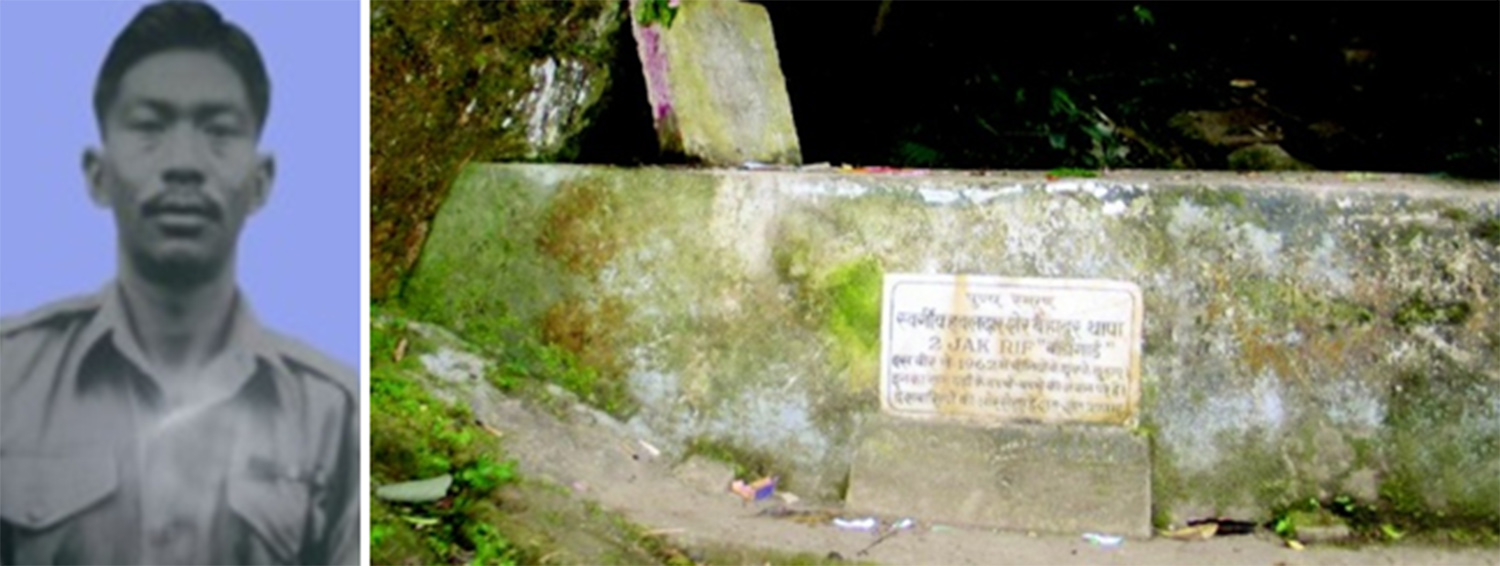
Supply line was cut off following retreat order which never reached the duo. Left with no food and insufficient ammunition, brave Shere Thapa of Indian Army’s 2 Jammu & Kashmir Rifles they feared any eventuality and decided to fight till death. The PLA jawans had sneaked through the Tama Chung Chung ridge. Thapa had positioned himself at a vertical slope – invincible high mountain ridge on one side, steep slope down to Ngo stream, source of Subansiri River, on the other side. He had located the most strategic place, either to stop or kill the advancing Chinese soldiers. His light machine gun boomed relentlessly, like a roaring tiger. One after another 180 unsuspecting Chinese soldiers got killed and fell into Ngo River without anyone to count. It was 18 October, 1962.
Thapa had sacrificed his life in Middle sector (Upper Subansiri district) while protecting Mother India. His mortal remains were brought to Lemiking, last rites performed and a grave built there. The grave and a bridge named after him are evidences of his heroism.
Political interpreter Chader Mangha along with many villagers, who carried supplies, arms and ammunition for Thapa’s Army section, were witness to his bravery. Mangha, who died in 1994, was given a commendation certificate by the GoI in recognition of his service to the nation and promoted to the rank of political assistant. He had also narrated the entire episode to his daughter Yating Byaling, a resident of Gosing Taying village under Taksing circle, wife of former Minister Tanga Byaling. Byaling and present Minister Nakap Nalo also vouch of the bravery of Thapa and the village folk.
Even the Chinese had respectfully buried him and left a small note praising his bravery. “The first bridge, named after soldier Shere Thapa, with a 600-m steep climb….” is the reference about him with picture of his grave found in ‘Secrets of Subansiri, Himalayan Club, recoding the 2005 expedition report by a group of trekkers to famous Buddhist pilgrimage Takpa Shiri; Arunachal Expedition – Takpa Shiri; In Search of Old Pilgrimage Route to Takpa Siri 2005 and India 2005 – Alpine Journal.
Martyr’s Thapa’s bravery was brought to limelight by this editor after visiting Taksing in 2015. But why none ever bothered to honour his brave act, even posthumously is intriguing?
I have also interviewed septuagenarians Menjum Meyor and Thega Meyor of Anjaw district’s Kaho, the last Indian village located on Tibet-Burma-India tri-junction, who had assisted the Indian Army in digging trenches, carrying arms and ammunition, escorting them for maintaining surveillance when the Battle of Walong was fought at Namti. During the interview in 2012, they had admitted continuing do so even then, but their services during the war were neither recognized nor remunerated.
Their plain speaking begging with ‘Jai Hind’ reflected patriotism: “We do not recognize anyone as our forefathers were living in India and we have followed suit. We are son of the soil.”
Shockingly, 75-year-old Mayaso Pul had lost his left hand after ammunition carrying on shoulder got accidentally ignited. He regretted while talking to me: “Neither was I paid any remuneration nor any certificate given to me as a freedom fighter, though I have become handicapped for my life and living in penury.” Pul along with villagers had treated a solider (Sardarji) with bullet injuries on his neck and facilitated his return to the mainland.
I presumed that martyr Shere Thapa, Pul and Mayors might not have a god father or a senior Army officer to recommend their brave act. But with facts surfacing, it is still not late to honour them.


 20
