By Pradeep Kumar
NAHARLAGUN, May 10: Animal husbandry & veterinary department (AH&VD) secretary Mimum Tayeng expressed concern that African swine fever (ASF) surfaced in India first in few districts of Arunachal Pradesh in April last but Bhopal-based NIHSAD after tests had zeroed down to East Siang and Papum Pare distracts as hotspots.
Samples collected from 10 districts were sent to National Institute of High Security Animal Diseases (NISHAD) for tests on April 29 and reports were received on May I last, she told this daily on Sunday, adding that she had already issued advisory on May 2 banning consumption of pig meat in the state, followed by advisory issued by chief secretary banning inter-district movement and confinement of all domesticated ones based on cabinet decision.
Precautionary steps are only possibility to prevent spread of the highly contagious haemorrhagic viral disease which infects domestic and wild pigs for want of any vaccine or medicine for treatment so far, she said. Thus, the department doctors have been spreading mass awareness and resorting to sanitation of hotspot areas by following guidelines of World Organisation for Animal Health (OIE), she informed.
Moreover, the contact tracing, sample collection, area-wise death data collection process is continuing for notifying contaminated areas and specify hotspots – green, orange and red zones based on proliferation, she disclosed.
When asked if the ASF emerged from a village in Xizang province of China bordering Arunachal Pradesh in April last before spreading to Arunachal Pradesh and then to Assam where around 2,900 pigs across 306 villages were killed by ASF, as claimed by Assam’s Animal Husbandry Minister Atul Bora, she denied any knowledge, saying she knows about its spread Arunachal.
“Despite the go-ahead from the Centre, Assam Govt will not cull the animals immediately and choose an alternate option to prevent the spread of the disease”, Bora had told during a press conference at Guwahati recently.
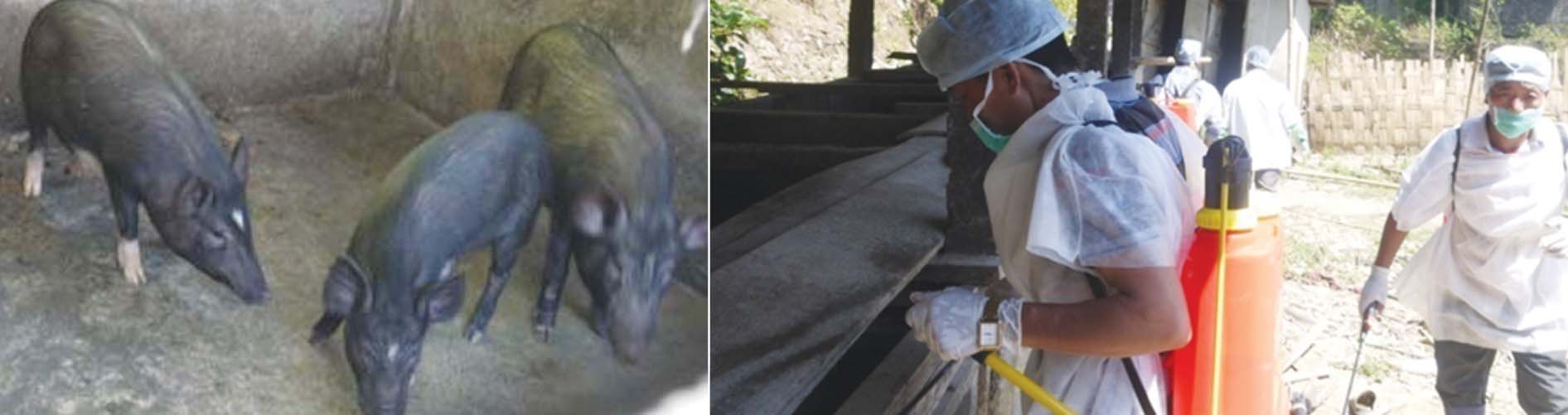
However, a team of senior AH&VD doctors led by joint director Dr Techi Taku today launched awareness and sanitization campaign in various hotspot areas of Naharlgun. Nearby Nirjuli in Papum Pare district and Pasight, Bilat & Mebo in East Siang district have been identified as epicenters, he disclosed.
His team included Papum Pare DVO Dr Dagge Riba, Dr D Garam, Dr S Yomdo, Dr M Ette, & Dr Mui Tame while a team of doctors Dr Dammo Riba and Dr Nido Tayo (a PG in veterinary science & radiology) led by department’s lone microbiologist Dr G B Garam have been collecting samples from infected pigs for further tests as sought by NIHSAD of Indian Council of Agricultural Research. Another infected pig report has been received from Yupia, Dr Garam said.
“We have been asked to send area-wise death reports of central government daily but no specific guidelines have been received so far for which such campaign would continue,” Dr Taku said, and termed this as an unprecedented situation with reported death of about 2,000 pigs across the state by first such infection.
Another team (Dr K Basar and DR G Radhe) on a public address system fitted vehicle has been making public announcement across the Capital Complex to caution the masses about the disease, he added.
The decision for culling of pigs within one-km radius of identified epicenter as well as compensation to the owners of dead pigs are jurisdiction of the state Govt, Dr Taku said, adding that the animal owners do not give correct number of cattle during department census. Thus those who have given correct number would avail the benefits if the GoAP grants compensation for which the department being facilitator should not be blamed, he added.
The team along with Labour Cooperative Society members led by chairman Dowa and woman wing chairperson Rahu Yai campaigned in Panachyat and Huchang colonies as a team of six IRBn cops including four women led by O Boko stood on guard.
One Lindum Tara of Panchayat Colony claimed that he had 21 pigs and nine were killed while Hake Tadu of Huchang colony claimed about death of his 20 pigs.
Legislator Lombo Tayeng, when contacted, informed that large numbers of pig in his Mebo assembly constituency area were killed. However, East Siang DC Dr Kinny Singh could not be reached for comment.
It may be recalled here that a team led by senior veterinary Dr G Phil along with police had seized 30 to 40 kgs of pork meat from Itanagar market on May 1 last for violating prohibitory order issued by Capital Complex DC.
The ASF was first detected in 1921 in Kenya, transmits by direct contact with infected domestic or wild pigs, consumption of contaminated material, like food waste, feed, garbage etc. With mortality rates as high as 100%, but the ASF is not a public health threat, according to World Organisation for Animal Health.
Historically, the outbreaks have been reported in Africa and parts of Europe, South America, and the Caribbean. The disease since 2007 has been reported in many nations across Africa, Asia and Europe, in both domestic and wild pigs. China has been battling ASF since August 2018, after the disease spread rapidly throughout the world’s top pork producer, killing millions of pigs and sending pork prices soaring.


 20