
By Pradeep Kumar
NAHARLAGUN, May 19: The novel Coronavirus (COVID-19) pandemic, the first and worst ever human crisis is helping people in 212 countries to learn many a lessons for the unforeseen future not to be taken aback by any unexpected situation.
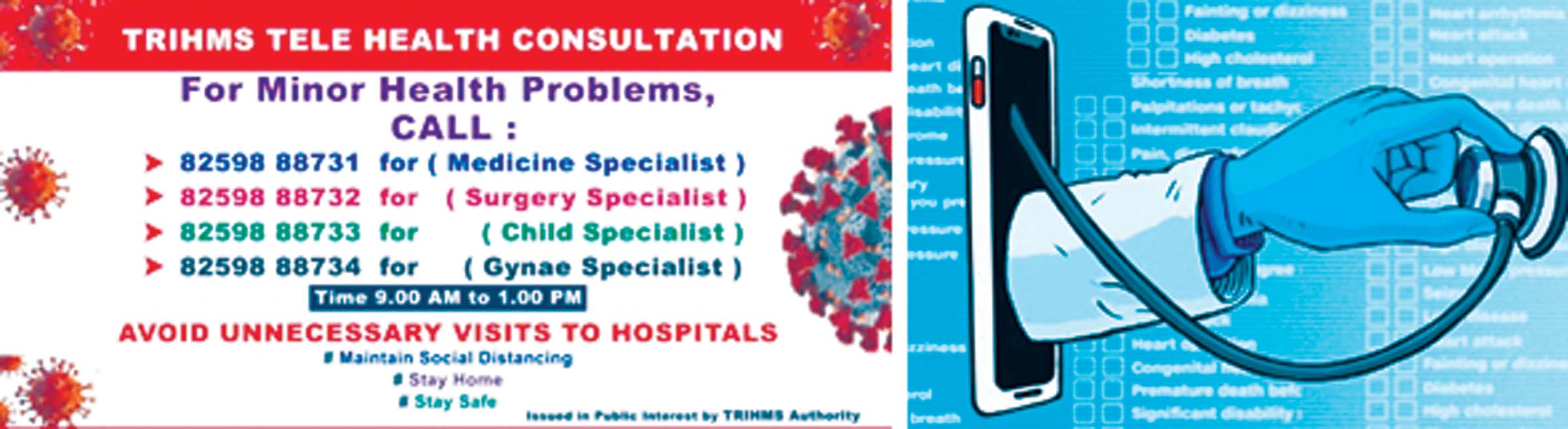
The health sector, most important aspects of life, would undergo sea changes as visible in Arunachal Pradesh. With nationwide lockdown forcing people to remain indoors, patients are worst sufferers. Therefore, tele health consultation with medicine, surgery, child and gynae specialists has been introduced in Tomo Riba Institute of Health & Medical Sciences (TRIMHS) recently.
These departments have been provided with mobile sets with numbers and the patients could either dial up or WhatSaap the specific number to seek advice when the specialist, if required, could make video calls to see the patients, director Dr Moji Jini said.
Pointing out that maintaining physical distancing, using masks and following other standard operating procedures are essential to prevent outbreak of COVID-19, Dr Jini said, adding that mass awareness about the virus is given daily in front of the registration office using public address system.
Though tele consultation has been introduced here first by TRIMHS, an IT engineer from Bangaluru said that it has been gaining popularity very fast and would come to mainstream now as a COVID-19 gift. He is right as Mercedes F1 engineers help in making a breathing aid for COVID-19 patients in less than 100 hours while auto makers are racing to make ventilators.
It may be recalled that a telemedicine unit was set up in RK Mission Hospital, Itanagar in 2004 to help patients get consultation with outside specialist. The link was given by Indian Space Research Organization when popular Narayan Hrudayalaya, Bangalore, India’s largest multi-specialty hospital chains with 30,000 beds, houses the Bangalore cardiac unit, the world’s largest pediatric heart hospitals and renowned telemedicine centre of famous heart surgeon Dr. Devi Shetty; Amrita Institute of Medical sciences, Cochin; Rabindranath Tagore Institute of Cardiac Sciences, Kolkata and Tata Memorial, Mumbai had consented to offer consultation.
The hospital a and used to offer free service then. I remember speaking to Dr Shetty then when he had announced to offer free surgery services to few congenital heart cases belonging to BPL category on recommendation of RKMH.
In fact, telemedicine by using electronic information to communicate technologies to provide and support healthcare when distance separates the participants was a new horizon in public health in India.
“Tele” is a Greek word, meaning distance and “mederi” (means ‘to heal’ in Latin) and telemedicine initially considered ‘futuristic’ and ‘experimental’ wile. Time magazine had called it “healing by wire”, has become a reality today and continue to stay. Telemedicine have varieties of applications in patient care, education, research, administration and public health. People living in rural and remote areas across the world struggle to access timely, good-quality specialty medical care and telemedicine has the potential to bridge this distance and facilitate healthcare in these remote areas.


 20

