
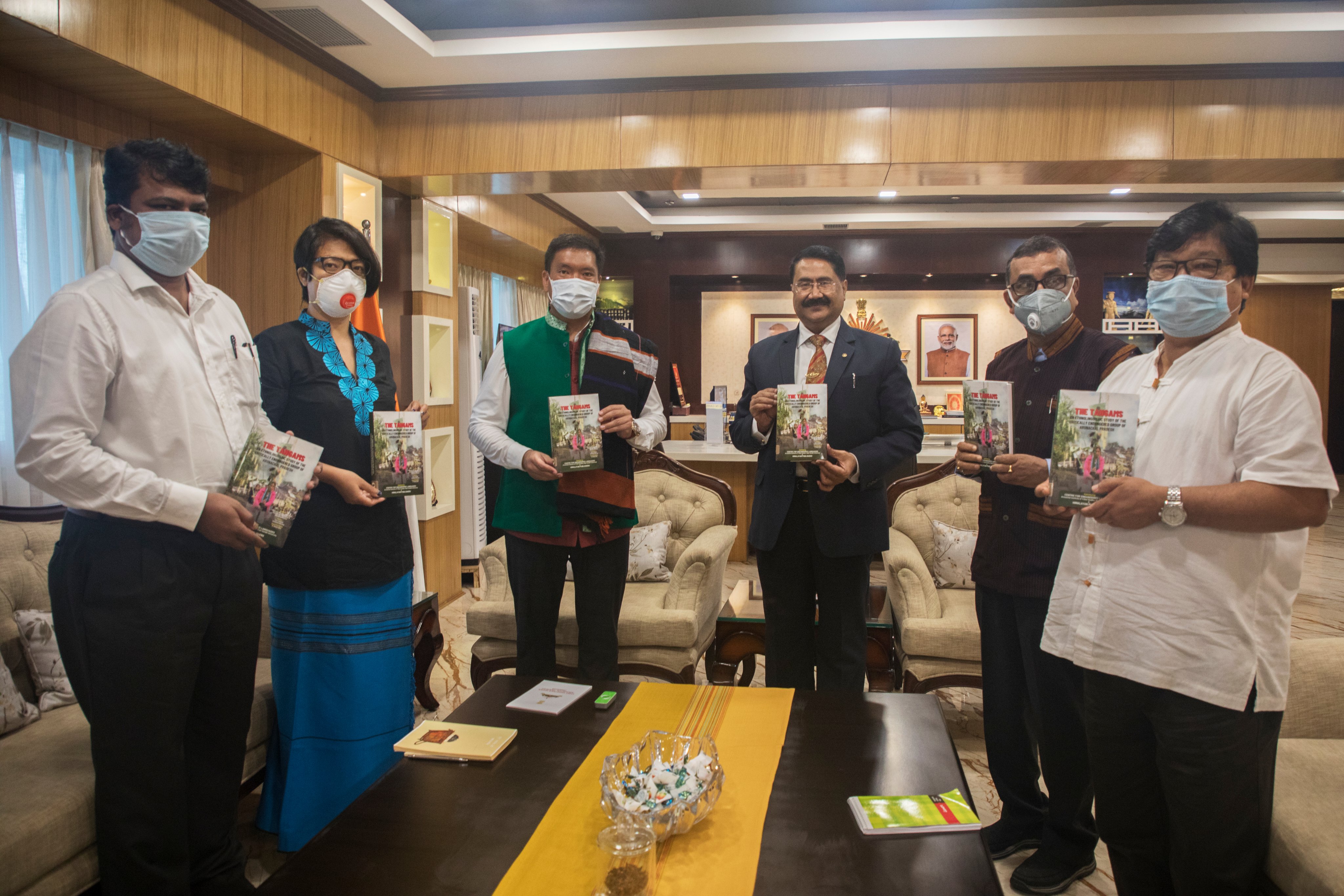
ITANAGAR, July 06: Attributing loss of language to cultural erosion, Chief Minister Pema Khandu stressed on timely preservation of mother tongues of Arunachal Pradesh after releasing a book – The Tangams:An Ethnolinguistic Study Of The Critically Endangered Group of Arunachal Pradesh – here on Monday.
The book, published by RGU’s UGC sponsored Centre for Endangered Languages (CFEL), under Arunachal Institute of Tribal Studies (AITS), is based on Tangams, a critically endangered speech community of Arunachal Pradesh living in Kugging village of Upper Siang district.
Tangams are one of the lesser-known ethnolinguistic groups within Adi tribe with total population of only 253, according to 2016 CFEL field survey.
RGU vice chancellor Prof. Saket Kushwaha, Pro-VC Prof. Amitava Mitra, registrar Prof. Tomo Riba, AITS director-cum-CFEL coordinator Prof. S. Simon John, CFEL senior research fellows Prof. Jumyir Basar and Kaling Dabi were present.
Various chapters reflect the outcome of the study giving critical insight into Tangam language including structures within Tani group of languages besides valuable primary data on endangered oral narratives, like ritual, lamentation and festival songs, lullaby and cultural practices, particularly social & political life, religion and belief systems. The book will be useful not only for future generations of the community but also for linguists, anthropologists, educators and policymakers.
The CEFL team’s Kaling Dabi, Kombong Darang, Rejhoney Borang, Chera Devi and Rumi Deuri are co-authors, edited jointly by Lisa Lomdak and Rejhoney Borang and executive editor Prof. John after four-year extensive field research and documentation. The research team comprises of scholars from linguistics, anthropology, folklore, tribal studies and mass communication. The CEFL is now focusing on field survey, documentation, outreach events, analysis of critically endangered languages and studying speech communities in their socio-cultural contexts.


 20

