
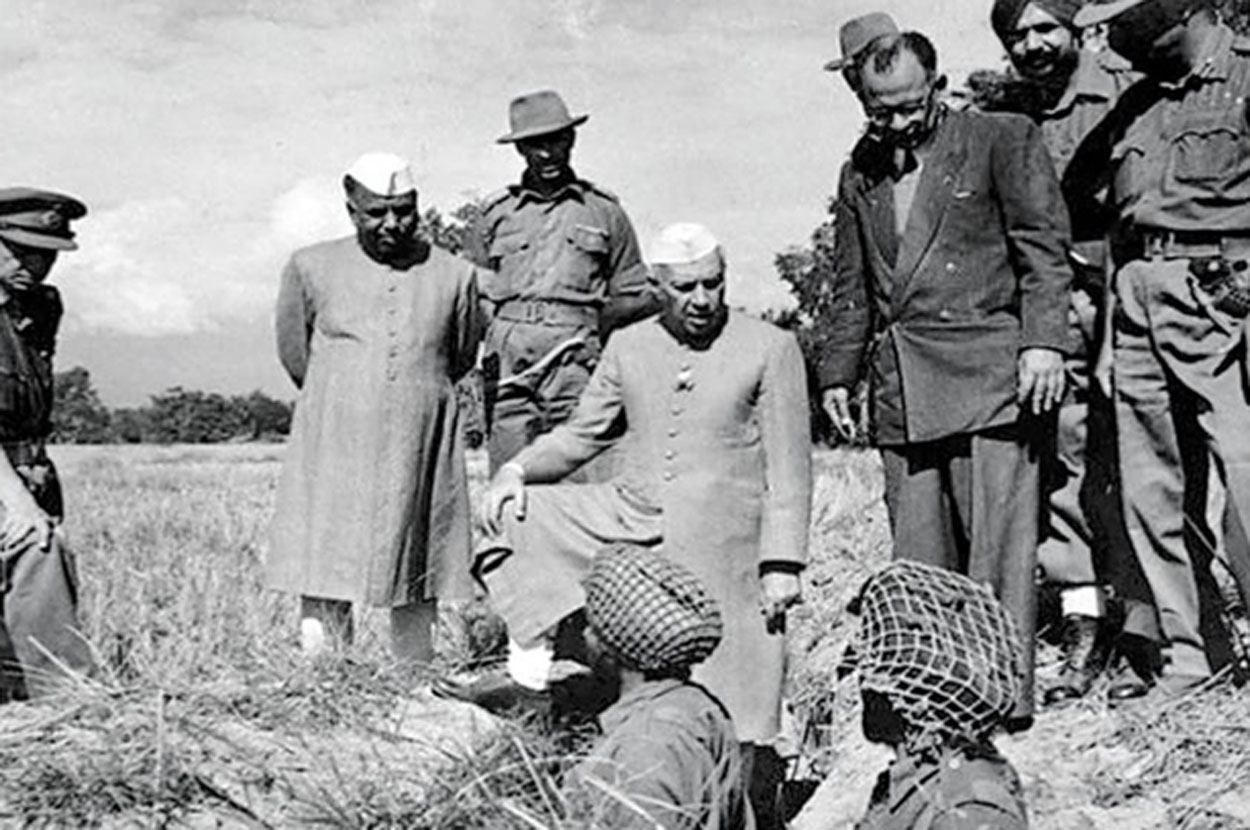
Nehru meeting Indian soldiers in NE in 1962
Beyond the Horizon
By Pradeep Kumar
Second is the ghost of intelligence failure. During1955-57, Indian sleuths completely missed the construction of the Trans- Karakorum Highway. It was only on 31.08.1959 that Nehru informed the Rajya Sabha, “According to an announcement made in China, the Yehcheng-Gartok Road, which is also called the Sinkiang-Tibet Highway, was completed in September 1957… Two reconnaissance parties were accordingly sent last year. One of these parties was taken into custody by a superior Chinese detachment. The other returned and gave us some rough indication of this newly constructed road in the Aksai Chin area.” Similarly, the Forward Policy was a product of bad advice by then director Intelligence Bureau B.N. Malik, supported by Lt General B.M. Kaul, then Chief of the General staff, contrary to the counsel given by military intelligence.
Compare this with 2020. Eminent strategic commentator Saikat Datta, in a piece in Deccan Chronicle on June 18, said, “In October last year a senior Indian security official on a visit to Ladakh met Indian Army’s 14 Corps General Officer Commanding (GOC). The Corps was raised in aftermath of the Kargil war between India and Pakistan in 1999 and has its headquarters in Leh…The Indian security official gave a detailed briefing to Lieutenant General Harinder Singh, a former Director General of Military Intelligence, who took over as GOC of 14 Corps late last year. The Indian security official explained that the change of Jammu & Kashmir status had irked the Chinese. In the coming months they would up the ante and try to capture more land and shift the LAC deeper into Indian-held territory…”
While in 1957-59, the instruments of intelligence collection were rudimentary and limited to human intelligence as Nehru pointed out in his intervention to the Rajya Sabha, six decades later with all the sophisticated technical assets at our disposal, how did we miss the Chinese military build-up in the western Himalayas? Who bears responsibility for this massive failure?
The third is the apparition of military failure. On 23.05. 2001, Neville Maxwell, author of India’s China War, placed the tactical responsibility for the debacle. In an article on rediff.com, Maxwell wrote: “HB/B (Henderson Brooks report that went into the causes of the 1962 defeat) place the immediate cause of the collapse of resistance in NEFA in the panicky, fumbling and contradictory orders issued from Corps HQ in Tezpur by a ‘triumvirate’ of officers they judge to be grossly culpable: General Sen, General Kaul, and Brigadier Palit.” At the higher defence management level, COAS General PN Thapar and Krishna Menon had to resign taking responsibility for the debacle. Even Nehru came in for withering criticism for his idealistic foreign policy predilections.
Compare this with the situation today. At least 143 veterans of the armed forces in a signed letter to the PM wrote: “The incident at Galwan could only have happened because of failure at one or more levels in the political, civil and military establishments, especially in continuous intelligence acquisition and dissemination.” They have demanded that a fact-finding commission be constituted and its report be tabled in the Parliament. The question, therefore, is can Chief of Defence Staff Bipin Rawat. Lone military advisor to the government, 14th Core Commander General Harinder Singh, or for that matter even the defence minister and the PM escape from responsibility for the theatre-level incursions? The coming months will answer that question.
Fourth is the solace of redemption. In both 1962 and 2020 our deliverance lied in the grit and bravery of the Indian Army. On 18.11.1962, the 13 Kumaon under the command of Major Shaitan Singh Bhatti made their last stand to the last bullet at Rezang La. Similarly, on15.06.20, the 16 Bihar Regiment led by Colonel Santosh Babu, though ambushed heavily, bravely fought the Chinese aggressors with their bare hands killing an unspecified number of PLA soldiers and losing 20 of their compatriots in turn. The unmatched valor of the Indian Army in 1962 is on display again as Indian and Chinese troops stare each other in the eye.
Even the headlines are the same. On July 6, India’s former foreign secretary shared on Twitter a newspaper clipping of 15.07.1962 that stated: “Chinese troops withdraw from Galwan post”. (Three months and 14 days later, the Chinese invaded India on 20.10.1962.) On 06.07.20, a piece by another erudite strategic commentator Pranab Dal Samantha appeared in The Economic Times titled “First signs of Chinese withdrawal in Galwan; India and China to issue statements.” History is a cruel teacher.
This is where the similarities end. In 1962, Nehru did not try to cover up the Chinese betrayal. On 26.10.1962, Nehru accepted a young Vajpayee’s demand and called a Parliament session on November 8. He brusquely brushed aside LM Singhvi’s suggestion that the house meets in a secret session. He said: “The issues before the House are of high interest to the whole country. Right at the beginning to ask for a secret session would have a bad effect on the country”. Unfortunately, PM Modi did the exact opposite when at an all-party meeting on 19.06.20 he declared “not an inch of land has been occupied by anyone,’’ thereby squarely playing into the Chinese narrative of events.


 20

