

Why political stand contradictory?
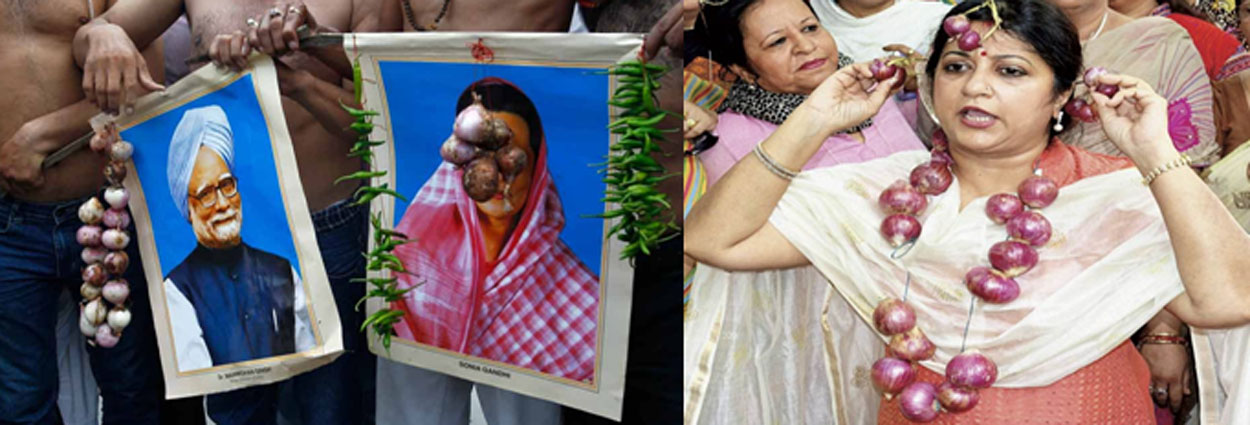
BJP agitators in Allahabad on 14.08.13 hold garlands of onions and green chillies around portraits of PM Manmohan Singh and Congress president Sonia Gandhi & 2) Delhi Pradesh Mahila Congress member with onion garland to protests against the price hike in New Delhi on 06.11.20
History has a strange way of inflicting cruelty on those who most value it. As people who derive considerable inspiration from ancient civilizations, the BJP leadership was probably aware that Egyptian pharoahs regarded the onion as a symbol of eternity.
The humble piyaz was sacred enough to be carved into King Tut’s tomb and valuable enough to be gifted on weddings in medieval Europe. Traditional values, obviously, haven’t changed.
India is the second largest producer of onions and among the top exporters of the vegetable that is a staple in Indian households. The smell of onion is in the air while the onion bomb is ticking again putting Narendra Modi Govt on the defensive as it tries to defuse the bomb before it explodes. Two back-to-back desperate attempts to tackle the onion crisis by the Modi Govt show how much importance the bulb holds in the country.
Maharashtra and Haryana go to the polls next month. Election is also slated for November end in Jharkhand. All these states are ruled by the BJP and the party has developed a strategy since 2014 to contest elections projecting PM Modi as the face of governance. But given the coup potential of onion, both Modi Govt and the BJP-led state Govts would be on their toes ahead of polls in Maharashtra and Haryana.
 made Indira Gandhi high and dry!
Beyond the Horizon
By Pradeep Kumar
Indira Gandhi, defeated after she suspended democracy by declaring emergency from 1975 to 1977, swept back into power in 1980 by turning the price of onions into a populist rallying cry. Waving garlands of onions at political gatherings, she assailed the Govt for its failure to control prices to bag nearly 65 per cent seats in the Lok Sabha election, termed as “Onion Election” by herself.
Though rising onion prices contributed to fall of the first non-Congress (Janata Party) Govt in post-independence era, but onions had made her cry when its prices skyrocketed in 1981.
During the winter session of Parliament in 1981, Rameshwaram Singh (Lok Dal) walked into the Rajya Sabha wearing a garland made of onions. When Singh complained to the Chairman of the House M Hidayatullah about rising onion prices, he shot back saying – “Let’s see what you will wear when the prices of tyres go up or for that matter the prices of shoes.”
In 1997, onion prices skyrocketed after a bad harvest and forced the then agriculture minister Chaturanan Mishra of PM I.K. Gujral Govt to impose a ban on export which brought dwpon the prices soon. But the farmers switched to other lucrative crops and then reverted to onions again, making yield assessments hazardous.
The next jolt was felt around Diwali in 1998. Congressman Chhagan Bhujbal sent a box of onions to the then Maharashtra Chief Minister Manohar Joshi and explained – “Diwali is a festival where you give something precious. This time, onions are very precious.” An embarrassed Joshi was then forced to relent and made onions that were being sold for Rs 45/kg in Mumbai, available for Rs 15/kg to ration card holders. Responding to exorbitant prices of onion, the state and national Govts had heavily subsidized, which newspapers termed as sop to woo voters.
India’s ace comedian and satirist Jaspal Bhatti had organised a fashion show in Chandigarh’s Sector 17 in November that year with models walking down the ramp wearing onions. As the models walked down the ramp, flaunting the onion theme, Bhatti stole the show by announcing, “politicians in power may ignore onions but not the onion beauties”.
Onions were selling for 40-50/kg when Delhi assembly elections were held in later part of 1998 with Sushma Swaraj made Chief Minister just 40 days before the polls. The BJP had failed to
capture power in Delhi and Swaraj was ousted by Sheila Dikshit due to the onion crisis. The unseasonal rains in September and October 1999 led to all calculations going awry posing challenge for the Vajpayee Govt.
In 2010, errant rainfall led to a country-wide onion crisis. An otherwise reticent Prime Minister Dr Manmohan Singh realizing the political gravity of expensive onions, then described it as a “grave concern”. Exports were stopped, import duties were cut and the government appeared to be in damage control mode. But a 2012 study by Competition Commission of India suggested the Govt was up against a factor it had little control over – pure simple greed.
In December 2010, retailers’ markup over the wholesale market price was more than 150% in almost all major markets, which was not based on demand and supply problem.
In August 2013, prices shot up to Rs 100/kg in some parts of north India, forcing to float a tender to import onions from Pakistan, Egypt and China. Rise in price of onions and other essential commodities pushed inflation, making the UPA II even more nervous as it prepared for Assembly elections in crucial states, like Delhi and Rajasthan. The Congress was comprehensively routed in both states. After his loss, Rajasthan Chief Minister Bhiaron Singh Shekhawat was famously quoted as saying: “The onion was after us.”
The November elections are the first to take place since the BJP came to power in March in New Delhi and Indira Gandhi’s daughter-in-law, Sonia, became president of the opposition Congress Party. For the BJP-led Govt, which has pressed the panic button, the onion mess has proved the proverbial last straw. Thus, New Delhi-based Center for the Study of Developing Societies political scientist Yogendra Yadav once said: ”Onions are a metaphor for the world turned upside down. They become a symbol of what is happening to the basic things of life.”


 20
