
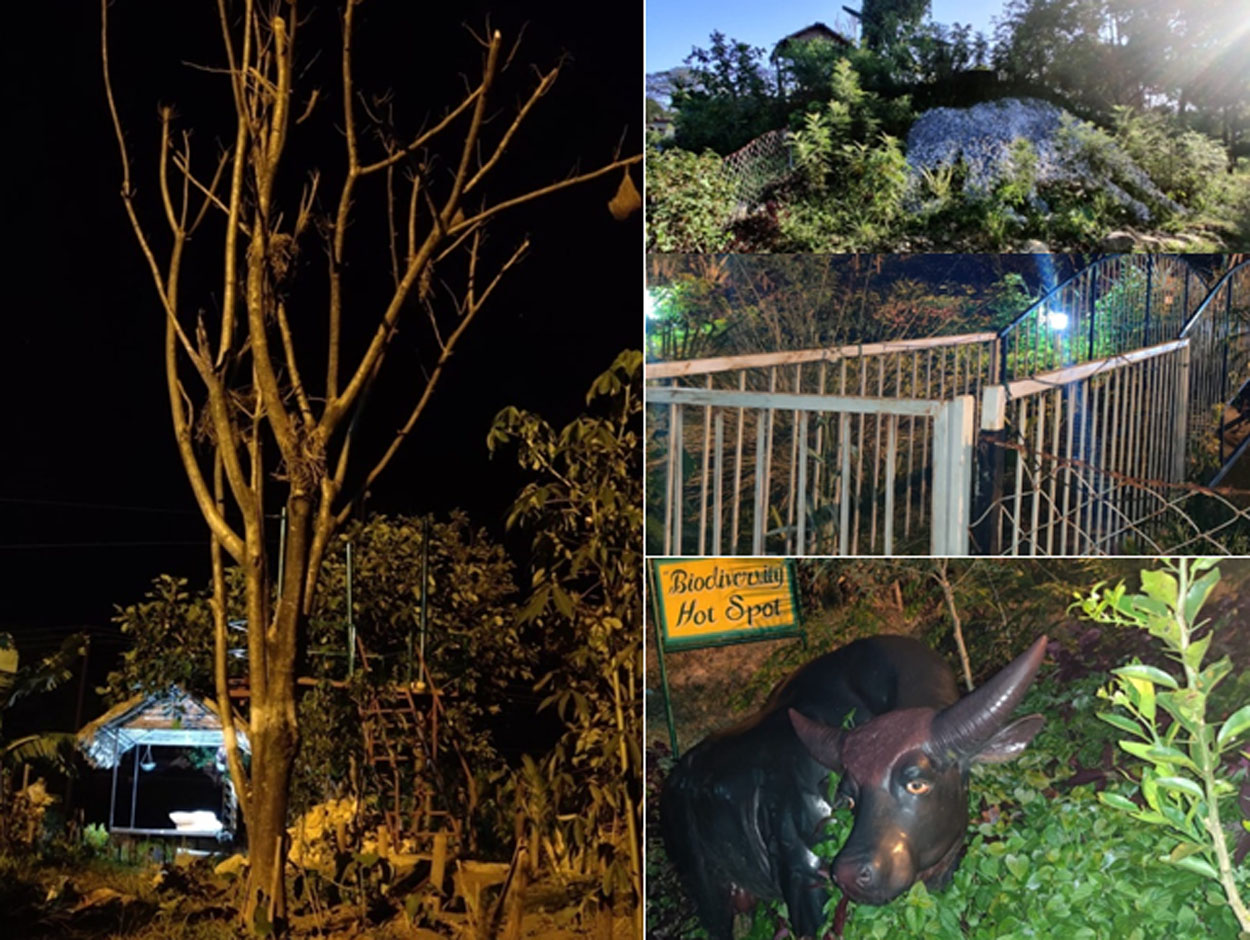
Men working for the project, tree with nest, planed trees, the iron bridge, the mithun, wooden bridge & the tribal hut
By Pradeep Kumar
ITANAGAR, Nov 10: A plot of unused and damp land, opposite side of College of Horticulture and Forestry (CHF) entrance road here, developed as a biodiversity hotspot by CHF dean Dr. B. N. Hazarika, would serve as a model to woo tourists as well as encourage protection of rich flora and fauna of this state.
Conceiving the idea of a multi-faceted project, Dr. Hazarika leveled the land by filling it before adding one after another innovative concepts to bring mass awareness about the utility of unused land, which could well be described as Arunki Anokha Anchal.
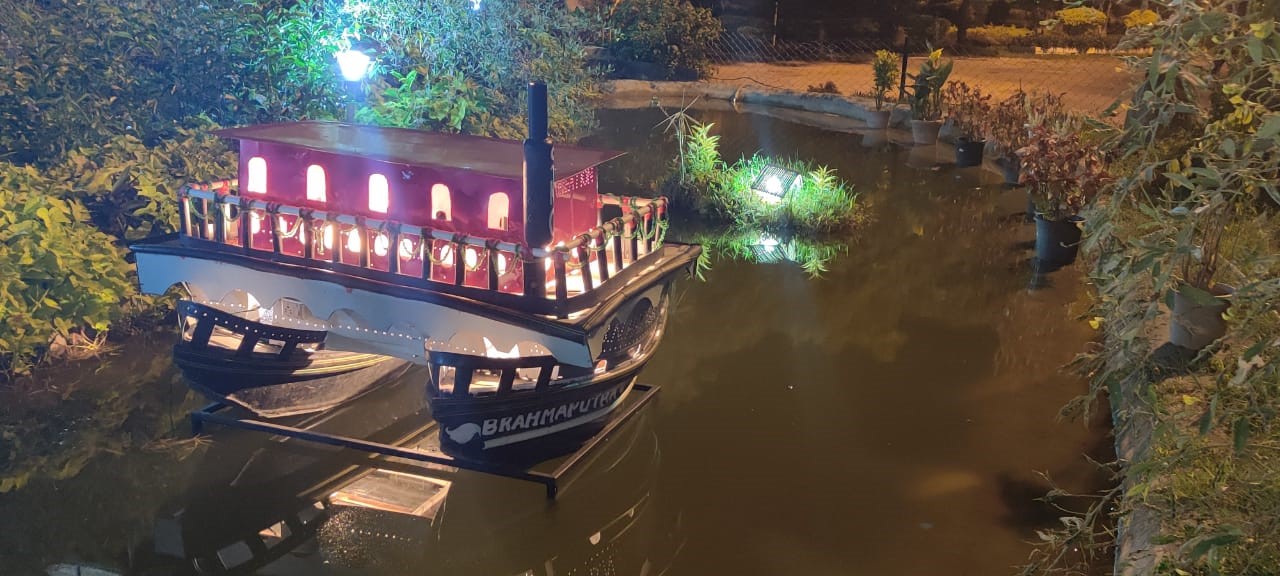
The concepts include an artificial lake, a wooden bridge, an iron bridge, a boat named Hazarika Titanic, a tribal hut, a dry tree with nests, a wooden mithun (Arunachal Pradesh state animal), large plantation on hill side, which would impress any visitor, said RABI-project assistant manager Evie Koyu, a nature lover herself.
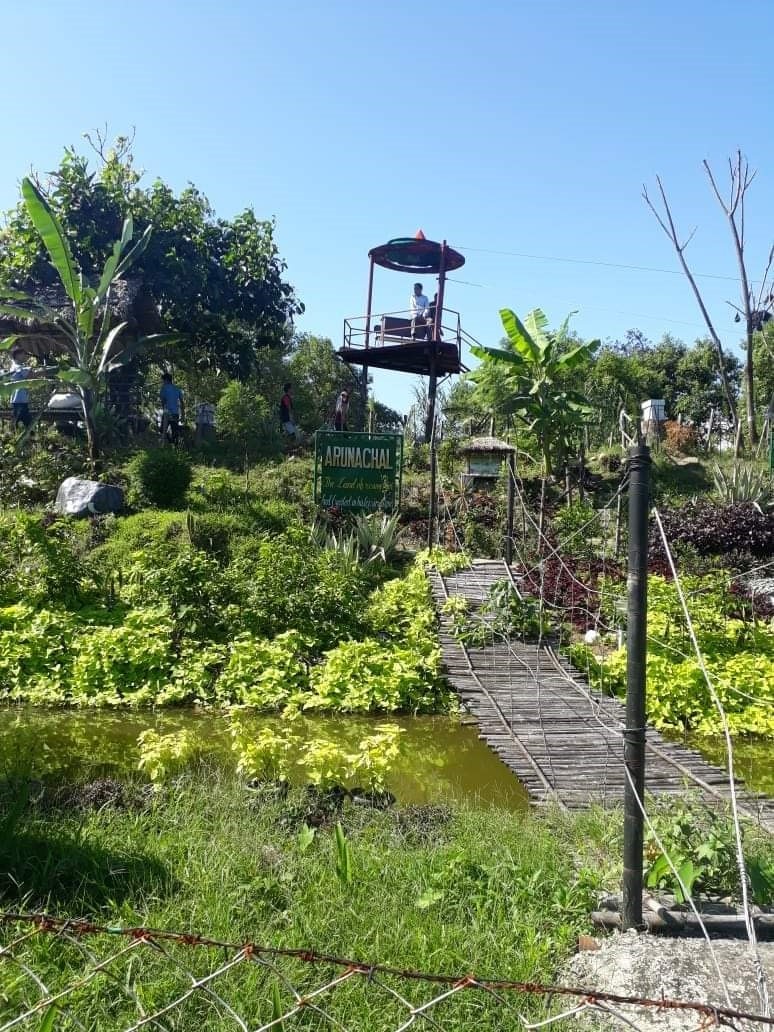
About 24 truck-load of soil was used to fill the low lying land on Tuesday and a small hillock would also be developed on the back side, she told this daily over telephone, adding Dr Hazarika goes on adding something new even by spending his own money. The entry is free for one and all.
This seems to be a technical copy of Singapore Tourism Board, which has created artificial garden, forest, world’s first nocturnal zoo set in a humid tropical forest (Night Safari), to name few most popular tourist attractions. Tourism is a major industry and highest contributor to the Singaporean economy, Total 18.5 million international tourists went to Singapore in 2018 and spent Singapore $27.1 billion.
Arunachal Pradesh, the 14th largest state in India, spread in total 83,743 sqkm geographical area had total population of 16.75 lakh in 2019. This Himalayan state has no dearth of land with population density of 17 per sqkm against national average 382 per sqkm.
Though civilizations appeared and disappeared for jaru aur jamin (women and land), but no mechanism has been developed as yet to tap this vast unutilized land bank though the hilly state boasts of very hard working womenfolk around whom the state’s economy centers.
The Green Revolution launched between 1950 and late 1960s by introducing set of research technology with lab to land initiatives including high-yielding varieties of cereals, especially dwarf wheat and rice had increased agricultural production worldwide. The term “Green Revolution” was first used by William S Gaud, the administrator of U.S. Agency for International Development during his speech on 08.03.1968.
India in 1966-67 imported 20 million tonnes of foodgrains but because, agriculture minister C. Subramaniam had launched Green Revolution for double-cropping and India became self sufficient in wheat and rice ib1979.
Operation Flood was launched on 13.01.1970 as world’s largest dairy development program which had transformed India from a milk-deficient nation into the world’s largest milk producer, surpassing the USA. Amul, a dairy cooperative, set up as India’s National Diary Development Board by Verghese Kurienas its chairman earned the sobriquet as White Revolution.
These are glittering examples of “Where there’s a will there’s a way” adage. Thus, it is high time to encash state’s vast landbank toeing the above model to boost tourism not only to benefit the masses but to enrich state coffer.


 20
