
By A O News Service
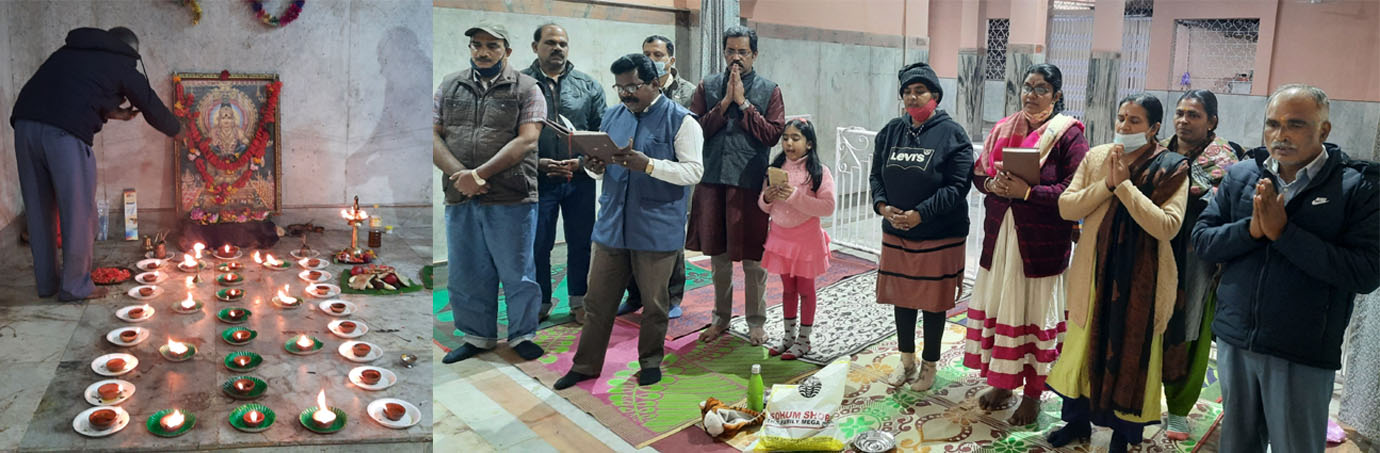
NAHARLAGUN, Dec 05: Few South Indians working in different capacities in Arunachal along with their families worshipped Lord Ayyappan at Shiv Temple here on Saturday as an annual event, an initiative of Ayyappan Seva Bhajan Samity led by president D Nair and secretary K B Satheesan.
Lord Ayyappan or Manikandan, popular in Kerala, is considered to be the union of Lord Vishnu and Shiva. Although the worship of Ayyapa was prevalent across the world, the early ages of expansion of Christianity and medieval expansionism of Islam confined its worship to South India.
Lord Ayyappan is considered to be the ruler of the universe, and thus meditates alongside Lord Vishnu and Shiva. The most significant festival linked to him is the Makaravilakku (Makara Sankranti), observed around the winter solstice.
Sabarimala, the most prominent Ayyappan shrine nestled in the hills of Pathanmthittha in Kerala, shrine receives millions of pilgrims every year in late December and early January, by climbing the hill barefoot, making it one of the largest active pilgrimage sites in the world.
Ayyappan is believed to be the celibate deity and a plethora of other scientific arguments to vindicate the same. It remains one of the few deities in Hindu tradition that are worshipped by all religious communities, including Muslims and Christians in Kerala.
Kerla Muslims revere him due to his friendship with Vavar, who is identified as a Muslim brigand in local versions of the Ayyappan myth. In this mythology, Ayyappan confronts the plunder-driven pirate robber Vavar in the jungle on his way to collect tigress milk. In another version, Vavar is stated to be a Muslim saint from Arabia, who works with Ayyappan. A mosque dedicated to Ayyappan’s lieutenant Vavar swami stands next to Kadutha swami shrine at the foot of the pilgrimage path, both as a form of guardian deities.
The Vavar legend and palli shrines may reflect the Hindu approach to accepting and co-opting legendary figures or saints of other religions within its fold.


 20

