
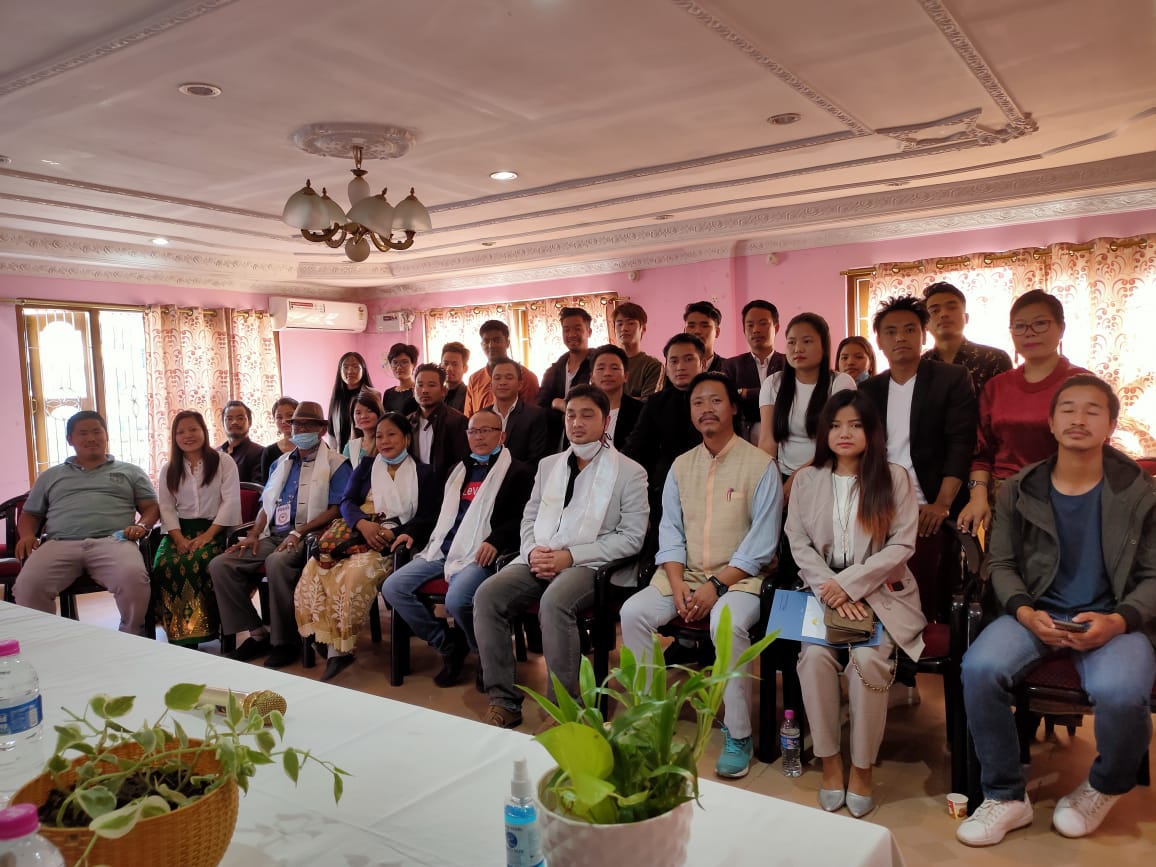
- Conduct folk music prog in schools: Barman
By Pradeep Kumar
NAHARLAGUN, Dec 12: Stressing that policy formation is panacea to protect, promote and popularize rich folk lore and folk music of Arunachal Pradesh, state’s noted folk singer Bamang Loram advised the new born Hindustani Classical and Folk Music Society (HCFMS) to move the Govt to achieve the goal.
When the state has been witnessing mushrooming of NGOs which have not been working for the society, he appreciated the HCFMS as a genuine platform formed by dozens of professional singers and students of Fine Art and Music department of Rajiv Gandhi University at a function here on Saturday. Such NGO could get financial support from the government once the policy is formed, he said.
He cited the example Arunachal Artists’ Forum which was given Rs 50 lakh corpus fund by the state Govt to intensify its activities on his request to the chief minister. Likewise, this new NGO should also try to inherit the knowledge gained by such related bodies and work in close coordination with them, he said.
Loram, who explored the folk music being an inborn singer and known as a folk singer since 1990s became famous after his first cassette – Nyokum Dapo – hit the market, said that with the death of any tribe its language, culture and folk music would die if not preserved.
He lauded the young singers, led by Bamang Ama, 2nd runners up of 5th edition of Nyishi Idol, who rented a melodious folk song earlier for composing a very meaningful song – Any yange kurium kulu lo atu gungte di doging hum ginglu hiba nyi (This folk song depiction of step by step human race).
RGU Fine Art and Music department assistant professor Ashok Barman, speaking as chief guest said: “Though various state and district level singing competitions are organized regularly but all Arunachalee singers are idols,” He suggested the HCFMS to make a yearly calendar to take up various activities, like organizing music programmes in schools to bring mass awareness about Hindustani classical and folk music.
Barman, who was first to join and made the department functional from scratch with 20-seats of three-year B Music course, said that the seat numbers rose to 22 while M Music with 12 seats would begin from this year. But the department gave the much desired thrust to RGU with invitation for programmes at Raj Bhawan and statehood day celebration regularly, he said.
Though there is no dearth of talents in this state but most of them are hidden and the HCFMS could play a pivotal role to give them the much desired exposure, he said, adding improving singing quality is the need of the hour.
Both exhorted HCFMS team, including chairman Runka Cheda, president Mariyom Lollen and women wing president Bamang Ama, to work with commitment for achieving the target for which they have come under one platform.
Highlighting what led to conceive the idea of HCFMS, Cheda, who has completed B Music from RGU, recalled as to how encouragement by his friends made him a singer since 2003. He appreciated Asst Prof Barman for strengthening the department and facilitating introduction of M Music course as its HoD as music has vast scope to offer opportunities as career.
Many important national platforms, were formed in a small way like HCFMS, he said and cited the example of Society for Promotion of Indian Classical Music and Culture Amongst Youth (SPIC MACAY), a voluntary youth movement which promotes intangible aspects of Indian cultural heritage by promoting Indian classical music & dance, folk music, yoga, meditation, crafts, among others.
A young graduate from Kharagpur IIT Kiren Seth, while doing doctorate at Columbia Univeristy, New York coincidentally had attended a Dhrupad concert by Ustad Nasir Aminuddin Dagar and Ustad Zia Fariddudin Dagar at the Brooklyn Academy of Music. On his return to India in 1976, he started teaching and doing research work at Delhi IIT, where he had started SPIC MACAY in 1977 and invited Dagar Brothers for its first concert at IIT Delhi on 28.03.1978, he said, adding it has now units in over 300 towns all over the world.
If Loram is known as folk song pioneer of Arunachal, his wife Pebi Ado Bamang, also present, is also a noted singer and capable of singing in both male and female voices, Ama said to the applause of the gathering.


 20
