
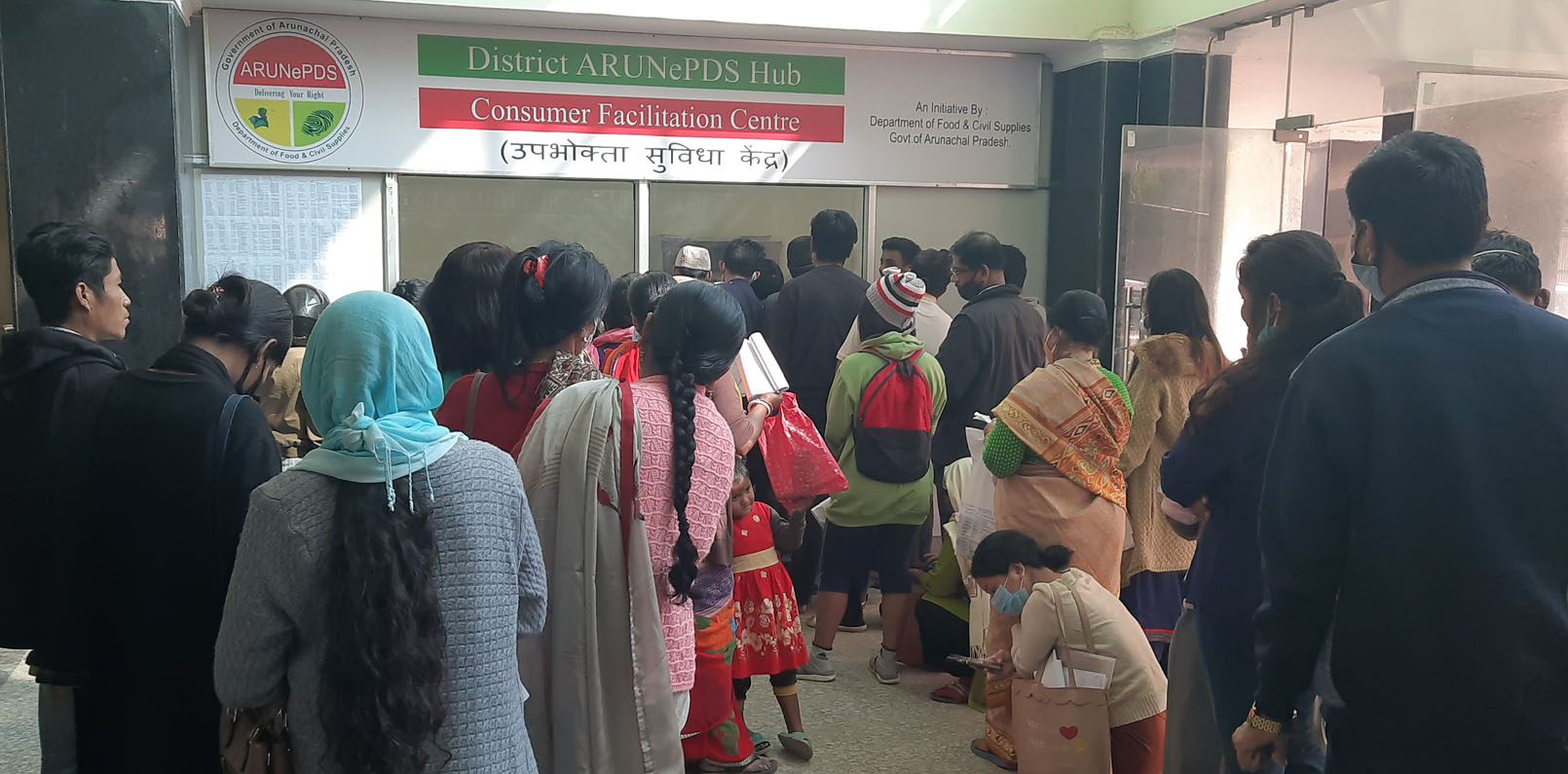
Long queue to renew ration cards in Naharlagun mini secretariat
- ‘One Nation One Ration Card’ still a day dream!
By Pradeep Kumar
ITANAGAR, Dec 15: The public distribution system (PDS) in Arunachal Pradesh is in doldrums as various central schemes have remained unimplemented while the genuine dues of fair price shop (FPS) owners have not been paid.
Rs 100 per quintal as handling charge to be paid to every FPS owner considering various difficulties of this hilly state is yet to be paid by the state Govt for the last two year though their services are being utilised to maintain supply, a top ranking officer of Food and Civil Supplies department told this daily on Tuesday on condition of anonymity.
The expenses are shared by central and state governments in 75:25 ratio and the Centre pays only after the state pays its share, he informed.
The central government enacted National Food Security Act, 2013 (NFSA) to ensure supply of highly subsidized foodgrains under Targeted Public Distribution System to 75% of rural and 50% of urban population.
The end-to-end computerization (E-E-C), a component of the NFSA, to revolutionize and improve supply through the PDS to the needy and poor across the country was implemented by the Centre in association with state/UT governments in 2018.
However, its implementation in Arunachal has been possible only in few districts while it has remained a far cry in all far-flung hilly areas. This has defeated the basic objective of the Act.
Interestingly, the One Nation One Ration Card (ONORC) plan, one of the top priorities of Union Food & Public Distribution department to provide an option to all eligible ration card holders covered under NFSA to access their entitlements from anywhere in the country.
New Delhi mandarins evolving one after another policy to receive wah wah for their initiatives should never forget about 12 states (Jammu & Kashmir, Uttarakhand, Himachal Pradesh, Arunachal Pradesh, Manipur, Meghalaya, Mizoram, Nagaland, Sikkim, Tripura, two districts of Assam namely Dima Hasao and Karbi Anglong and Darjeeling and Kalimpong in West Bengal) stretching across a length of 2,500 km and width of 250 to 300 km of the Indian Himalayan Region (IHR).
When the IHR, inhabited by about 50 million people (2017 data), is characterized by diverse demographic, economic, environmental, social and political systems, tough hilly terrain and unreliable climatic conditions, the above central policies need alternatives.
If the E-E-C has not been implemented in this Himalayan state, will the ONORC plan not remain a day dream? – A question for the top central bureaucrats to reply.


 20
