
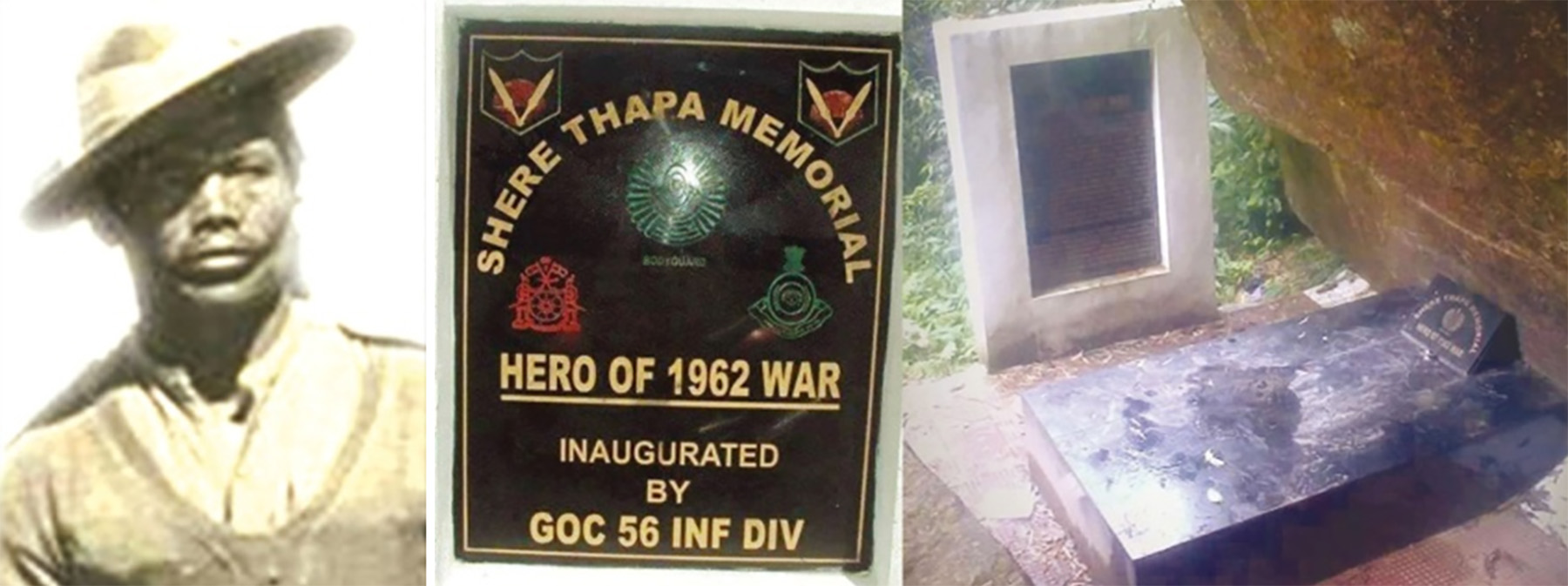
By Pradeep Kumar
ITANAGAR, Mar 26: “Hav Shere Thapa, born in Nepal on 27.12.1928, had served in J and K Regiment Special Force from 27.12.45 to 31.12.56 and became part of Indian Army on 01.01.1957. He qualified in MR-1.ACE-1 and TTT-1 to get promoted as havildar on 01.05.1962. He was part of A Company and appointed as platoon havildar under subedar Sher Bahadur. In November 1962, he was deployed in protective patrol in Tama Chung Chung ridge near Rio Bridge in Upper Subhansiri Valley of Arunachal Pradesh covering the track coming in from Indo- China border,” his commanding officer 2nd Lt Amar Patil, who retired as colonel, informed this daily on Friday .
“On 18 November 1962, the Chinese Army (People’s Liberation Army) launched offensive in Subansari Sector of NEFA (Arunachal Pradesh) and contacted the protective patrol at about 3 pm. The protective patrol was established in rocky outcrop area south of confluence of Ngo stream, the main source of Subansari River dominating steep slippery track from border coming down Tama Chung Chung ridge.
“As the enemy approached down the slippery slope and came within effective range, subedar Bahadur ordered the patrol to open fire. During the fire fight, Rifleman Inder Singh operation LMG No 1 sustained injuries and havildar Thapa took over the LMG and kept on engaging the enemy effectively.
“After some time, the patrol was running low on ammunition and subedar Bahadur decided to withdraw. Havildar Thapa volunteered to cover withdrawal of the platoon and relentlessly kept on effectively engaging the Chinese. When the platoon was safely away, he decided to extricate himself but succumbed to the onslaught of enemy who were coming over their dead soldiers.
“The Chinese Army buried him on the spot with respect and erected a wooden board as memorial with inscriptions in Chinese praising his bravery and sacrifice. This was unique gesture by enemy very rarely seen in history of warfare. The locals who had witnessed the battle informed that the Chinese had suffered more than 150 casualties including 70 dead with one senior officer. The Chinese radio declared on 19 November 1962 that they had suffered 155 casualties.
“Havildar Thapa died on 18 November 1962 and had wife Dilli, three daughters Dhanisara, Syani and Nurma. Efforts to get their present details have not succeeded as Gorkha Records Kunraghat were unable to give address and required details.
“After the unilateral withdrawal of Chinese Army the locals retrieved the remains of havildar Thapa and performed last rites and built a monument for him as they had seen the fierce fight given by him. The GOC 56 Inf Div placed a plaque at the memorial. Three locals have started revering havildar Thapa as the saviour of Subansari districts.
“The people of Arunachal Pradesh look up to him as a role model and feel agitated that he was not given the well deserved gallantry award by the central Govt where as the Chinese had given him respectful burial and erected a wooden board memorial with Chinese inscription praising his bravery and sacrifice. (The author as second lieutenant was his commanding officer)
It may be recalled that while highlighting – Martyr Army havildar Shere Thapa biography traced in July 1 edition of this daily in 219, I had mentioned, “Thapa born in Nepal, was enrolled in to Indian Army on 01.01.57 (No 13710603W), served with J&K Special Force. His wife is Dilli (82), daughters – Dhanisara (68), Syani (65) and Nurma (62). Neither is qualification nor his address was available in official record.
All Arunachal Pradesh Gorkha Youth Welfare Association chairman Sonar Chanbir, presently working as PA of Deputy Chief Minister Chowna Mein, had assisted in getting the details from official records.
I had managed to get his picture through a senior Army from 2 J & K Rifles, about renovation of the memorial and the renovated memorial was inaugurated by Army’s 56 Infantry Division GoC in 2016 had placed a wreath on the memorial in recognition his bravely. Though All Arunachal Pradesh Gorkha Youth Welfare Association (AAPGYWA) pitched in support but still the biography of Thapa remained in mystery.


 20

