
Drug making inroads into Arunachal too
There are many examples of state police seizing drugs from arrested peddlers including police personnel. In a recent case, Arunachal Pradesh Police SIT had busted illegal drug racket of contraband drug heroin operating in Capital region with arrest of five persons, including two IRBn constables and seizure of commercial quantity of contraband substances, syringes, cash amounting to Rs. 33,36,001, bank passbooks with Rs Rs 6,77,473 deposit and nine mobile phones, SIT SP Dr Navdeep Brar had informed on 01.06.20.
The kingpins identified as Oyar Panor and Mrs Yayi Lendo Jomoh were operating from Chandan Nagar area and during a raid in the area on 28.05.20 had arrested Panor, Jomoh and Rain Rai.
Bomdila police on 07.09.19 under the guidance of West Kameng SP Raja Banthia had nabbed a drug peddler Dilip Gor alias Kaka, 40, of Assam’s Udalguri and recovered four kg Ganja and 20 grams Charas (Marijuana), locally called black from his possession. Moreover, the team by led by Bomdila PS OC SI K Dev had also arrested Dondu Sidisow, 19; Miza Khadisow, 19; & Ako Sidisow, 18 from various parts of Bomdila.
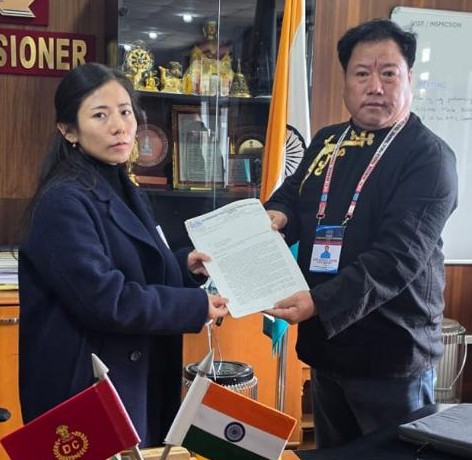
However, noted writer Yeshe Dorji Thongchi, a1980-batch EAC and 1992-batch IAS, while serving as Changlang DC (April 98-May 2001) had stirred the conscience of entire nation after seizing 99-kg of Charas being brought from infamous Golden Triangle during 1998 assembly polls. Charas was Rs 1 crore/per kg in global market then. In fact, Thongchi is second longest serving DC of India for 12 years 4 months (after Ajit Jogi as DM & collector for 13 years).
Charas is the name given to hashish form of cannabis which is handmade in Indian subcontinent & Jamaica. It is a cannabis concentrate made from the resin of the cannabis plant (Cannabis sativa or indica).The plant grows wild throughout Northern India along the stretch of the Mimalayas (its putative origin) and is an important cash crop for local people. The difference between charas and hashish is that hashish is made from a dead cannabis plant and charas is made from a live one.
Beyond the Horizon
By Pradeep Kumar
Manipur’s Binalakshmi Nepram, in her article – Drugs, Guns and Four Stories from the Northeast-, in Outlook’s 25.09.20 edition, had highlighted the tell all stories of drugs, their sources and supply routes.
“Northeast India comprises of eight states of Assam, Arunachal Pradesh, Manipur, Meghalaya, Mizoram, Nagaland, Sikkim and Tripura. The region which makes up 7.6% of India’s land area and 3.6% of its total population was home to four nation states which later merged with India, some voluntarily and some under duress.
“The fire of insurgency has engulfed this strategic region for the last half century, making it one of South Asia’s most disturbed regions. Bordering the five countries of Bhutan, Nepal, Bangladesh, China and Myanmar, the region has immense geo-political significance. The region is joined by a 14-km wide and 60-km long “chicken’s neck” of land between Nepal and Bangladesh. There are over 220 indigenous communities in the region, earning it the name of a “Miniature Asia”. Over 50,000 people have been killed and 20,000 widowed in my home state Manipur alone due to the conflict and martial law clamped here since 1958.
“The story of narcotics in NE India started around 1983 when heroin, a deadly derivative of morphine, started making an entry into our society, particularly Manipur. Within two decades, the Northeast states recorded 1,10,000 drug addicts and over 6,871 HIV positive cases, with Manipur having nearly 8% of India’s total HIV positive cases and ranked third in India. It is vital to note that 75% of the HIV positive cases in Manipur were intravenous drug users, and the disease spread to their sexual partners and their children. Drugs and HIV/AIDS devastated families not just in Manipur, but in other neighbouring states like Nagaland, Meghalaya and Assam as well.
‘Proliferation of narcotics production in the world started in the Golden Triangle area following the World War-II. Almost 80% of production of opiates of the world originate from the “Golden Crescent” and the “Golden Triangle” area, now called “Golden Pentagon” with the induction of Vietnam-Cambodia and Nagaland-Manipur in NE India. Several countries of South Asia are strategically located on the heroin trafficking routes – India, Bangladesh, Nepal & Sri Lanka.
“NE India shares a 1,643-km border with Myanmar, which belongs to the Golden Triangle group, a drug producing area where 68% of all known illicit opium production and refining in the world takes place. Some 90% of this mountainous terrain is under poppy cultivation and accounts for 65% of estimated total world opium poppy cultivation. According to the US Drug Enforcement Administration, Myanmar produces 80% of heroin in Southeast Asia and is responsible for 60t of the world’s supply. Heroin from this region soon found its way to western Europe as new smuggling routes opened through China and former Soviet Union. NE India too falls in the heroin trafficking route with many of the heroin labs located near the Indo-Burma border.
“Reports in 1989 pointed out that Manipur, Mizoram and Nagaland together accounted for the smuggling of at least 20 kg of heroin every day and that the bulk of it was sent to different parts of the country for eventual routing to the United States and Europe. Heroin was then sold under different brands such as ‘Two Lions and a Globe’, ‘Double Globe’, ‘Five Stars’, and even ‘Dangerous’.
“The question to ask then is, who at the time were the kingpins of this trade in India’s Northeast? It was certainly not the drug users and the petty drug traffickers, who were usually caught and jailed.
“The first district affected by heroin in the NE as per research done is Churachandpur located in southern part of Manipur bordering Northwest Myanmar. The road at Behiang was a creation of the World War-II. According to Manipuri journalist Phanjaobam Tarapot, some of the important trafficking routes in NE India are as follows: Behiang-Singhhat-Churachandpur-Imphal,
Behiang-Singhhat-Tipaimukh-Silchar (in Assam), Tamu-Moreh-Imphal, Homalin-Ukhrul-Jessami-Kohima, Mandalay-Tahang-Tiddim-Aizwal-Silchar, Homalin-Kamjong-Shangshak Khullen-Ukhrul, Myitkina-Maingkwant-Pangsau Pass-Nampong-Jairangpur-Digboi, Putao-Digboi- Pasighat (Arunachal Pradesh)-other destinations, Tamanthi (Myanmar)-Noklak (Nagaland-Myanmar Border)-Kohima-Dimapur, New Somtal (in Chandel district)-Sugnu-Churachandpur-Imphal-Kohima-Dimapur and Kheinan-Behiang-Churachandpur-Imphal-Kohima-Dimapur.
“Apart from these well-identified routes, there are several other tracks used by smugglers for illicit trafficking of heroin. After the narcotic drugs reach Imphal, Aizwal, Kohima, Silchar or Dimapur, they are dispatched to Calcutta, Mumbai, Delhi, Chennai or Bangalore and other places. Lack of security posts at border points coupled with inadequate security staff and connivance of some officials have led to heroin freely entering the region. The involvement of some security personnel in smuggling out thousands of kilograms of ganja in truckloads from Manipur to other states, like Bihar and surrounding areas have been reported. Moreh in Manipur and Champhai (Mizoram), a border town in Mizoram and other border points have become floodgates of heroin from the northwest part of Myanmar. A Mizoram Government Report points out that the heroin is smuggled from the Golden Triangle via Myanmar by almost half a dozen syndicates. The rapid increase of drug smuggling in Mizoram appears to be due to its strategic location, with a 704-km international border with Bangladesh and Myanmar.
“Chemicals from India help make heroin in Myanmar, which in turn has devastated India’s northeast with the help of venal druglords, politicians, and even some elements of the armed force.”
(Nepram is founder-director of Manipur Women Gun Survivors Network, Control Arms Foundation of India, and co-founder of Global Alliance of Indigenous Peoples, Gender Justice and Peace)
Rs 2 cr Charas seized: She is right as 181 kg of charas worth around Rs 2.25 crore were seized in Uttar Pradesh’s Shamli district on 04.01.21, one of the biggest drug seizure in western UP.
A truck and a car with five bags containing drugs smuggled from Nepal were intercepted near Lank outpost on the Karnal-Meerut Highway and truck driver Vajid arrested, SP Sukirti Madhav had told PTI. The drug smuggling gang was active in Bihar, Delhi, Uttar Pradesh, Punjab and Haryana.


 20