
By Pradeep Kumar
Beyond the Horizon
India is a Sovereign, Democratic and Republic nation since 15.08.1947 to adopt its Constitution on 26.01.1950 with power to citizens to choose their own government that paved the way for democracy. Democracy [a Greek word, dēmos (people) and kratos (rule)] is a form of government in which the people have the authority to choose their governing legislators.
The Bengal battle between Modi and Mamata proved it beyond doubt as the alleged goondaism of TMC cadre kept aside, the Bengali bhadrolok became one reflecting spirit of unity to face the mighty BJP which had everything at its command – the resources, campaign mechanism, government machinery and what not. They rose above caste, creed religion and language to vote to show the BJP that stereotype rhetoric yields no result.
Elections in India unfold significant and unprecedented lessons for getting a grasp of the incessantly changing dynamics of democratic politics. Given the multilayered and overlapping nature of social bases, the impactful emotive appeals of identity and development and the all-pervasive influence of personalities, every election in India provides crucial political messages.
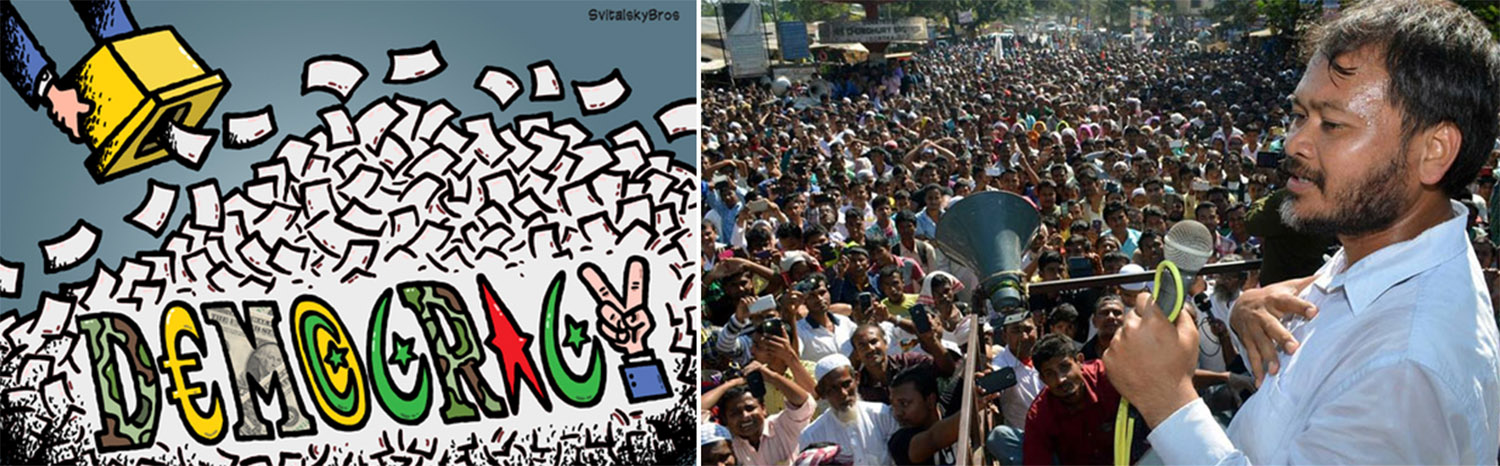
In Assam, jailed anti-Citizenship Amendment Act (CAA) activist Akhil Gogoi became the first Assamese to win an election without hitting the campaign trail and still in judicial custody as he clinched Sibsagar constituency by defeating his nearest rival Surabhi Rajkonwari (BJP) by a decisive 11,875 votes.
Founder of newly floated Raijor Dal, Gogoi had staged a sit-in protest against the controversial CAA, arrested in December 2019 over sedition charges under the UAPA and put behind bars by present BJP government. But, he bagged 57,219 votes as an Independent, garnering support from 46.06% of the electorate. The Congress, which had initially backed the Gogoi, became a chameleon to give ticket to Subhramitra Gogoi, who came third in the contest.
The RTI activist, in an attempt to reach out to the people of the state, wrote several open letters from jail, highlighting problems that need to be addressed. After victory, his letter from the jail reads: “I express deep gratitude to the people of Assam for supporting me by going against the government. I thank each and every one of those who supported me. I thank the new government and urge them to ensure that everyone should get free vaccines. The government should organise vaccine camps in villages and at panchayat level for the people.
“Regionalism has won… those who have humanity (must) support the regionalism and the process of strengthening regionalism has been started in Assam. With a new idea regionalism will come up among the people of Assam,” the letter added.
The firebrand peasant activist is perhaps the first MLA to swing into activism a day after the poll results were announced. His first demand before the new Govt came on Monday, even before he took the oath, demanding free COVID vaccination for 3.3 crore people of the state in the next three months, the first and foremost task of the new government. His legal counsel Krishna Gogoi said that his team will soon move the NIA court, seeking bail so that Akhil can enter the assembly to take oath as an MLA.
In Bihar, don-turned-politician Anant Singh, won Mokama constituency in 2020 while in Beur jail in a UAPA case for discovery of weapons including AK-47 from his residence in 2019. RJD leader Ritlal Yadav, who won Bihar Legislative Council election in July 2015 as an independent, was in Beur jail till August 2020 accused in over 33 criminal cases, including murder, had contested Danapur seat but was defeated by Asha Devi (BJP), to name a few.
Bertrand Russell, one of the early 20th century’s most prominent logicians and champion of freedom of opinion to lead British “revolt against idealism” defines Democracy as: both the word and the thing, was invented by the Greeks. So far as is known, nobody conceived of it before their time. There had been monarchies, theocracies, and aristocracies, but nobody had imagined a system in which all the citizens should have a voice in government. Even the most extreme forms of democracy developed by the Greeks were limited in certain respects; women and slaves had no part in government. As far as women are concerned, Plato thought this limitation unjust, but he had few followers in this matter.
Where democracy prevailed in ancient Greece the individual citizen had, in many ways, more power than he has in a modern democratic state. He could vote on every proposed law, judges were chosen by lot from among the citizens, and there was no powerful bureaucracy to place obstacles in the way of the popular will. Such a system was only technically possible in a city-state, since it presupposed that the citizens could assemble and vote directly on each measure, a thing which, in a large modern state, is not possible.
It cannot be said that the system was very successful. It arose in opposition to aristocracy, which itself had arisen in opposition to monarchy. Aristocracy, in most Greek city-states, was defeated by democracy, but democracy itself, as a rule, gave way to tyranny. A tyrant, as the Greeks understood the word, was not necessarily a bad ruler; he was merely a man who had acquired the powers of monarchy by force or the popular favour, and not by heredity. He generally made himself the champion of the people against aristocrats and plutocrats, and when he acquired sufficient popularity he represented that his enemies were plotting to assassinate him and that he needed a bodyguard if his life was to be preserved. When once he had got the bodyguard, he only had to favour the men who composed it, and the people were forgotten.
The Greeks never discovered any method of making democracy secure against this sort of thing. Democracy, however, lingered until the time of Alexander the Great, who, before embarking upon his Persian war, forced treaties upon the Greek city-states compelling them to keep the democrats in subjection.
Rome, on a larger scale, repeated the Greek experience. There was a long period of strife between the aristocracy and the populace. Julius Caesar won favour as the champion of democracy, which he abolished as soon as he was securely established. After his day, democracy disappeared from the world for a long time. It rose again very slowly and very gradually as a result of the new commercial prosperity that began in Lombardy in the eleventh century, and spread northward to such great centres of trade as the Hanse towns.
Modern Liberalism begins in Milan in the conflicts of that city with its Archbishop and the Emperor. It was a very limited form of democracy, consisting chiefly of independence from feudal magnates and ecclesiastical dignitaries. It had immense historical importance as giving opportunity for revival of political speculation and freedom of thought. Democratic forms of government, it is true, did not last very long. They gave way in Venice to aristocracy, and in Milan and Florence to the rule of plutocratic bosses. But there were always limits to what these men could practise in the way of abominations, since they had no traditional claim to power and were liable to be expelled if they behaved too badly.


 20
