
Beyond the Horizon
By Pradeep Kumar
Unsung hero of Indo-China war
After India gained independence in 1947, and Communist China came into existence in 1949, the Chinese PLA annexed Tibet in 1950, and began constructing border posts in Aksai Chin.
Taking advantage of undemarcated border both in north and northeast, the Chinese laid claims on Aksai Chin and NEFA (present Arunachal Pradesh).
In fact, Chinese leadership and the Central Military Council on 06.10.1962 had decided to launch a large-scale attack to punish perceived military aggression from India. In Beijing, a larger meeting of Chinese military was convened in order to plan for conflict. Mao and the Chinese leadership issued a directive laying out the objectives for the war including expelling all Indian troops within Chinese claimed territories in eastern sector and end the war with a unilateral Chinese ceasefire and withdrawal, followed by a return to the negotiating table.
China’s PLA launched multi-front attack on Oct 20, which was responded by unprepared Indian troops while Zhou and Nehru exchanged letters on negotiated boundary settlement, restoration of peace and friendly relations, line of actual control, McMhaon Line or MacDonald Line, but neither side declared war, but PLA forces were more aggressive to attack since Nov 14 including on Se La pas and Bomdi La on Nov and captured Thembang, supply route to Se La, that isolated 10,000 troops of India’s 4th Infantry Division.
But, the PLA had penetrated close to outskirts of Tezpur in Assam, nearly 50-km from NEF border. China had reached its claim lines so the PLA did not advance farther, and Zhou Enlai declared a unilateral ceasefire on Nov 19 midnight followed by their withdrawal from Indian Territory.
Indian forces suffered heavy casualties, with dead Indian troops’ bodies being found in the ice, frozen with weapons in hand. The Chinese forces also suffered heavy casualties, especially at Rezang La.
While 1,383 Indian army personnel were killed, 1,047 wounded, 1,696 missing and 3,968 jawans captured while PLA’s 722 killed, 1,697 wounded. (source:historyguy.com)
But, 4th Garhwal Rifles due to lack of resources was asked to retreat. But, rifleman Jaswant Singh Rawat, serving in 4th battalion remained at his post at Sela Pass and single-handedly fought for three days on Nov 17. The battle had resulted in 300 Chinese casualties but only 2 Indian jawans killed and eight wounded.
The Chinese forces cutoff Jaswant Singh’s head and took it back to China as a war souvenir. After the war was over, the Chinese commander, impressed with his bravery, had returned his head along with a brass bust made of the soldier. It is now installed at the site developed as Jaswant Garh War Memorial. He was posthumously awarded Maha Vir Chakra for his bravery. Rawat’s saga of brevity, valour and his love for his nation serve as a great source of inspiration to Indian soldiers since then.
—————————————-
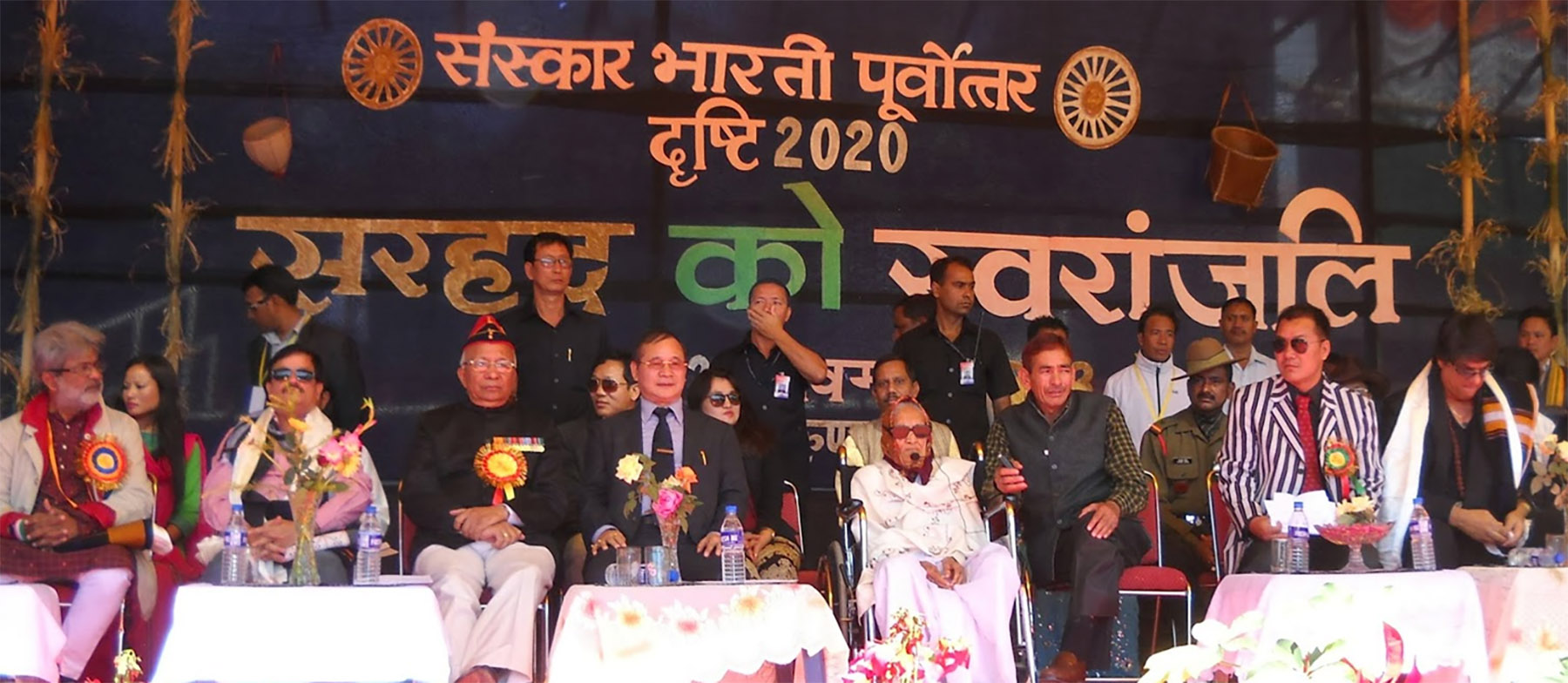
The 1962 war, heroism of rifleman Jaswant Singh Rawat, MVC, was hardly known across India, Thus. a three-day Sarhad ko Swaraanjali as a tribute to martyrs of 1962 Indo-China war was organized at Itanagar IG Park in November 2013 under the banner of Sanskar Bharati at the initiative of its Arunachal Pradesh unit president Sukhdeb Biswas.
Great martyr Rawat’s 94-year-old mother Lila Devi, who despite on a wheel-chair, was brought all the way from Dehradun as the chief guest of the event.
Sukhdeb and all members of national NGO Sanskar Bharati were well aware of the patriotic value of the song and relevance of great martyr’s mother 94- year-old Leela Devi, who despite on a wheel-chair, was brought all the way from Dehradun as the chief guest of the event.
Chief Minister Nabam Tuki, in his address on cocluding day on 24.11.13 had said “Arunachal Pradesh is the nation’s ‘sentinel of the east’ and its people are patriotic and ‘jealously guarding the territorial integrity of the country’, before felicitating her and conveying his gratefulness on behalf of the people of the state.
Heaping praises on Sanskar Bharati, he said patriotism of people of NE, Arunachal Pradesh in particular, is unfathomable and through this programme this will be now acknowledged by the entire country. “The need of the hour is to awaken the patriotism in us and reiterate our duties towards our motherland. I appreciate the novel endeavour of the organizers,” he added.
Terming martyrdom as the “ultimate” form of patriotism, Governor Lt. Gen (Retd) Nirbhay Sharma had said paying homage to such brave sons was the “highest” form of worship.
“The nation can never repay them for their deeds. It is an act which is well beyond the confines of religion and politics,” he said while felicitating the families of martyrs at Raj Bhawan here
Leela Devi, mother of Late Rifleman Jaswant Singh Rawat, Maha Vir Chakra, Yape Yajo, mother of Late NK Tape Yajo, Kriti Chakra, Pate Yayir, mother of Late Lance Naik Pate Tasuk, Sena Medal, Tabit Tapak, relative of SSB constable late Tagom Taki along with other family members were present on the occasion.
Sharing his experience, the governor said, “Having been a soldier and worn the uniform for 40 years, I know that a soldier fights for his country irrespective of his religion, caste and community. I am often asked as to why does a soldier (during war) walk into a situation of certain death? What makes him do this act”?
“Having seen this from close quarters, I consider it to be a determination to achieve the goal and defend the motherland. The man in him urges him to go on and on and the nation must recognize it. We are indeed proud of our armed forces and men in uniform who truly symbolise the spirit of secularism and patriotism,” he added.
Governor’s wife Jyotsna Sharma, chief secretary Dr. HK Paliwal, development commissioner Ramesh Negi, Lt. Gen (Retd) V.M. Patil, Officiating Sub Maj, 11 Garhwal Regiment, naib subedar Yespal, representing Garhwal Regiment to which Rawat belonged to, Arunachal Pradesh Ex-Servicemen Association president Hony Captain Lobsang Monpa, among others, were present.
Terming the programme as the golden contribution of late Sukhdeb, North East RSS in-charge Dr Sunil Mohanty recalled the unique event when 10,000 people had sung in one voice Lata Mangeshkar’s ever patriotic song.
Ae mere watan ke logo, Tum khub laga lo nara
Ye shubh din hai ham sabka, lahra lo tiraga pyara
Par mat bhulo seema par, viro ne hai pran ganvaye
Kuchh yad unhe bhi kar lo, kuchh yad unhe bhi kar lo
Jo laut ke ghar na aaye, jo laut ke ghar na aye
Aye mere vatan ke logon
Aara aankh mein bhar lo paani
Jo shaheed hue hain unki
Zara yaad karo qurbaani
O! the people of my motherland!
Raise all the slogans you desire,
This is a great day for us all,
Hoist your beloved tricolor,
But don’t forget on the border,
The brave did lose their lives,
And remember each great soldier,
Who did not return home ever.
O! the people of my motherland!
Shed a few tears,
For those who martyred on ice,
Remember their great sacrifice!
Cultural artists representing whole India including Mahabharata’s Bhishma Mukesh Khann and many luminaries had taken part in the 24-hours unforgettable non-stop cultural programme.
Many great music maestros have sang their own renditions of ‘Ae Mere Watan Ke Logon’, but none can compete with ‘nightingale of Bollywood’, Lata Mangeshkar’s rendition, who created
The song was written by poet Pradeep to commemorate Indian soldiers who died during the Sino-Indian War. Pradeep was deeply moved by the casualties of war. In late 1962, while taking a walk along Mahim beach in Mumabi, Pradeep became inspired. He borrowed a pen from another walker and wrote the opening stanza of the song on a piece of foil that he ripped out from his cigarette pack.
A few weeks later, Pradeep was approached by producer Mehboob Khan to write a song for a fundraiser scheduled to be held at the National Stadium in New Delhi. Pradeep accepted the offer, recruited music director C. Ramchandra to write the music and asked Lata Mangeshkar to sing the song.
The first live performance by Lata Mangeshkar of the song was on 26.01.1963, just two months after the end of the war, at National Stadium, New Delhi where President S. Radhakrishnan and Prime Minister Jawaharlal Nehru were present.
The performance of the song moved Nehru to tears. “Those who don’t feel inspired by Aye mere watan ke logo don’t deserve to be called a Hindustani”, said Nehru, who was visibly moved by the song.[
The event had raised Rs 1.3 crore for the Army Welfare Fund. The song’s lyricist, Pradeep, was not invited to the performance. Pradeep performed the song for Nehru on 21 March 1963 at a function at R.M. High School in Mumabi and also presented Nehru with the original handwritten lyrics of the song. The song received rave appreciation from across the country.


 20
