
Beyond the Horizon
By Pradeep Kumar
Appearance of ominous signs on skies of Dwarka as omen scaring all about mishappening in future was omen of downfall of Yadu dynasty in about 9,000 years ago. Similarly, novel coronavirus SARS-CoV-2, named as corona virus disease (COVID-19) by WHO since its emergence in December 2019 has so far affected 220 countries and territories killing 3,514,288people, confirmed cases 169,166,43 and 15,08,27,185 recoveries.
The fear spread by the deadly virus among the humanity world over is perhaps worst ever since human civilization. If there is such striking similarity between ‘Dwarka omen’ and COVID-19 that has put the scientists to test, is it speculating worst days in future, the way Yadu dynasty had fallen?
Once upon a time, there was a numinous kingdom all made of gold in the middle of the sea. It was built by enchanting Lord Krishna Legends surrounding this city are still a concept of fascination, no wonder, since this city was. It was named Dwaraka due to its many gateways (dwaras) to the mainland.
Sacred scripture of Srimad Bhagvatam, the city of Dwaraka was built due to constant attack on Mathura, the land of Yadavas, by Magadha ruler Jarasandha. Thus, Lord Krishna had decided to have a separate city on western coast of India and given shape by great architect Vishwakarma.
After leaving Mathura, Lord Krishna had resettled his able ancestors by developing a new city in the existing ruins in Dwarka region. But how and who destroyed Dwarika and how it drowned in the sea were unknow till it came to limelight.
Dwarka then was province of Sindh in Pakistan and Gujarat in India. The area between it was called Yadu Kshetra. The state’s division earlier was on the basis of river and forest area. Saraswati river used to merge with the sea near Kutch in Gujarat. From Saraswati River towards Godavari-Narmada towards Vidarbha to the banks of Indus River on other side was under the Yadus and across the Indus was the territory under Yadu’s other brothers.
Holding Krishna responsible for complete annihilation of Kauravas, Queen Gandhari had cursed Lord Krishna holding him responsible for Mahabharat in which all his 100 sons were killed. However, at Dwarka, a Yadu youth mocking at great sages Gautam rishi and Viswamitra with a iron pot in his belly was cursed that he would give birth to a musala (iron rod) which will be the cause of total destruction of Yadavas.
Several days later, ominous signs began to appear on skies of Dwarka and all were scarred of some mishappening in coming days. However, one night a verbal fight ensued between Yadav commanders over using ill-tactics in Mahabharat War. Soon they divided onto two groups followed by pitched battles. Soon 10 lakh Yadavas perished leaving behind Krishna, Balram, queens and children. Gandhari’s curse had shown its wrath and Yadavas had perished. Lord Balram left for his divine abode. Lord Krishna sent a messenger to Arjuna to take all queens and children with him to Indraprastha and told them to go within seven days after which Dwarka will plunge into Arabian Sea. After which he went to a forest and pondering over all past events while lying down with one of his feet on the other. It Hunter Jara (who was Bali in Rama Avtar) mistook his feet as a deer’s ear and shot at ii with the same iron-piece-headed arrow into his feet.
Arjuna went to Dwarka and took the Vajra and the remaining Yadav women to Hastinapur. Vajra, the great-grandson of Krishna, was declared king of Mathura at Hastinapur. Mathura region is called Brajmandal by the name of Vajranabha.
Sri Krishna left for ultra-divine realm Goloka, Arjun and all Pandavas too left this earth and Dwarka got submerged in the sea as predicted by Sri Krishna.
These maritime remains of Dwarka were first noticed by Indian Air Force pilots flying over the sea and then mentioned in 1970’s Gazetteer in Jamnagar.
Indian Navy divers under as directed by Archaeological Survey of India (ASI) first in 2005 and again in 2007 had successfully extracted about 200 specimens lying in the sea near the Gulf of Kutch in Gujarat and extensive survey also found limestone blocks. Naval divers excavated them from within a radius of 40,000 sqm and samples of buildings the blocks were initially described as limestone, which experts said they were remnants of a very large and prosperous city and temple.
The ASI experts had sent those specimens to archaeological laboratories of India and abroad, which did not match Indus Valley Civilization architecture being very ancient.
A team of Pro. S R Rao of Mysore University, who had worked with state and national archaeological department, in 1979–80 had discovered 560-meter-long Dwarka wall, utensils of 1528 BC to 3000 BC, many relics of Indus Valley Civilization and many secrets after digging at the place where Battle of Kurukshetra was fought.
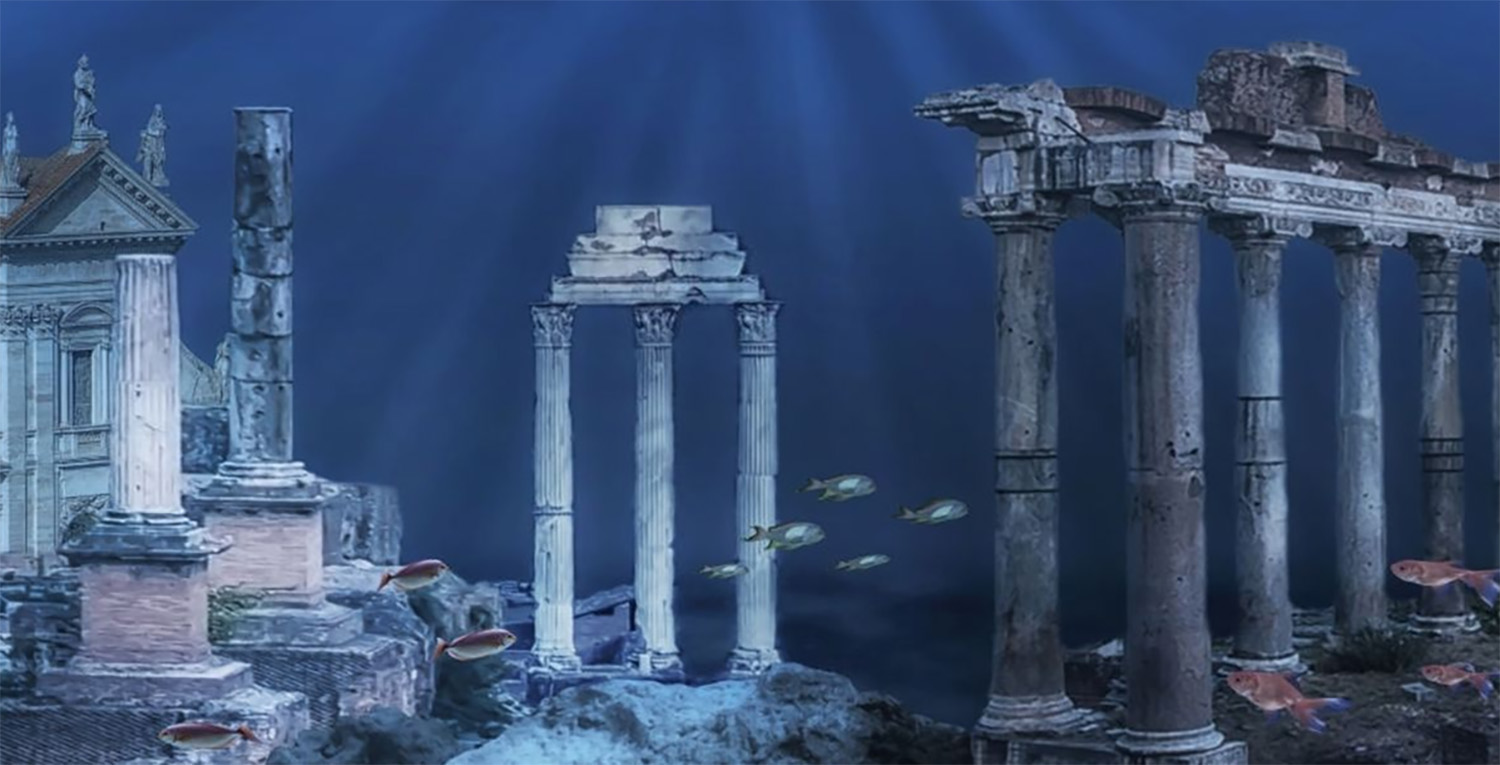
In 2001, the Govt asked for a survey by the National Institute of Ocean Technology to estimate the damage caused by pollution on the beaches of Gujarat. When the marine foothills were examined, a man-made city was found on the sonar, which, upon examination, found that the city is 32,000-year-old and has been merged in the sea for 9,000 years. It is believed that the city may have merged into the sea due to rising sea level at the end of the ice age (Pic below) 9,000 years ago, but there may be other reasons behind it.
The data of this excavation work was presented to various national and international experts. These experts including from the US, Israel, Sri Lanka and the UK. The specimens were also sent to foreign laboratories to eliminate suspicion of any error regarding the antiquity of the remains.


 20
