

Beyond the Horizon
By Pradeep Kumar
The air over the ocean moves due to differences between air pressure within the atmosphere. Warm and moist air moves up and away from the ocean surface causing an area of lower air pressure below for a cyclone. The whole system grows gradually and becomes fast with time and an eye is created in the centre, which is the low-pressure centre into which the high-pressure air flows from above, thus creating a cyclone.
Tropical cyclones are known by various names in different parts of the world. As hurricanes in North Atlantic Ocean and eastern North Pacific and typhoons in western North Pacific around Philippines, Japan and China while as severe tropical cyclones, tropical cyclones, or simply cyclones in western South Pacific and Indian Ocean.
A tropical cyclone generates winds that exceed 119-km per hour, extreme cases winds may exceed 240-km/h while gusts may surpass 320-km/h. Accompanying these strong winds are torrential winds and a devastating phenomenon known as the storm surge, an elevation of the sea surface that can reach 20-feet above normal levels. Such a combination of high winds and water makes cyclones a serious hazard for coastal areas in tropical and subtropical areas of the world.
But, the Bay of Bengal is a more active basin than the Arabian Sea for brewing cyclonic storms.Years after year India’s eastern coastal belt has been ravaged by super cyclonic storms. Twelve cyclones formed in Bay of Bengal ravaged eastern coastal states of India in last four years. Out of five cyclones witnessed in Indian coastline ina year, four originated in the Bay of Bengal and only one in Arabian Sea.
2021: Super Cyclone Yaas had made landfall at Dhamra port in Bhadrak district of Odisha around 9 am on May 26 with sustained wind speed of 130 to 140 kmph gusting up to 155 kmph and hit 30-km south-southeast of Balasore at 9.30 am.
Tauktae, a very severe cyclone rising over North Indian Ocean on May 14 had impacted Kerala, Karnataka, Goa, Lakshadweep, Dadra and Nagar Haveli and Daman and Diu and Gujarat with heavy rainfall and flash floods.
2020: Super cyclonic storm Amphan was a very powerful tropical cyclone raising on May 20over the Bay of Bengal o strike Odisha and West Bengal.
2019: Cyclone Fani was extremely severe cyclonic storm in the shape of hood of a snake that had threatened Odisha and Andhra Pradesh on May 03. Cyclone Vayu in north-western India emerging from Arabian Sea had caused moderate damage in states, including Gujarat. Kyarr and Maha were cyclones at same time developed over past 10 days in Arabian Sea. Cyclone Kyarr moved towards the Gulf of Aden from Indian coast while cyclone Maha cane to Indian west coast, besides Hikka.
2018: Cyclone Phethai was part of North Indian Ocean cyclone season over Bay of Bengal. Cyclone Gaja hit Tamil Nadu, Andhra Pradesh and some parts of coastal Puducherry with heavy rainfall in Cuddalore and Pamban.
Cyclone Titli, a very severe cyclonic storm on Oct 11, was part of North Indian Ocean cyclone season to make landfall in Odisha’s Gopalpur and Srikakulam of Andhra Pradesh.
2017: Severe Cyclonic Storm Mora, formed over south-eastern Bay of Bengal on May 28,was a deadly tropical cyclone to cause widespread devastation, severe flooding and deaths in Sri Lanka, Andaman & Nicobar Island, Bangladesh, Myanmar& NE India.
Cyclone Ockhi was most intense and one of the strongest tropical cyclone of North Indian Ocean cyclone season. Ockhi from Arabian Sea had affected coastal areas of Kerala, Tamil Nadu and Gujarat and to devastated parts of Sri Lanka on Nov 29.
Tropical cyclone Maarutha emerging from southern Bay of Bengal first made landfall on April 15 in Myanmar and caused notable damages.
2016: Tropical cyclonic storm Roanu which intensified into a cyclonic storm on May 19 had caused severe flooding in Sri Lanka & Bangladesh and deaths besides torrential rainfall in Tamil Nadu, Andhra Pradesh, Kerala & Odisha.
Severe cyclone Vardah, originating near Malay Peninsula on Dec 3, had brought heavy rainfall to Andaman and Nicobar Islands then crossed the eastern coast of India and affected Chennai, Kancheepuram and Visakhapatnam before affecting Somalia later.
2015: Extremely severe cyclonic storm Chapala was a powerful tropical cyclone formed on Nov 1 in Arabian Sea to gain estimated sustained wind speed of 240 km/h to be among the strongest cyclones on record in Arabian Sea since 1922. It was followed by extremely severe cyclonic storm Megh formed on Nov 5 in eastern Arabian Sea asworst tropical cyclone to ever strike Yemeni Island of Socotra, causing destruction and deaths.
2014: Cyclone Hudhud was a strong tropical cyclone, which on Oct 12had caused maximum damages to Visakhapatnam city of Andhra Pradesh besides Odisha.
2013:Cyclone Phailin was second strongest tropical cyclone in India since the 1999 Odisha cyclone that had emerged on Oct 12 resulting in heavy rainfall in Odisha, Andhra Pradesh, Jharkhand and other states.
Very severe cyclonic storm Lehar, formed in South China Sea on Nov18 and entered Bay of Bengal to intensify as category-1 hurricane by Nov 24.
Severe cyclonic storm Helen formed in Bay of Bengal on Nov 18 had brought heavy rainfalls in eastern India and became a severe cyclonic storm to affect Andhra Pradesh.
2012: Cyclone Nilam, originating from Bay of Bengal in South India, was a deadliest tropical cyclone. Its heavy rains and strong winds had affected Chennai Port of Tamil Nadu and New Port railway station in Kakinada in Andhra Pradesh
2011: Very severe cyclonic storm Thane, strongest tropical cyclone within the Bay of Bengal, developed in Indonesia on Dec 22, gained wind speed of 1540 km/h while approaching Tamil Nadu and had speed of 1,000 km/h at southeast of Chennai.
2010: Extremely severe cyclonic storm Giri, originating over Bay of Bengal on Oct 19 to gain peak wind speed of 195 km/h on Oct 22, made landfall at Kyaukpyu in Myanmar and killed at least 157 people and made over 70,000 homeless.
Severe cyclonic storm Jal, developed from South China Sea on Oct 28. hit Thailand and Malaysia, triggering severe flooding and deaths to be known as 4th deadliest tropical cyclone in India.
2009: Cyclone Phyan emerged in Arabian Sea and caused heavy rainfall in Tamil Nadu, Maharashtra and Gujarat. It was one of the wettest cyclones in India and brought extremely heavy rainfall of over the coasts of Karnataka, Goa and Maharashtra.
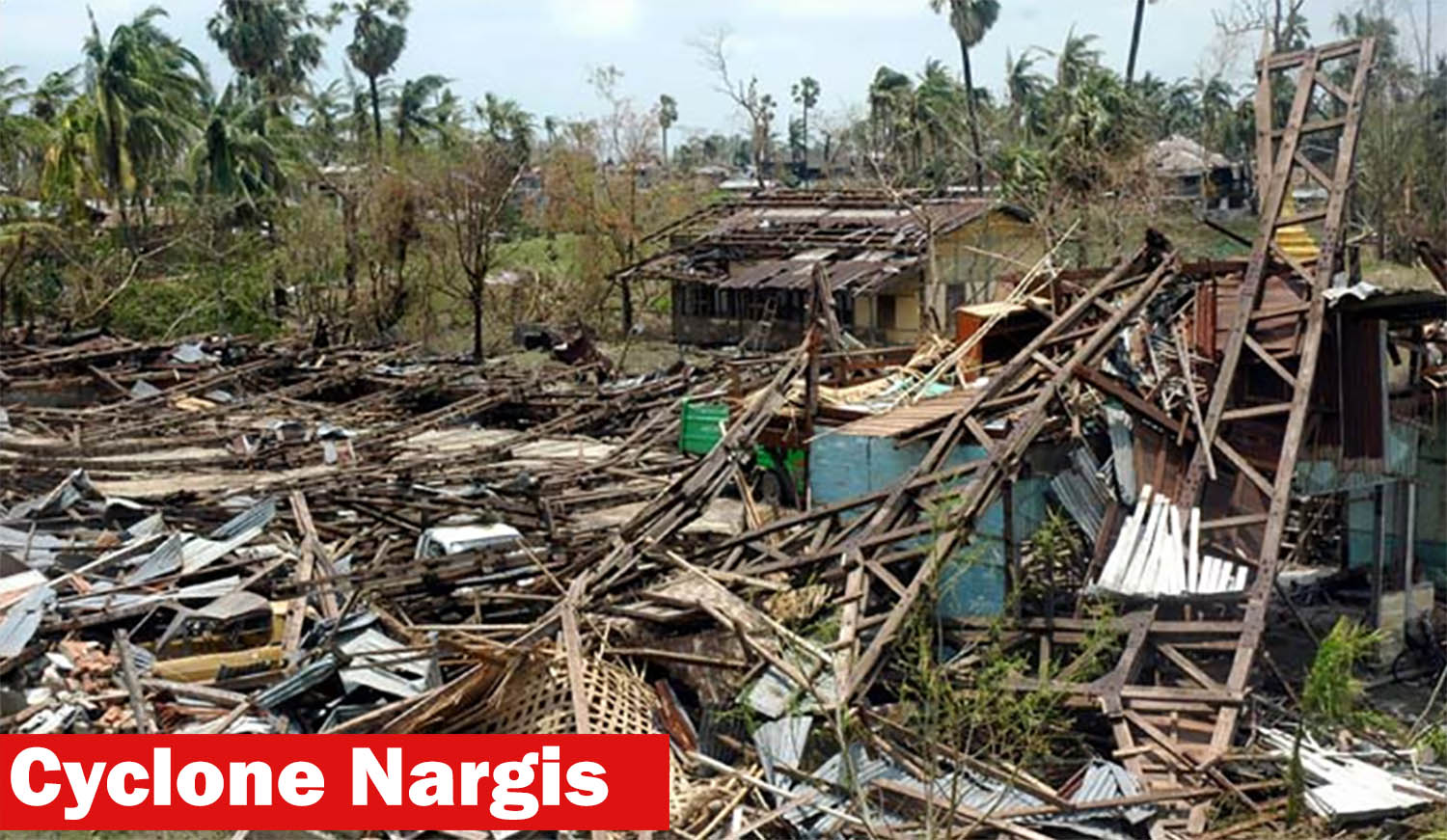
2008: Extremely destructive and deadly tropical cyclone Nargis had made landfall in Myanmar on May 20 sending a strong surge 40-km up densely populated Irrawaddy delta causing catastrophic destruction and at least 1,38,373 fatalities, Labutta township alone had reported 80,000 deaths &10,000 deaths in Bogale while around 55,000 people went missing besides many unreported deaths. This was worst natural disaster in Myanmar’s recorded history.
2006: Extremely severe cyclonic storm Mala, formed over southern Bay of Bengal & nearby Andaman Sea on April 24, intensified to gain speed of 185 km/h on April 28, made landfall in Myanmar’s Rakhine state on April 29.
2005: North Indian Ocean cyclone season was destructive and deadly to southern India. The basin covering Indian Ocean north of Equator and inland areas sub-divided by Arabian Sea & Bay of Bengal and recorded 12 depressions. Cyclonic storm Hibaru emerging from Arabian Sea in September killed 13 people; another formed over land killed 26 in Madhya Pradesh, followed by another depression in July that killed one person; series of deadly storms killed six people in MP, cyclonic storm Pyarr killed 80 people, unknown tropical storm killed 16 people in nearby Bangldesh; a deep depression in October killed 100 people in Andhra Pradesh; cyclonic storms Baaz and Fanoos . in December hit southern India killing 11.
Cyclones Viyaru (2013), Laila (2010), Bijli (2009), Nisha (2008) & Machilipatnam (1990) have destructive history.

Deadliest tropical cyclone: Devastating tropical cyclone Bhola, formed over central Bay of Bengal 08.11.1970, had struck East Pakistan (present-day Bangladesh) and West Bengal on November Nov 11 resulting in strong surge to flood much of the low-lying islands of Ganges Delta and gained peak wind speed of 185 km/h on Nov 10 to make landfall in East Pakistan coast. At least 500,000 people had lost their lives, including 45% of 167,000 population of Upazila & Tazamuddin to make Bhola the deadliest tropical cyclone ever recorded and one of the world’s deadliest natural disasters (pic above).
Then Pakistani Govtled by junta leader General Yahya Khan was criticized by local political leaders and global media for delayed relief operations. Thus, opposition Awami League had gained a landslide victory in the province and continuing unrest between East Pakistan and central Govt triggered the Bangladesh Liberation War, which led to widespread atrocities and eventually ended with creation of Bangladesh.
1977 Andhra Pradesh cyclone, noticed southwest of Nicobar Island on Nov 14, gained peak sustained wind speed of 230 km/h as a modern-day super cyclonic storm to Andhra Pradesh on Nov 17 killing at least 10,000 people,
1999 Odisha super cyclone BOB 06, originating from Sulu Sea on Oct 21 organized into a tropical depression in Andaman Sea to rapidly intensify to become super cyclonic storm and gained peak windspeed of 300 km/h and made landfall in between Ersama and Balikuda in Jagatsinghpur district, southwest of Paradip on Oct 29. The wind speed was so high that anemometer, a device to measure wind speed, in IMD office and Paradip had failed to record it.
The storm was greatest cyclonic disaster to strike Odisha in 20thcentury, raking the state and adjacent areas with high storm surge, powerful winds, and torrential rainfall. The storm’s impacts exacerbated and 5–6 m surge brought water up to 35 km inland, carrying with coastal debris and inundating towns and villages. The surge combined with heavy rains led to widespread flooding, damaging around 1.6 million homes and causing rivers to breach 20,005 flood embankments, destroyed numerous crops, including sugar cane, rice, and other winter-time harvests.
The estimated death toll varied to suggest30,000 fatalities,includingover 8,000 inJagatsinghpur, majority of which was caused by storm surge. The total damage was estimated to be US$4.44 billion. Extensive recovery efforts begun with help of Indian Armed Forces while the central Govt granted Rs 3 billion to Odisha Govt.Contributions from foreign Govts amounted to nearly US$13 million, with more than half by the United States.Besides other state Govts, numerous international aid agencies also joined the relief mission.


 20
