

By Pradeep Kumar
ITANAGAR, May 31: Abraham TagitSorang became 14thArunachaee to scale Mount Everest, 29,028-feet Mount Everest, the highest peak on the earth.
He is the second Arunachalee to ink the record this season, 20 days after Dirang-based National Institute of Mountaineering and Allied Sports (NIMAS)’s TashiYangjom deed it on May 11.
Sornag, hailing from Sapha village under Pip-Sorang circle of Kra-Daadi district, is on his way back but facing tough challenges due to inclement weather, said Indian Weightlifting Federation vice president Abrham K Techi, adding Sorang is not first from the district but also first civilian Nyishi to achieve this feat. It was trade & commerce director TakongPertin who alerted about it first.
“On May 12, 50 climbers reached the summit, which now means that over 150 have climbed Everest this season. There are still over 300 climbers waiting for their turn to climb the fixed lines to the top. Nepalese mountaineer and the expedition manager of Seven Summit Treks, ChhangDawa Sherpa, congratulated Shehroze Kashif for becoming the youngest Pakistani to climb Everest at 19. “This morning Kashif successfully climbed the Mt. Everest as a part of Seven Summit Treks — Everest Expedition 2021,” he wrote.
Mount Everest has been scaled by more than 6,000 climbers since it was first scaled by Edmund Hillary and Sherpa Tenzing Norgay in 1953 and at least 311 people died Reuters reported on 27.08.20. But Arunachal Pradesh has uniquedistinction with 14Arunachalees achieving this feat so far:
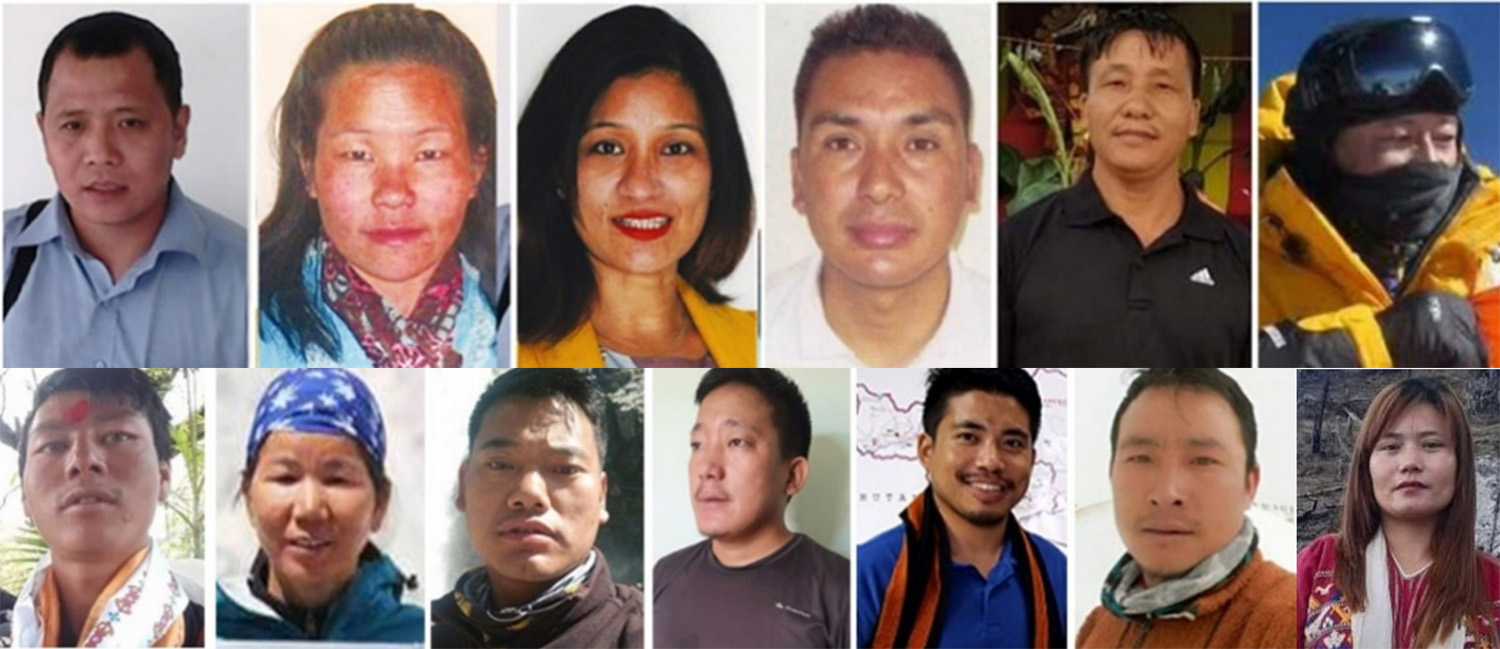
(From L to R) Mra, Mena, Jampsenpa, Lama, Bagang, Paljor, Khandu, Lingi, Nimsonga, Tamut, Teksang, Dondup & Yangjom
The mountaineers are – TapiMra (21.05.09); Tine Mena, 1st NE woman (09.05.11); AnshuJamsenpa (12.05.11, 21.05.11, 21.05.13, 06.05.17 & 21.05.17 [only woman on earth to scale five times]; Nima Lama (17.05.13); SSB constable Tame Bagang (21.05.13); KaldenPaljor (21.05.17); DorjeeKhandu and TongchenNimsonga of NIMAS (19-20.05.18), Muri Lingi (14.05.18); Kishon Teksang& Taka Tamut (24.05.18) [Tamut without the support of Sherpa guides while Tekseng had also climbed till Camp IV (26,000ft) without supplemental oxygen, a rare feat], Tibetan Army man SangeDondup (2019) and
TashiYangjom of NIMAS (14.05.21). Yangjom was ninth climber of the institute to scale Everest.
This again proves right, what I had written on 14.05.21, “more Arunachalees with their special physique could climb Everest if those interested are given proper training besides lucrative incentives through a policy”.
It was Edmund Hillary of New Zealand and TenzingNorgey Sherpa of Nepal (who took Indian citizenship on 29.05.1953), were first to summit Mount Everest while Bachendri Pal of Uttarakhand was first Indian woman to summit it on 23.05.84 at the age of 30 to be conferred Padma Bhusan in 2019.
As Mount Everest draws more than 500 climbers each spring to attempt the summit during a small window of favorable conditions on the rugged Himalayan Mountain that tops out at just over 29,000 feet.
A new study led by researchers of University of Washington and University of California, Davis, finds that the success rate of summiting Mount Everest has doubled in the last three decades, even though the number of climbers has greatly increased, crowding the narrow route through the dangerous “death zone” near the summit. However, the death rate for climbers has hovered unchanged at around 1% since 1990.
The findings were published Aug. 26 in the open-access journal PLOS ONE. They represent the most comprehensive look at success and death rates in the published literature on Everest. The paper also identifies patterns in the characteristics of mountaineers — such as age, sex and prior experience — that might influence their likelihood of summiting or dying during the spring climbing season.
“Mount Everest is still a very dangerous mountain, and climbing it will never become a walk in the park, because it’s way above the limits of what most people can do,” said lead author Raymond Huey, a UW professor emeritus of biology. “Unfortunately, reported statistics of risk on Everest are often inaccurate. By analyzing climbing data, we provide accurate information on the chances of success and on the chances of dying, thereby helping climbers make an informed decision about whether to attempt this great peak.”
These patterns also can help Nepal and China in deciding whether to institute restrictions on climbers such as maximum age or experience level, Huey added.


 20
