

By A O News Service
ITANAGAR, June 07: NGO Helping Hands would set up skill training centres across NE states to offer skill training by involving corporate bodies with global presence, informed its president Robin Hibu during informed proposal of providing over 2-hour-35-minute review meeting on Sunday evening.
It was lauded by participating members CA Akash Sharma, financial expert Gaurav Raj Thakur, media consultant Pradeep Kumar, Dr Gampi Padu, Manipur National Institute of Technology’s assistant professor Dr Sangeeta Laisham, Gaurav Vats and Rajni Subba.
Pointing out that NE has been known for in-migration as workers from across India come to the region to serve, Robin said that this offers enough scope for skill training, like carpentry, masonry, plumbery and electrician for people to earn their livelihood. A survey has to be conducted to assess requirements of the NE people and seek help of DoNER Ministry for the purpose.
Skill training in Govt sector has been for names sake only, Dr Laisham said, adding the local textile and handicraft producers fail to get remunerative prices for their products for lack of market. Moreover, job placements have to be ensured in other parts of India.
Citing examples of her state Arunachal, Dr Padu in her support said that it has to be meaningful to make them earnable, when Hibu consented and said that the corporate body has suggested to promote traditional handicrafts and textiles for which the NE is known for ages.
Informing that Arunachal Pradesh National Youth Project (NYP) unit empaneled with 12 central Govt departments including skill development ministry and National Skill Development Council of which he is vice president, Kumar said that NYP has skilled over one lakh people in the state whose list was submitted to former chief secretaries Ramesh Negi and Shakuntala Gamlin.
Suggesting a ground level survey involving agr-hoti departments as to what could be cultivated keeping national market in view, Kumar said that 22 farmers of Anjaw district encouraged by NYP with the help of a funding agency had cultivated large size cardamom and the first yield was sold for Rs 1.72 crore to create a national record.
Moreover, only Apatanis and Monpas of total 24 major communities of the state, are known to be skilled carpenters and masons for which these trades should be included in the skill training. Moreover, thousands of Arunachalees recruited by private sectors across the country had returned home due to paltry salary. Thus, Guwahati where many large scale industries are already set up and many are coming up should be targeted first for job placements while forward and backward market linkage should be made part of skill training national project.
Song and dance are in the blood of NE people for which song could also be one of the trades. Helping Hands is lucky as its member Dr Padu is the first woman of Arunachal to obtain degree in music and sing in Guwahati DD Kendra first in 1994.
The review meeting covered fast areas including appreciation of all member doctors who have been offering counselling to the people to face the prevailing COVID-19 pandemic.
Cautioning that COVID-19 third wave is expected, Hibu urged all members to get prepared to face it and help people under its ‘Mission save life’ for which if required vehicles would be hired. The MoU would be signed shortly for opening Helping Hands chapter in Nagaland and Manipur, both states worst hit by COVID-19, he added.
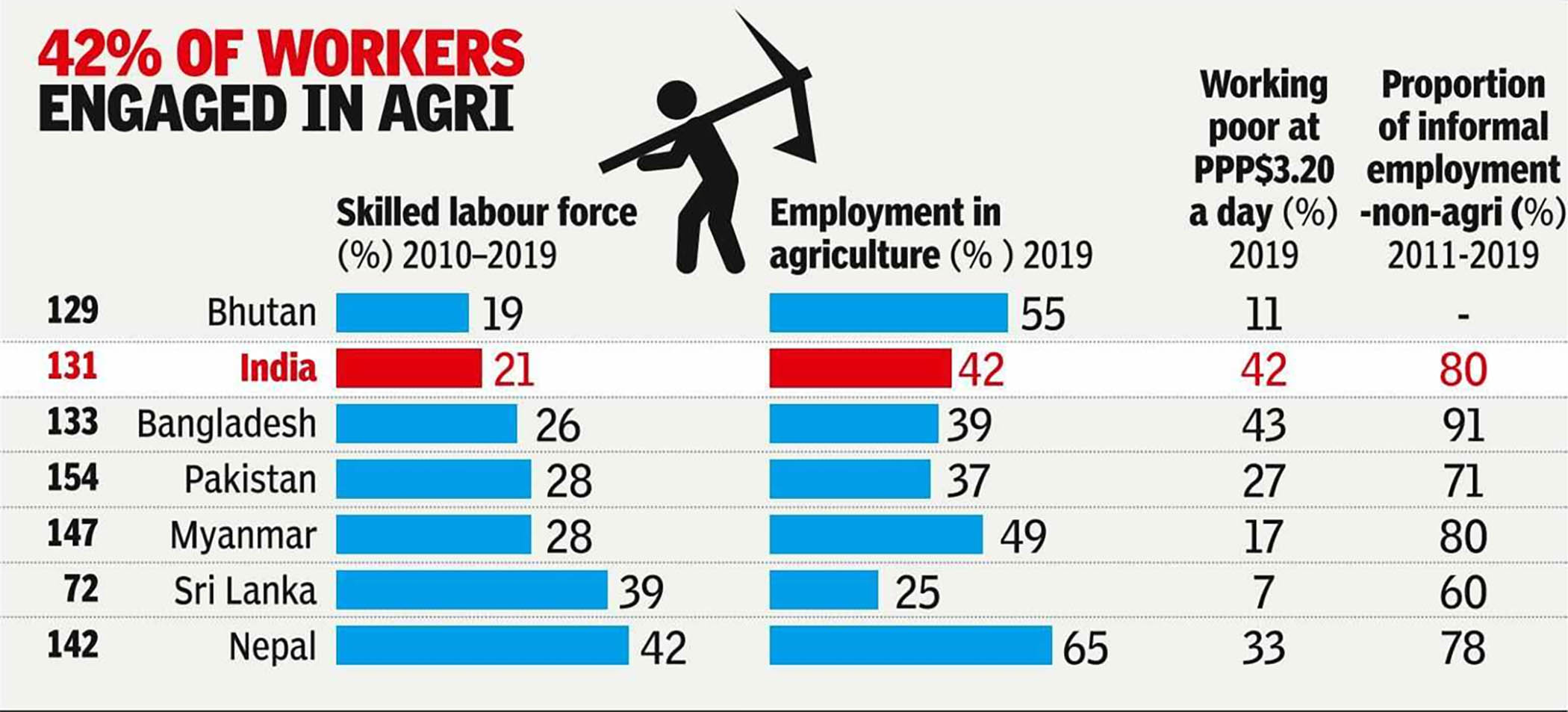
Agency adds: Barely one in five Indians in the labour force is “skilled” according to Human Development Report (HDR) 2020. With the figure at 21.2%, India is 129thamong 162 countries for which this data is available. The countries closest to India in sharing this dubious distinction are Ivory Coast, Sudan, Liberia and Cameroon, most of which are classified in the low human development category. Others with similar level of skill in their labour force are mostly in sub-Saharan Africa.
The United Nations Development Programme’s HDR ranks countries according to a wide range of human development parameters apart from core economic factors like GDP and per capita income. The report defines skilled labour as people who are 15 years or older and have “intermediate” or “advanced” level of education as classified by the UNESCO.
Nearly all countries at the top of this list are advanced economies with very high Human Development Index (HDI). Japan, which tops this list, is ranked 19thin the overall HDI ranking and has 99.9% of its labour force classified as skilled.
Belarus, the US, Lithuania and Russia have over 96% of their labour force classified as skilled.Apart from the US, Japan and Canada, most countries at the top of this list with over 90% of their labour force being skilled are from eastern Europe. For advanced economies in western Europe like Germany, Switzerland, Sweden, France and the UK, the proportion ranges between 80% and 90%.
In India’s neighbourhood, only Bhutan has a lower proportion of skilled labour than India. In Nepal and Sri Lanka, nearly 40% of the labour force is skilled, while it is 28.1% in Myanmar, 27.8% in Pakistan and 25.8% in Bangladesh. Bhutan’s 19.5% is lower than India’s proportion. Data for China was not available. India’s labour force is also characterised by a high proportion of employment in agriculture and the informal sector with nearly half of its workforce classified as “working poor” — employed people who live on less than $3.20 a day in purchasing power parity terms (about Rs 70 a day at 2020 rate).
While they are above the international poverty line defined at PPP $1.90 a day (about Rs 42), these people are vulnerable to fall below it. According to the report, about 42% of employed people fall in this category in India. Although this is slightly lower than in Bangladesh, all other countries in the neighbourhood have a lower proportion of such employment. The share of agriculture and the informal sector in India’s employed people is comparable with its neighbours, but other large economies have a minuscule proportion. In Japan, for instance, only 3% of the workforce is in agriculture. For the US, Germany, France and the UK, the proportion is even lower.


 20
