
From Our Correspondent
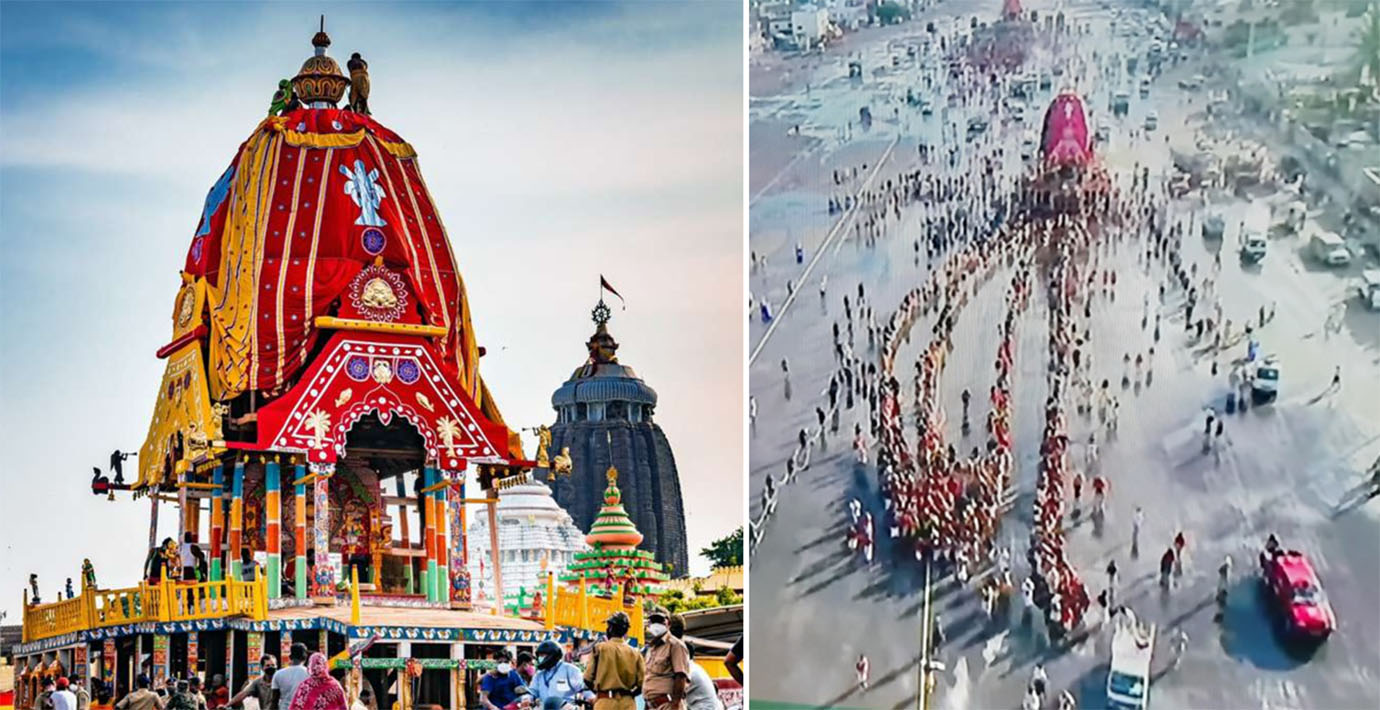
PURI, July 12: The nine-day long Jagannath Rath Yatra, one of the biggest festivals in India, begun on Monday at Jagannath Temple in Puri, considered one of the Char Dhams. The Rath Yatra culminated after Lord Jagannath’s Nandighosa chariot reached nearby Gundicha temple here. The Rath Yatra is 460-year old and finds mention in Brahma Purana, Skanda Purana, Padma Purana, and Kapila Samhita.
Jagannath considered ”lord of the universe”; is a deity as part of a triad along with his brother Balabhadra and sister, devi Subhadra. Jagannath as per Hinduism is the supreme god, Purushotama. To most Vaishnava, Jagannath is an abstract representation of Krishna, or Vishnu Nand to some Shiva.
The Jagannathism as a major deity emerged in early middle age and later became an independent state regional temple-centered tradition of Vaishnavism.
Unusually, the icon is made of wood and replaced with a new one at regular intervals.
The origin and evolution of Jagannath worship is unclear. Some scholars interpret hymn 10.155.3 of the Rigveda as a possible origin, but others disagree and state that it is a synthetic deity with tribal roots.
Jagannath is considered a non-sectarian deity. The Jagannath temple is massive, over 200 ft high in the Nagara Hindu temple style, and one of the best surviving specimens ofKalinga architectures, namely Odisha art and architecture. It has been one of the major pilgrimage destinations for Hindus since about 800 CE.
The festival is among the most famous Vaishnavite rituals in India and abroad, and therefore, usually witnesses much fervour and enthusiasm among devotees who come to pray to the deities – Lord Jagannath, Lord Balbhadra and Lordess Subhadra. For the festival, special chariots are built every year, and this year has been no exception.
However, while usually tourists throng the temple premises during the festival, this year, due to the coronavirus restrictions, no devotees were allowed for second year in a row during the much awaited festival, even as Lord Jagannath is one of the principal deities in Odisha.
A two-day curfew was imposed and total of 65 platoons of police force were deployed across the city, informed Northern Range IGP Narasingha Bhol.
“Ahead of Rath Yatra, curfew has been imposed from 8 pm, July 11 till 8 pm, July 13 in Puri. 65 Platoon have been deployed at different points. No devotees are permitted to attend the yatra,” Bhol had told ANI here on Sunday.
Earlier, Jagannath Temple chief administrator Krishan Kumar had informed that all arrangements for the Rath Yatra were complete which had arrived at Singh Dwar.
The Archaeological Survey of India (ASI) had sought permission for laser scanning of Jagannath Temple ahead of the yatra and given permission for all parts of the temple except ‘garbhagriha’, Kumar had said.
The secret rituals of Lord Jagannath would take place at night before the deity is carried from the temple to the Rath.
The servitors testing negative for COVID-19 would be allowed to pull the chariots, Jagannath Temple administrator Ajaya Jena said but Kumar had asserted that everyone involved in the yatra has been tested and only those who have tested negative for COVID-19 are being allowed to take part.
The servitors who have been vaccinate and tested negative for COVID-19 will be allowed to attend rituals. This will be the second year in a row when the devotees will not be allowed to attend the celebrations due COVID-19 pandemic.
Special Relief Commissioner Pradeep K Jena on Thursday had said that the Supreme Court’s guidelines, which were issued last year on conducting Rath Yatra will be followed this year too. The state Govt has restricted the Rath Yatra to other places in the state but the rituals will be allowed to perform in the temples without any gathering.
“Only selective people having 48-hr RT-PCR negative report or those who are fully vaccinated will be allowed to pull the chariots but not more than 500 persons” Jena had said.
Similar criteria have also been followed by police personal and 1,000 officials will be deployed for duty.
The Supreme Court on July 22, 2020, modified its earlier order and allowed the annual event to be held with the coordination of temple committee, state and central Govts without compromising with guidelines relating to COVID-19.


 20
