
Beyond the Horizon
By Pradeep Kumar
Thinking of a flying car is simple ridiculous and some may consider it hypothetical. But a 23-year-old amateur engineer Stefan Klein of Klein Vision has made it a reality by developing an electric car from scratch.
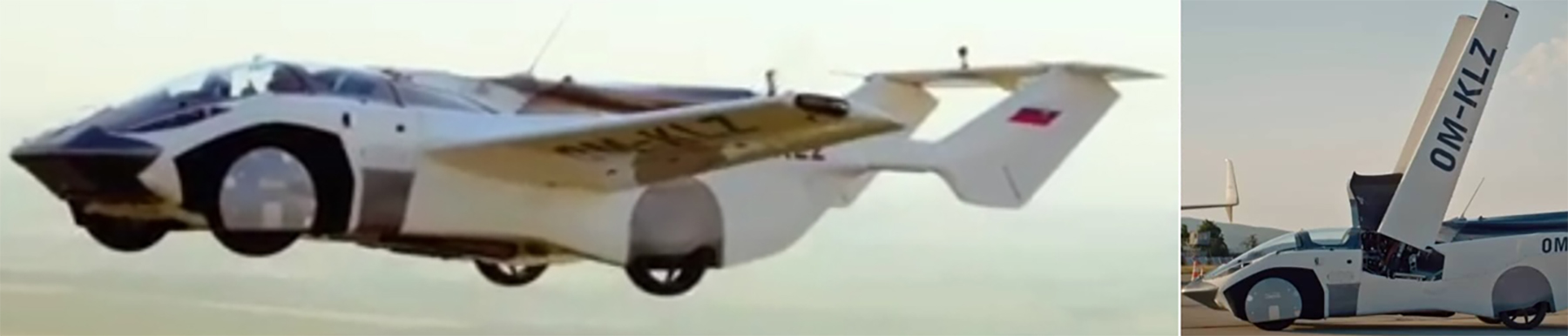
Named AirCar, a dual-mode car-aircraft vehicle moved closer to production, fulfilling a key development milestone by completing a 35-minute flight from Nitra to Bratislava in Slovakia. Its creator, Stefan Klein, says it can fly about 1,000-km, at a height of 8,200ft in October 2019.
After the flying car completed a manned flight, its designers hoped it could be a step towards making it the transport of the future. The AirCar is still in the prototype stage but hit a new milestone with its test flight.
Piloted by the company’s co-founder Stefan Klein, the car-aircraft took off from Nitra airport and landed 35 minutes later at Bratislava International Airport.
Equipped with retractable wings, a 160HP BMW engine with a fixed-propeller, and a ballistic parachute, the unusual aircraft can convert from an aircraft to a car in three minutes.
The AirCar has completed more than 40 hours of test flights, carried out steep 45 degree turns, been tested for stability and maneuverability, reached altitudes of 8,200 feet and zoomed through the air at a maximum cruising speed of 190 km/h.
“It’s great that the legislation allowed something like this to go from a virtual location to the real one. This is our goal, to create a real product that you will be able to buy one day,” says Klein.
But some experts think that the future is a long way. “We cannot say that in the coming years we will use flying cars here, but it is very good that this topic arises in Slovakia and there is a concrete result,” said Lubomir Palcak of Transport Research Institute in Zilina.
Klein Vision’s next step was to build pre-production model which it would have a 300HP engine and receive the EASA CS-23 aircraft certification with an M1 road permit. The company’s Prototype 2 was expected to have a cruise speed of 300 km/h and range of 1,000-km.
Klein Vision founder-cum-CEO Stefan Klein, after graduating from Slovak University of Technology in 1983, studied at Academy of Fine Arts and Design (AFAD) and at École des Beaux Arts et Design, Saint Étienne in 1993. He became head of department of AFAD’s transport and design responsible for innovative research projects in cooperation with top automotive brands, including Audi, Volkswagen and BMW. In 2005 he was appointed the visiting professor at Mackintosh School of Art in Glasgow.
He has personally clocked up over 1,200 hours of flying a powered aircraft, over 3,000 hours of flying a glider and hundreds of hours as a test pilot. His ability to combine design and innovation with commercial acumen has resulted in several successful projects such as the walking excavator for Menzi Muck Switzerland, Locomotive 772, Golf car for Melex Poland and a variety of electric scooters.
AeroMobil-I: Beginning of Klein flying cars dates back to 1989 when he finished his diploma thesis AeroMobil – ‘Personal Vision of Transport System’. His first type was named AeroMobil I. It consists of 4 lift surfaces with the canard type design. Wing span is 2.5 meter with total length of 5 meters. Concept being off any transformation cycle and is able to fully realize car and aircraft mode. The complex aerodynamics has been solved in the series of wind tunnel tests leading the overall concept to be fully operative however the practical driving test in the existing infrastructure has not led to optimal results due to the model’s overall width.
AeroMobil-II: Klein in 1996 unveiled a new concept, codenamed AM2. This was the first prototype where the car/aircraft modes were achieved via transformation. The key step in transformation process is the wing rotation around the main wing bolt. The new concept featured new innovations related to take-off and transformation. Both prototypes AM 1 and AM 2 are currently part of the exhibition in Aviation Museum in Košice. AirCar: However, his passion for flying led him to co-found with his brother and close friends Air Explore charter airline company. He left AeroMobil Company in 2016 to pursue his applied research and design in his own company Klein Vision, co-founded with his entrepreneur friend Anton Zajac in 2017. AirCar has been developed in Klein Vision since 2017 and represents a brand new, patented technology. 12 patents protect a new and unique way of transformation from aircraft to car and vice versa. He has devoted last 20 years converting his flying-car dream into reality. He flew prototype of AirCar that was successfully tested at Nitra airport.
Curtiss Autoplane: In 1917, Glenn Curtiss, who could be called ‘Father of the flying car’, unveiled the first attempt of such a vehicle. His aluminum autoplane sported three wings that spanned 40 feet. The car’s motor drove a four-bladed propeller at the rear of the car.
Flying cars are also a popular theme in fantasy and science fiction stories. Flying car or roadable aircraft is a type of vehicle which can function as both a personal road vehicle and an aircraft. As used here, this includes vehicles which drive as motorcycles when on the road. The term “flying car” is also sometimes used to include hovercars or small VTOL aircraft with no roadable capability such as some flying jeeps.
Many prototypes have been built since the early 20th century, using a variety of flight technologies. Most have been designed to take off and land conventionally using a runway, although VTOL projects are increasing. None has yet been built in more than a handful of numbers.
Their appearance is often predicted by futurologist and many concept designs have been promoted. But their failure to become a practical reality has led to the catchphrase “Where’s my flying car?” as a paradigm for failure of predicted technologies to appear.


 20

