
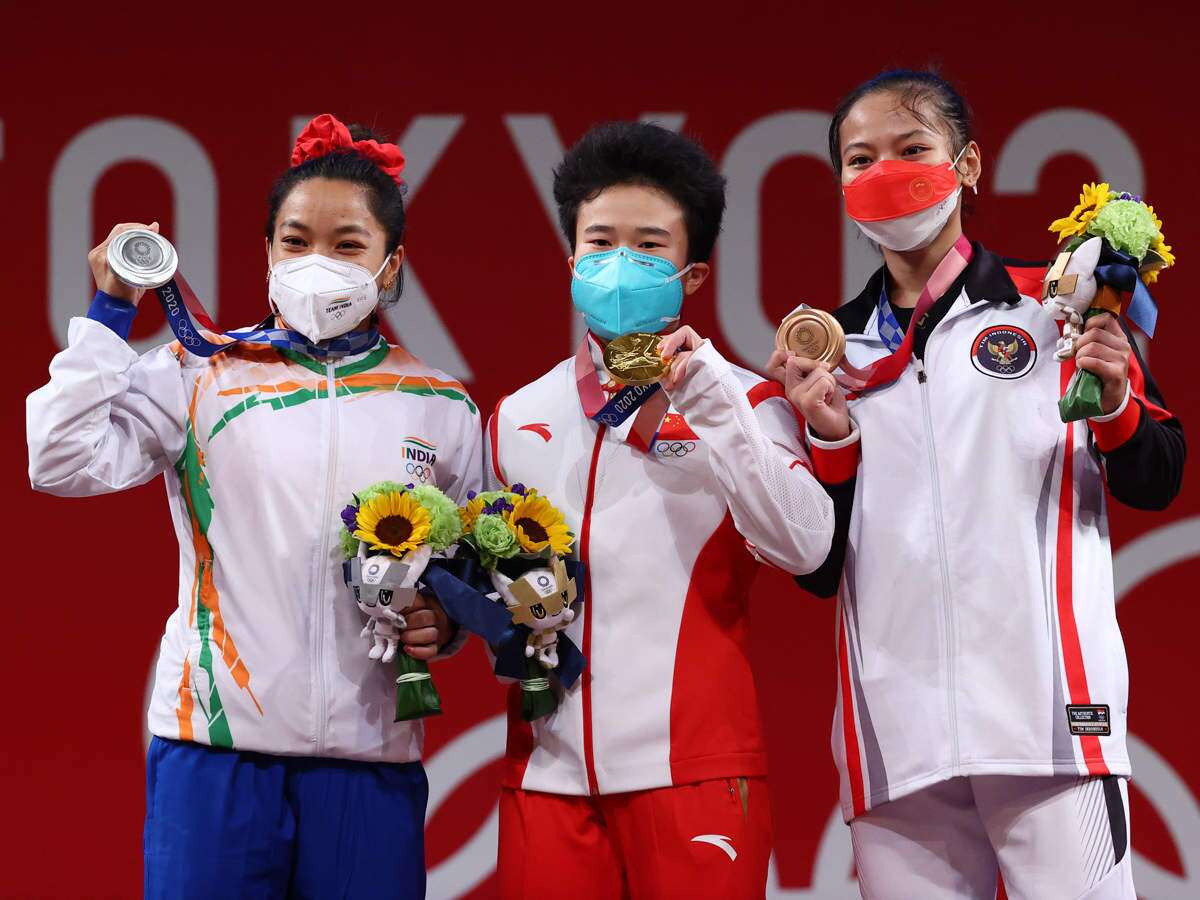
- Killer instinct attributed to medal
By A O News Service
ITANAGAR, July 24: Mirabai Saikom Chanu ended India’s 21-year wait for a weightlifting medal at the Olympics by clinching a silver medal in 49-kg category to open country’s account on Saturday.
The 26-year-old lifted a total of 202-kg (87kg+115kg) to better Karnam Malleswari’s bronze in 2000 Sydney Olympics. With this, she exorcised the ghosts of 2016 Games where she had failed to log a single legitimate lift. However, it was a disappointment for shooter Saurabh Chaudhary who could only finish 7th in the men’s 10-m air pistol final.
India is represented by a 127-memebr athlete team in Tokyo Olympics-2020, the largest contingent in Indian history, but Chanu made the nation proud to send a wave of happiness across the country, particularly among sports persons and sports lovers.
Union Law Minister Kiren Rijiju, who till recently was holding the charge of Youth and Sports Affairs, was the first to congratulate her for the feat and tweeted ‘Cheer4India’.
When one of India’s greatest moments in weightlifting was being hoisted into reality by the legendary Karnam Malleswari, at the Sydney Games in 2000, the state of Manipur was laying the ground for their own moment in the sun, albeit 21 years later. Barring the Beijing Games, the state has sent four different women weightlifters over five Olympics — a generational effort that culminated in Chanu’s monstrous 202-kg combined lift for the Tokyo Olmpics silver medal in 49-kg weightlifting category.
Two decades of consistently churning out weightlifters that are among the best in the world is Manipur’s reminder that the Olympics are not a once-in-four-years’ event, but a way of life.
A way of life that begins at a young age because of state’s unique way of organizing sport for young children through clubs. Former commissioner of youth affairs and sports for Manipur R K Nimai Singh tries to put into words this spirit of the land when he says: “The sport club culture has been a part of Manipur for centuries now. These clubs might not necessarily be dedicated to a single sport. These clubs aren’t associated with any state or national associations. They are only present because of the love of sport and an outlet of activity for young kids. For a Manipuri child, there is an option other than studying and that is to play.”
In Manipur, children are afforded the opportunity to decide what sport to play and what sport to pick. By the time they reach their teens, they may not be specialists in a particular sport, but a consistent level of physical activity leads to a far easier transition than most young athletes when moving professionally into a discipline.
As has been the case from the start of this century, a steady stream of women in weightlifting, heading to the farthest corners of globe to compete in the best tournaments on offer, continues to fuel the desire for what is a casual aspect of life, to become the centre-point of their existence.
But what happens when these kids start to grow up? “In the beginning of the 90’s, people started to realise that sport could be an earning profession,” says Singh. The opening of a Sports Authority of India centre in Imphal suddenly gave state’s weightlifters opportunity to go from spare parts of automobiles as weights, to real imported equipment. Former weightlifters were also part of the change as their careers transitioned from athletes to coaches.
Chanu’s story trudges along the same lines — a young 12-year-old child lifting heavy logs in her hometown of Nongpok Kakching, 44-km away from Imphal, who one day got noticed by Anita Chanu, a former international weightlifter and coach.
What Anita saw in younger Chanu was something most Manipuri experts in sport say is an intrinsic part of their cultural identity. “When I saw her lift for the first time, she had a killer instinct,” says Antia. And how is that killer instinct quantifiable?
“Explosive strength,” stresses Anita, who further explains by saying that people from the NE states of India are smaller in height but make up for it with a Maradona and Messi-esque low centre of gravity, a crucial aspect of why Manipur does so well in sport, be it weightlifting or football or boxing. That low centre of gravity saw Mirabai pick almost four times her body weight across five successful lifts in snatch and clean and jerk categories.
But it isn’t just height or body type or region that defines their abilities. The secret also lies in what is put into their bodies. Or rather, what has been put into their bodies for generations.
A few days ago, on the eve of Indian sportspeople leaving for the Tokyo Games, Prime Minister Narendra Modi asked an athlete’s uncle, ‘Kaunsi chakki ka atta khilate ho’. That same question must now be asked of Manipur’s athletes, except instead of wheat, it’s their consumption of rice that dictates success in a sport like weightlifting.
“Most athletes in lower weight categories come from Asian countries like China and South Korea. These countries are famous for sticky rice being a part of their diet. In Manipur, most people eat rice as a primary source of energy,” says Manipur Weightlifting Association secretary Sunil Elangbam.
This simplistic way of nutrition, one that has been a generational staple for them, is considered a prime source of fuel by experts for essential carbohydrates that end up aiding in physical training. These carbohydrates do the twin job of being easy to digest while pushing the body to recover faster after intense workouts.
It is this combination of the right kind of food, the lay of the land, and generations of women to look up to in weightlifting, that brewed itself into the perfect storm. A silver medal in Tokyo was borne out of a killer instinct that now adorns the state, just as its glory in the Olympics do. (with agency inputs)


 20

