
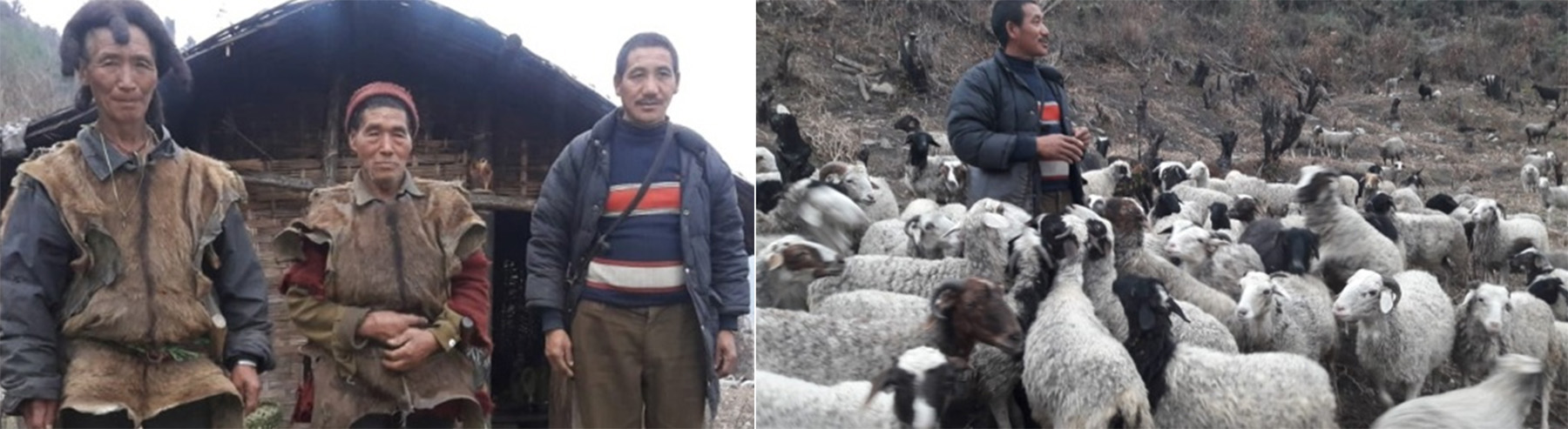
Lukezepas jn front of a hut in their grazing land and with livestock
By Pradeep Kumar
ITANAGAR, Sep 11: Lukezepas, a sub-tribe of Monpa, who live in few villages of West Kameng district and their population is around 2,000, who used to earn their livelihood by rearing ships in higher reaches of the Himalayas to earn their livelihood are quitting their age-old profession and opting for other profession for survival, said Dr Pema Thungon.
 Thungon, who was awarded Ph.D. degree to Pema on her thesis “Changing Socio-Economic life of the Lukezepas of Arunachal Pradesh” by environmental science department of Rajiv Gandhi University (RGU) under the supervision of Prof Nishamani Kar, said that many have left the practice and switched over to rice cultivation and supply of firewood.
Most of the ship rearers lead nomadic life as they live in small hurts in their grazing lands devoid of health and education facilities for which their children remain illiterate. Their products including ships are hardly on demand in the market for which they find it too difficult to meet their both ends, she said with remorse in an exclusive interview to this daily.
However, ship rearing could be sustainable if sheep breeding firms are set up by the Govt like the Yak firm at Dirang, to market their products and ships, the Lukezepas, who are living far away from the impacts of modernity, could survive with dignity, she said with conviction.
“I took around five years by shuttling from one village to another to interact with them and study their lifestyle as guided by Prof Kar to delve into every aspect of their life , who rear ships in higher reaches of the Himalayas to earn their livelihood,” said Dr Thungon, a resident of Shergaon.
Arunachal Pradesh is known for its unique demography with identified 26 major tribes and more than 100 sub-tribes. The Na or Nga, a sub-tribe of Tagin, having approximately 1,500 population, live in few villages in Taksing circle of Upper Subansiri district’s higher reaches is an example, Prof Kar said, adding such in-depth study by any scholar would bring to light many unknown facts of small tribal groups of the state.
Interestingly, the district data in Wikipedia include five major tribes, namely Monpa (which includes Dirang, Bhut, Lish, and Kalaktang Monpa), Miji (Sajolang), Sherdukpen, Aka (Hrusso), and Bugun (Khowa) and minority tribes, namely Takpa, Lishipa, Chugpa and Butpa. But there is no mention of any sub-tribe.
However, yak herders Brokpas, living in West Kameng and Tawang districts, are known for their traditional knowledge. It involves local-level decision making, healthcare, food security, education, natural resource management, and a host of their activities in their community. There are around 24,000 yaks in both districts. Brokpas are expert in traditional breeding and conservation of local breeds.
“With more and more young Brokpa herders opting for sedentary lifestylem their normadic way of life is under threat for which National Research Centre on Yak is trying to make their life better through various innovations and technologies to improve yak husbandry practice so as to conserve the “Ship of the Mountains” and its purveyors the Brokpas,” writes Sanjit Maiti, Vijay Paul, Sanchita Garai and S. M. Deb in their article: “Ship of the Mountains:Yak rearing by Brokpas in Arunachal Pradesh”.
Such initiative for Brokpas, which often appears in local media, is praise worthy. But why not such steps for the ship rearers, like Lukezepas, wondered Dr Thungon?


 20

