
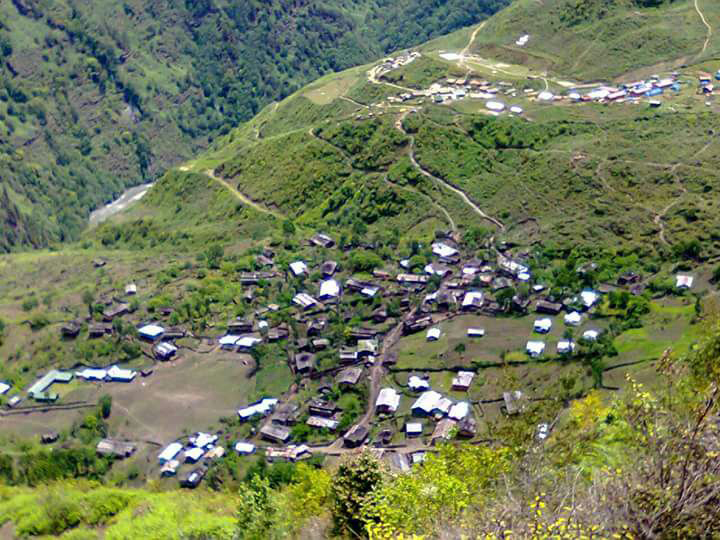
Taksing, 22-km from China
Beyond the Horizon
By Pradeep Kumar
Lot of water has flown down the mighty Brahmaputra River with the passage of time, but Indo-China border row remained stuck since demarcation of Sino-Tibet boundary by British negotiator Henry McMohan on a map during Simla convention in 1913–14, known as McHohan Line, which Beijing refuses to accept.
As Arunachal Pradesh shares highest 1,126-km of total 3,488-km Indo-China border or Line of Actual Control (LAC) and China oft-repeatedly claims this state as its territory (South Tibet) despite India’s firm rejection, the border de-population for lack of desired development is one of the visible negative impacts.
Thus, senior BJP MLA Lokam Tassar had raised “impact of de-population across Indo-Tibetan (China) border region of Kurung Kumey district and remedial measured to address the issue” in state assembly on August 28. Chief Minister Pema Khandu attributing it to lack of infrastructure, basic amenities and employment opportunities had said that the state Govt has initiated several measures through various central schemes to stop it.
In fact, MLA Tassar, whom I had named as ‘porter track MLA’ had raised this issue umpteen times in the assembly, and in 2014 had highlighted the plight of the locals as well as the security personnel, many of whom had lost their lives and even their mortal remains were not recovered in Kurung Kumey district.
Indo-Tibetan Border Police and the Army guard Indo-China border, but it is the border residents who have been serving as sentinel of the nation without any basic amenities available to them. Their mass migration to urban areas had alarmed those who matter and the Centre had announced Rs 5,000 crore to resettle them along the frontier of this sensitive state.
Taksing, last border village in Nacho circle of Upper Subansiri district, 22-km from China, which I have visited many times, is located very close to LAC much ahead of ITBP establishment, is a glittering proof as the brave residents greeting each other with ‘Jai Hind’ guard the frontier.
“We are left to fend for ourselves trapped in a valley without air, telecommunication connectivity where darkness rules after evening with cultivation and animal husbandry unsustainable and hardly any help from outside,” were the honest opinion of then GPM Norbu Chadar and GB Logu Tarba responding to queries from this editor on 08.01.15.
“Road should link this village at the earliest to solve most of our problems. The PDS dropping point is at Limeking from where we carry rice and other essential load by walking through porter tracks for three days. Half of the 50 kg rice is consumed on the way and as hardly anything grows here for the poor villagers have to depend on crops like potatoes etc., though not enough to sustain life, but somehow we survive”, the duo had emotionally outpoured their grievances before saying: “We are serving as sentinels of the eastern frontier but who cares for us?” Of course, the BRO has linked Taksing with district HQs Koloriang by road now.
“The announcement was based on feedbacks from central agencies while central and state BJP joint team after visiting border areas had facilitated the decision of the one-month old government. Besides the memorandum submitted to Prime Minister Narendra Modi at Pasighat during his election campaign, letters to PM by citizens, including by state Governor Lt. Gen (Retd) Nirbhay Sharma, opinion of then Union MoS (Home Affairs) Kiren Rijiju and fruitful meeting of then CM Nabam Tuki with the PM on June 27.06.14 stressing on development of border areas and connecting unconnected administrative centres expeditiously.
This I had highlighted in my Beyond the Horizon column on 30.06.14 in “Modi advancing wheel of time, China reversing? Take the bull by its horn, Mr PM!” But its outcome matched the proverb “empty vessel sounds much”.
But none took note of my suggestion: “In fact, there are Army cantonments, huge establishments with all basic and modern amenities for the serving personnel along the border. More could be set up with an expanded mandate to allow border inhabitants to avail all facilities to encourage the locals to not migrate.
“It would have multi-pronged benefits: Firstly, the mass migration from border to urban areas would halt as the locals have their traditional means of earning livelihood which would be strengthened by the Army support. The tribal people are entitled to free PDS items and medical facility which could be given by the state Govt through these cantonments.
“Secondly, the locals conversant with the tough border terrain would continue to guide the security forces with renewed vigour to avert incursions. Even these people would get employment in the cantonment itself in different capacities”.
How to accomplish this Herculean task on war footing is a million dollar question? India is building world’s highest 1.3-km railway bridge, part of Udhampur-Srinagar-Baramulla Railway Link project worth Rs 1,486 crore to soar 359 meters above the river bed, 19 meters higher than France’s Tarn River bridge to boost connectivity to Kashmir Valley. It would be a mammoth next-generation technological marvel. If so, border development or resettling border inhabitants should be an easy task for nation’s security.
Why CM Khandu not adopt this novel idea which also supports India’s former home secretary G K Pillai’s idea of evolving a border population strategy to check infiltration from China into Arunachal Pradesh?


 20
