
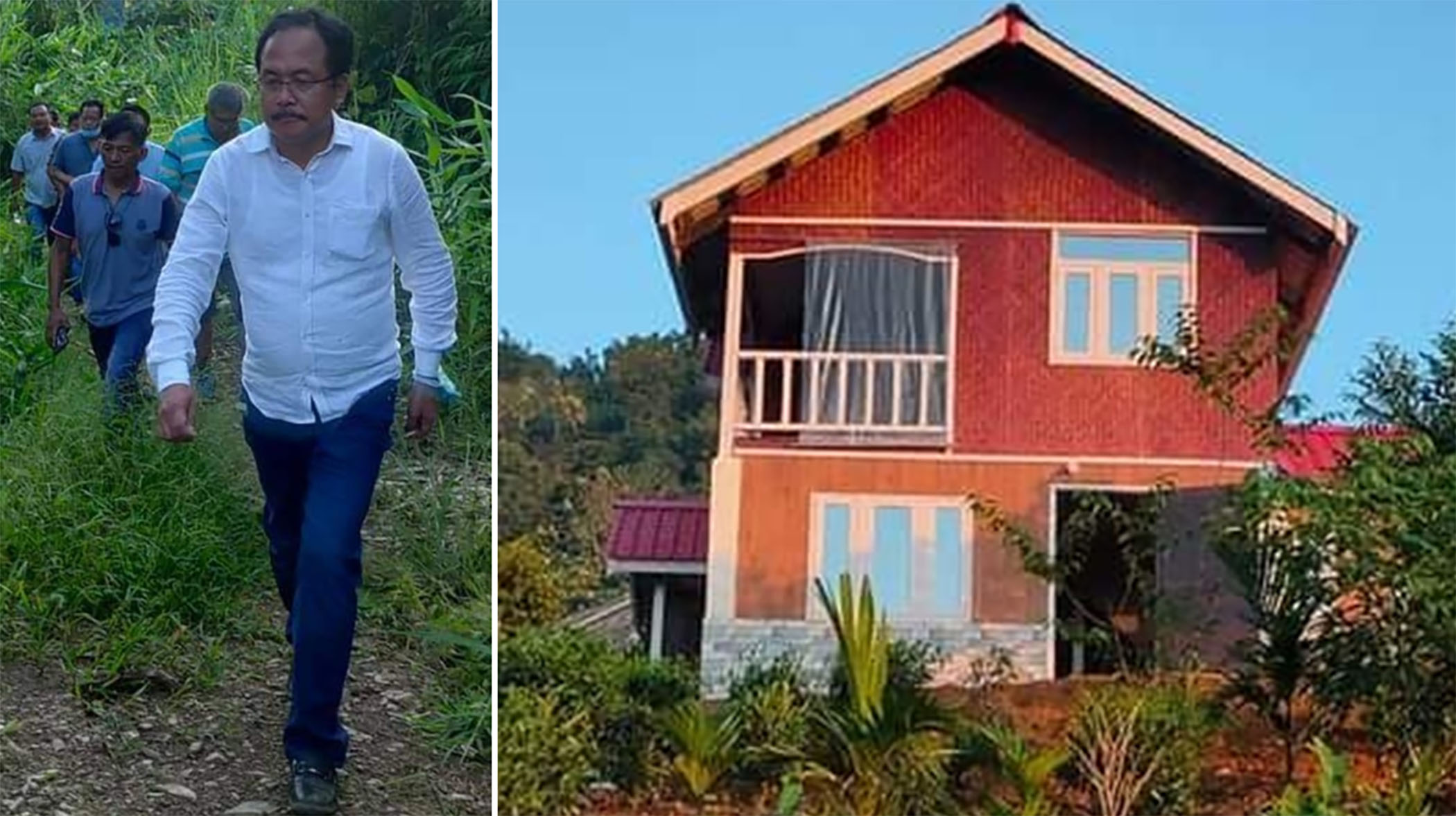
Road to Longsom village, houses built by villagers
By Pradeep Kumar
ITANAGAR, Oct 06: Kanubari lawmaker Gabriel D Wangsu of Longding district was the first in the state to initiate innovative way to offer various incentives to take up agri-horticulture cultivation to lure local people of his constituency leading hard life in higher riches of hills by adopting jhoom cultivation to come to lower area.
The incentives included road link, irrigation and marketing facilities. Thus a road was built towards jungle in Timongpong area in Longsom village two years ago.
Gabriel, adviser to agriculture & horticulture minister, visited Longsom village on Saturday last to his surprise found homes, huts and farms in the erstwhile jhumland.
Pleased with the development, he commented that none can deny the magic of road which connects unconnected area as visible in the above village where the residents are now living happily with hardship they used to undertake in the past.
Gabriel is right as the 2,407-km Trans-Arunachal Highway(TAH), a double lane highway linking existing 16 district HQs from Tawang along Indo-China border to Kanubari located at tri-junction of Assam-Nagalang-Arunachal border, conceived by former chief minister Dorjee Khandu and announced by then Prime Minister Dr Manmohan Singh at Itanagar on 31.01.08, would not only end the isolation syndrome but also help to tap vast untapped natural resources of the state in national interest.
In fact, in 10.06.19 edition of this daily, I had written: Gabriel’s unique ‘Mission of giving gainful livelihood’ continues. Trend setter Wangsu, Assam Sahitya Sabha’s Harihar Choudhury Award-1990 winner was an AIR announcer and multi-lingual sports commentator par excellence.
Strategically important Sela Tunnel is being built by the BRO to ensure all-weather connectivity to Tawang without travelling through the lone route passing through Sela Pass located at 13,800 ft as part of TAH, thanks to the initiative of present CM Pema Khandu.
“The journalist turned politician, who is the only state lawmaker to translate former President Dr A P J Abdul Kamal’s mantra to provide all facilities to hilly people by relocating them to lower reaches, said that his efforts to provide means of gainful livelihood to his innocent people continues.
In fact, he has achieved success by convincing his people living in higher reaches but in isolated locations without any facility. The ‘Mission to provide gainful means of livelihood continues as Kanubari assembly constituency has over 20,000 population, who faces problems of peculiar nature which could be solved through innovative methods alone.
The multifaceted lawmaker has given a new definition to development process in remote hilly areas through his innovative methods as highlighted in ‘Gabriel turns PURA into a reality’, in 08.01.18 edition of this daily.
Gabriel had inaugurated new Wunli-Rzu, Pamting-Rzu and Tingzen-Rzu villages, where about one lakh coffee saplings were raised in a nursery by him for the villagers. He has been continuing his mission to lure people living in higher reaches to come down to foothill areas by providing basic amenities and sources to earn livelihood. Toeing Provision of Urban Amenities to Rural Areas (PURA), an idea conceived by former president Dr A P J Abdul Kalam, he envisaged as a self-sustainable and viable model of service delivery to be managed through an implementation framework between different stakeholders – local people, public authorities and private sector as a strategy for rural development in India.
Huge potato production in remote Chatong village located along Tissa River under his assembly constituency had raised high hopes among the villagers to encash state’s huge agro-horticulture potentials. Lack of market linkage is the greatest hurdle for the farmers to sell their products including large qualities of cabbages though all products are organic with the villagers making vermicompost to meet requirement of manures, they said.
The innovative developments included about 25-km motorable PMSY road to link the village to Longsom zero point to ensure market linkage to Longding; constant water supply for cultivation to 242 Chanu farmers; strong wire rope suspension bridge over Tiiru River linking Ranglua Russa village having 249 inhabitants.
Longding boasts of vast visible and invisible natural resources, like paan (green gold), tea, rubber (white gold), huge oil reserves trapped (hidden gold) in coal deposits according to former ONGC CMD Chdamani Ratnam, who from 1990 onward had repeatedly claimed that India had a treasure trove of shale oil in Arunachal Pradesh and other parts of the NE which could produce 140 million tonnes per year to sustain India’s needs for 100 years, Namchik-Namphuk coal mine (black gold) with estimated 90 million tonunes and three perennial rivers offering hydropower potential (liquid gold).
Thus, I had spelt out the unique selling propositions (USPs) to Wanchos to improve their local economy in an article – Khaike pan Banaras wala, what are your USPs Longdigians? –, published in The Longding, a Gabriel edited souvenir, to mark the birth of state’s 17th district in 2012.
Noctes known for their rich cultural mosaic and rich traditions perform unique ritual (Pohornyu khaam siet) to install new log drum (khaam), considered world’s largest and longest musical instrument, symbolizing the spirit of Arunachal Pradesh. Huge tourism scope of Longding will surface, if Wancho or Nocte Festival could be introduced like Hornbill Festival of Nagaland.


 20
