
Beyond the Horizon
By Pradeep Kumar
‘Dog tail policy’
It is well known that none could straighten a dog’s tail in the world as it works on ‘lever system’. It snaps back if straighten and never stays put even if tied down for longer time. If a dog’s curled tail remains so till its death, how prudent it would be to expect China to change its ‘dog tail’ policy for India?
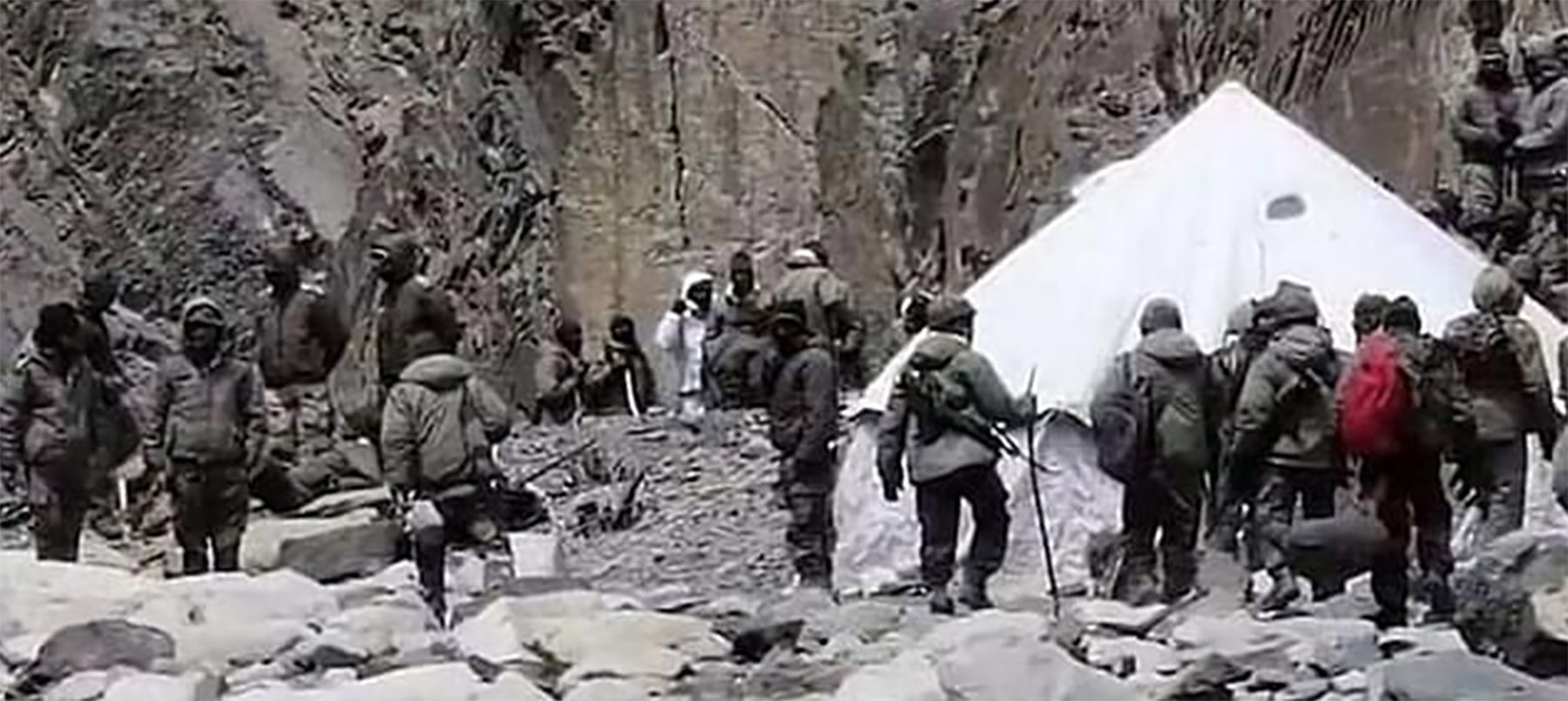
A day after news of China’s failed incursion into Tawang sector of Arunachal Pradesh broke, China resorted to its ‘dog-tail policy’ towards India by leaking on social media new image of clashes in the Galwan Valley.
A day after the news of China’s failed incursion bid in the Tawang made national headlines in India, new pictures of the Galwan Valley clashes, which allegedly show Indian soldiers in Chinese captivity, have emerged on social media platforms.
Last week, Indian and Chinese patrols came face-to-face in Tawang sector, which led to some jostling and a minor face-off to send a wrong message across the world.
This attitude is nothing but ‘dog tail’ policy of People’s Republic of China (PRC) to lay claim over Arunachal Pradesh, particularly Tawang Monastery, as its territory.
As I wrote in 29.07.21 edition of this daily – China claims Arunachal by its ‘dog tail’ policy? – Beijing needs to learn India history – “Interestingly, Tawang Monastery was founded by Merak Lama Lodre Gyatso in 1681 to honour the wishes of 5th Dalai Lama Ngawang Lobsang Gyatso while 6th Dalai Lama Tsangyang Gyatso was born in Tawang.
The 1914 Simla Accord demarcated the McMahon Line as new boundary between British India and Tibet. Tibet by this treaty relinquished several hundred square miles of its territory, including Tawang to the British, but it was not recognized by China (reason being only known to them).
The British undertook number of ‘forward policy’ measures after the outbreak of war with Japan in 1941 to tighten its hold over North East Frontier Agency (NEFA) area, which later became Arunachal Pradesh. The situation changed after India’s independence in 1947 but the PRC in 1950 seceded Tibet which lost its de facto independence.
But, Chinese Army had aggressed into Indian Territory on 20.10.1962 through Tawang, which was under Chinese control till the end of the war (known as Chinese Aggression) on 21.11.962. China voluntarily withdrew its troops and Tawang again came under Indian administration
Why China still continues to claim Arunachal Pradesh, including Tawang as its territory is intriguing for none one speaks in Chinese language (Mandarin) in any part of Arunachal.
In fact, China became People’s Republic of China (PRC) on 01.10.1949 while Bharat became Republic of India on 15.08.1947, to become the second most populous democracy of the world. Modern humans had arrived on Indian subcontinent from Africa no later than 55,000 years ago. The basin of 9,000 years ago evolving gradually into the Indus Valley Civilization of third millennium BCE is glittering example of birth and growth of Hindustan, which gave birth to four religions – Hinduism, Buddhism, Jainism and Sikhism.
By 1200 BCE, Sanskrit, an Indo-European language, had diffused into India from the northwest, unfolding as the language of Rigveda, and recording the dawning of Hinduism in India.
Thus, the rich ethnicity and uncounted languages made India the symbol of ‘Unity in diversity’. India adopted federal republic since 1950 to be governed by democratic parliamentary system. Vital to India’s self-image as an independent nation is its Constitution, which put in place a secular and democratic republic. It has remained a democracy with civil liberties, an active Supreme Court, and a largely independent press. India’s sustained democratic freedoms are unique among world’s newer nations.
India is a federal union comprising 28 states and 8 UTs which are governed by democratically elected Govts. However, North-East Frontier Agency (NEFA), originally known as North-East Frontier Tracts, one of the political divisions of British India and later of Republic of India till 20.01.1972, when it became Union Territory rechristened as Arunachal Pradesh. Its capital was Shillong till 1974 before shifted to Naharlagaun, but it gained full-fledged statehood on 20.02.1987.
However, NEFA’s Pradesh Council was converted to a Provincial Legislative Assembly on 15.08.1975, when Arunachal Pradesh graduated to parliamentary democracy with installation of P K Thungon-led Janata Party Govt. on 14.03.1978 after first general election to 30-member house of the UT conducted on 25.02.78. While Arunachal Pradesh got a seat in Rajya Sabha in 1972, elections to two Lok Sabha seats are conducted since 1977 as per state’s political records.
Is Beijing not aware of India’s political history? If yes, claiming Arunachal Pradesh or any part of it would be foolishness.


 20
