
Beyond the Horizon
By Pradeep Kumar
Climate changes impacts on natural and human systems have been reported widely, including changing precipitation and snow melt altering water resources, hydro(geo)logical behaviour leading to floods and droughts. Climate change is also likely to impact water quality, including increased sediment loads during floods and increased contaminant concentration during the dry season). Temperature increases are likely to increase water demand, particularly in irrigation due to increased evapotranspiration.
The immediate and direct impacts of climate change are going to be experienced with rising water crisis. Water organisations managing societal and ecological needs for water are likely to experience the impact the most. Thus, climate change adaptation for water management and identify the key knowledge gaps for successful implementation of adaptation strategies, particularly by Govt agencies, private companies, municipal corporations, NGOs, river basin management organisations or any agency that administers or supplies water to the users, are need of the hour.
Fresh water is scarce in many parts of the world and available at great expense now. Communities near the ocean can desalinate sea water for this purpose, but doing so requires a large amount of energy. But those away from the coast are left with only option to condense atmospheric humidity through cooling, either through processes that similarly require high energy input or by using “passive” technologies that exploit the temperature swing between day and night. However, with current passive technologies, such as dew-collecting foils, water can be extracted only at night. This is because the sun heats the foils during the day, which makes condensation impossible.
New technology: Well aware of this phenomenon, Switzerland is already getting ready to overcome water crisis as proved by an experiment in its capital Zürich.
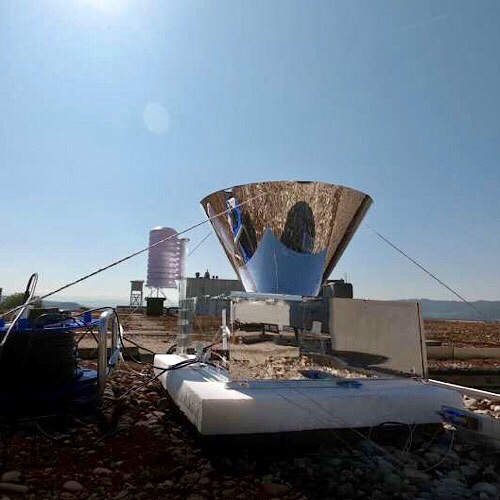
Researchers at ETH Zurich have now developed a technology for the first time that allows them to harvest water round the clock with no energy input, even under the blazing sun. The new device essentially consists of a specially coated glass pane, which both reflects solar radiation and also radiates away its own heat through the atmosphere to the outer space. It thus cools itself down to as much as 15°C below the ambient temperature. On the underside of this pane, water vapour from the air condenses into water. The process is the same as can be observed on poorly insulated windows in winter.
The scientific approach to coat the glass with specifically designed polymer and silver layers cause the pane to emit infrared radiation at a specific wavelength window to the outer space, with neither absorps by the atmosphere nor reflects back to the pane. Another key element of the device is a novel cone-shaped radiation shield. It largely deflects heat radiation from the atmosphere and shields the pane from incoming solar radiation, while allowing the device to radiate the aforementioned heat outward and thus to self-cool, fully passively.
As tests of the new device under real-world conditions on the roof of an ETH building in Zurich showed, the new technology can produce at least twice as much water per area per day as the best current passive technologies based on foils: the small pilot system with a pane diameter of 10 cm delivered 4.6 mm of water per day under real-world conditions.
Larger devices with larger panes would produce more water accordingly. The scientists were able to show that, under ideal conditions, they could harvest up to 0.53 decilitres (approximately 1.8 fluid ounces) of water per square metre of pane surface per hour. “This is close to the theoretical maximum value of 0.6 decilitres (2.03 ounces) per hour, which is physically impossible to exceed,” says Iwan Hächler, one of the doctorate scholars under ETH Zurich Prof (thermodynamics) Dimos Poulikakos.
Other technologies usually require the condensed water to be wiped from a surface, which requires energy. Without this step, a significant portion of the condensed water would cling to the surface and remain unusable while hindering further condensation.
The ETH Zurich researchers applied a novel superhydrophobic (extremely water-repellent) coating to underside of the pane in their water condenser, which caused condensed water to bead up and run or jump off on its own accord. “In contrast to other technologies, ours can really function without any additional energy, which is a key advantage,” Hächler said.
The researchers’ goal was to develop a technology for countries with water scarcity and, in particular, for developing and emerging countries. Now, they say, other scientists have the opportunity to further develop this technology or combine it with other methods, such as water desalination, to increase their yield.
The production of the coated panes is relatively simple and building water condensers that are larger than the current pilot system ought to be possible. Similar to the way solar cells feature several modules set up next to each other, several water condensers could also be positioned side by side to piece together a large-scale system. (Courtesy: Brighter Side of News)


 20

