
By Pradeep Kumar
ITANAGAR, Oct 23: Many Arunachalee farmers have already achieved the goal of doubling farmers’ income while few have tripled their income from onion cultivation in Namsing and Riga circles much before the target year of 2022-23, Pasighat-based College of Horticulture and Forestry (CHF) associate professor (vegetable science) Dr. Chandra Deo said.
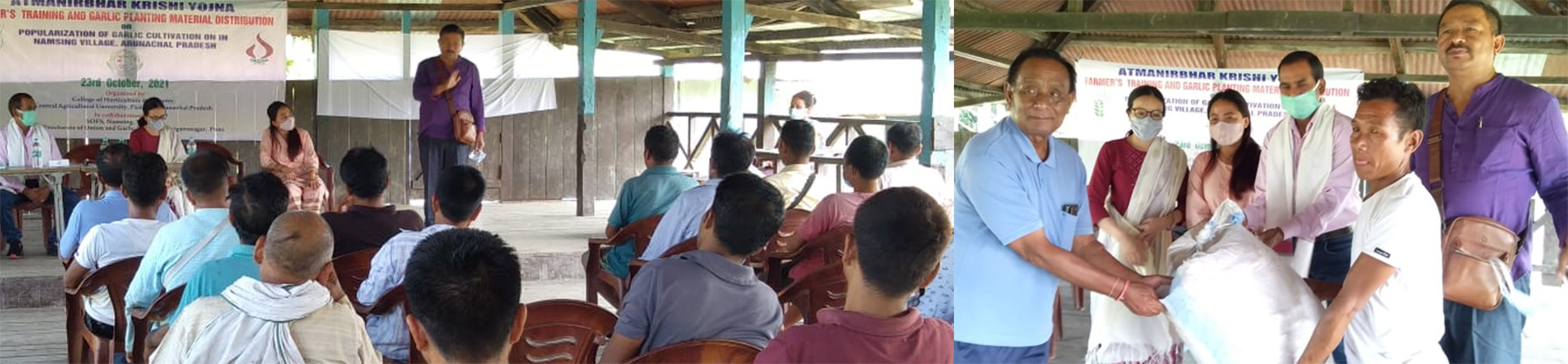
After conducting garlic cultivation training under Atmanirbhar Krishi Yojana in collaboration with Namsing Orgamic Farmers Society for 40 farmers at Namsing in East Siang district on Friday, he told this daily over telephone that garlic cultivation would serve as new income booster for the farmers showing keen interest.

Hema Modi
Explaining as to how the farmers doubled their income, Dr Deo reminded that “you had interviewed progressive farmers Hema Taki (of Rune village) and Niyi Modi (Rayeng) and Rajen Kalita (Sikha Bamin) and written that Taki had earned Rs 60,000 (2018-19) and Modi Rs 17,000 against an expenditure of Rs 3,500 with free seeds and technical support of CHF: in your daily on July 19 last – Onion heralds new rural economy.
“Both almost tripled their income to encourage nearby villagers to take up onion and garlic cultivation while initiative of local resident, a retired IAF captain Pangin, increased farmers’ number sharply to 40 with ‘dil mage more’ plea. Though onion cultivation was launched in 2018 involving 20 local farmers to boost rural economy, but the cultivation would slowly but steadily widen to other area, he disclosed.
Besides the technical training, the farmers were also given garlic seeds free of cost, Dr Deo, who was accompanied with another faculty, said that an order for 50-kg to 100-kg garlic seeds has been placed with Rajastan for distributing free among the farmers. Another bath of 40 to 90 farmers would also be given training soon in the college campus, he added.
Garlic (Allium sativum), a plant in Allium (onion) family, is grows in many parts of the world and a popular ingredient in cooking due to its strong smell and delicious taste besides its use in every Indian home for making chutneys, pickles and eating raw. The name garlic comes from Welsh word garlleg, which is transformed into English word garlic. Wherever it came from, there can be no doubt that garlic has captured the interest of gardeners and cooks alike. It is easily cultivated and, due to its growing reputation in health matters, will be of increased importance in gardens.
Health benefits: The general composition of garlic is 58% water, 33% carbohydrates, 6% protein, 2% dietary fiber and 1% fat. Besides distinctive taste, garlic has numerous health benefits because of its medicinal properties. Garlic supplements could combat sickness, including common cold and flu; reduces blood pressure; improves cholesterol level to lower heart attacks & strokes, world’s biggest killers; prevents Alzheimer’s & dementia diseases; act as performance enhancer of athletes as was given to Olympic athletes in ancient Greece; sulfur compounds help detoxify heavy metals in the body; minimize bone loss by increasing estrogen in females & osteoarthritis patients, sulfur compounds enter the body through digestive tract and travel all over the body to exert its potent biological effects including diallyl disulfide and s-allyl cysteine and last but not the least help to live longer by improving immune system.
Garlic was mostly used for its health and medicinal properties throughout ancient history and its use was well documented by many major civilizations, including the Egyptians, Babylonians, Greeks, Romans and Chinese. Garlic is probably native to Central Asia but has long been naturalized in southern Europe and throughout the world.
Total world production of garlic is more than 26.6 million tones with China alone contributing 80%. India is the second largest producer and accounts for almost 5% world production. It is mostly cultivated in Tamil Nadu, Andhra Pradesh, Uttar Pradesh & Gujarat, AGRI Farming reported in April 2021.
Prime Minister Naremdra Modi had given a clarion call for all our efforts to double farmers’ income by year 2022-23 with 2015-16 as base year with an annual growth rate of 10.4%.
Production: Rajasthan is one of the states in India leading in garlic production. Out of state’s 12 districts, Kota zone, including Baran district is the leading zone with highest area under cultivation while Baran, Chittor and Bundi are major garlic producing clusters. The net area under garlic in Rajasthan had increased from 69,000 hectare to 1.32 lakh hectare in 2018 to double production from 3.77 lakh MT to 7.7 lakh MT with 5,156-kg yield per hectare and in 2018-19 per hectare yield rose to 6,053-kg.
Garlic is also cultivated in all eight NE states but not commercially for which Pune-based ICAR-Directorate of Onion and Garlic Research has been promoting its large scale cultivation; Dr Deo said adding commercial production would end dependence of the state on outside supply as has been proved by onion cultivators.


 20
