
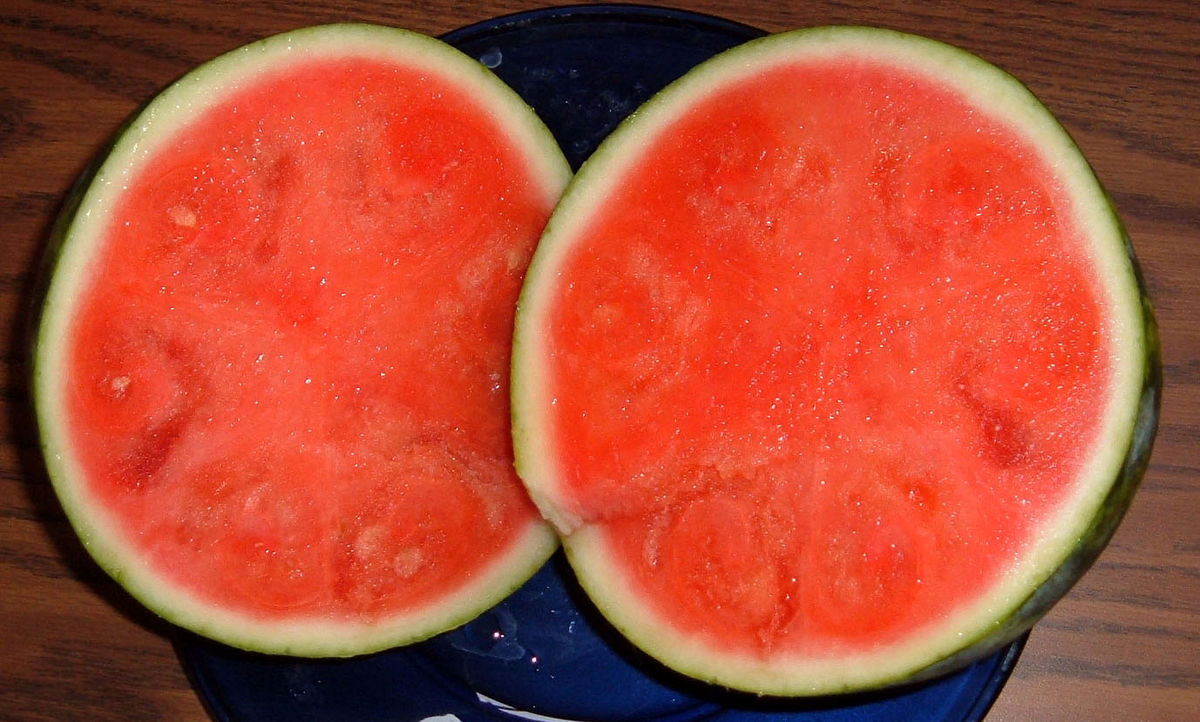
India’s cultivated watermelon since 7th century
Beyond the Horizon
By Pradeep Kumar
After successful cultivation of onion and garlic, Pasighat-based College of Horticulture and Forestry (CHF) now targets watermelon, a sweet and refreshing low calorie summer snack, that gives hydration and essential nutrients, including vitamins, minerals and antioxidants, said its associate professor (vegetable science) Dr. Chandra Deo.
“Watermelon cultivation needs dry sandy soil like Ganga River basin where thousands of farmers earn their livelihood. The farmers cultivate the fruit after water level of the river recedes”, Dr Deo told this daily on Sunday, adding East Siang district located on the bank of Siang River fulfills all requisites for its cultivation.
Same is the case in parts of Bihar, West Bengal and Odisha; he said citing successful examples of experiments conducted during spring-summer 2019-20 along Budi Gantak River bed by Dr. Rajendra Prasad Central Agricultural University, Pusa and Brahmani River bank in Dhenkanal district of Odisha in 2012-13 by Orissa University of Agriculture and Technology (OUAT), Bhubaneswar.
Mostly seeded watermelons procured from outside are sold across Arunachal Pradesh, which has prompted the CHF to encourage around 100 farmers to take up watermelon cultivation in January next by procuring around 50-kg high yielding seedless variety either from Dr. Rajendra Prasad Central Agricultural University, Pusa or Indian Institute of Horticultural Research in Bangalore, he informed. These seedless watermelons are sterile hybrid invented over 50 years ago which grow in 85-100 days and hugely popular in the United States, he said.
Watermelons, along with cantaloupe, honeydew, and cucumber, belong to Cucurbitaceae family and are of five types – seeded, seedless, mini, yellow and orange. Watermelon is consumed as diet, juice, salad, smoothies and its roasted seeds.
Health benefits: Watermelon with its natural sugars, nutritional & fiber content and around 90% water help in summer to get dehydrated; contains antioxidants (including vitamin C) which help remove free radicals or reactive species from the body generated by smoking, air pollution, stress and other environmental pressures; prevents cancer, asthma, heart diseases, improves brain and nervous functions; antioxidants L-citrulline and L-arginine improve function of arteries to reduce blood pressure; phytosterols reduce bad cholesterol to prevent high blood pressure and cardiovascular disease; prevent constipation & help easy digestion; check allergic reaction, good diet for diabetic people for natural sugar content
Sweet watermelon was first described by Carl Linnaeus in 1753 and named it as Cucurbita citrullus, renamed as genus Citrullus in 1836 while German botanist Heinrich Adolf Schradar named it as Citrullus vulgaris. It has many varieties – bitter wooly melon [Citrullus lanatus (Thunb)], Matsum & Nakai var. lanatus), citron melons (Citrullus lanatus var. citroide and var. vulgaris.
This taxonomy originated with erroneous synonymization of wooly melon (Citrullus lanatus) with sweet watermelon (Citrullus vulgaris) by L H Bailey in 1930. A proposal to conserve name, Citrullus lanatus (Thunb) Matsum & Nakai, was accepted by nomenclature committee and confirmed at International Botanical Congress in 2017.
The wild species closest to Citrullus lanatus are tendril-less melon Citrullus eecirrhosus Cogn from South African arid regions and Citrullus mucosospermus (Fursa) from West Africa. Sudan watermelons are close to domesticated watermelons. Bitter wooly melon was formally described and named by Carl Peter Thunberg in 1794 as Momordica lanata and renamed as genus Citrullus in 1916 by Japanese botanists Jinzo Matsumura and Takenoshin Nakai.
Evidence of cultivation of both C. lanatus and C. colocynthis in the Nile Valley has been found from 2nd millennium BC onward and seeds of both species from 12th Dynasty sites and in tomb of Pharoah Tutankhamun. Watermelon seeds were also found in Dead Sea region of ancient settlements of Bab edh-Dhra and Tel Arad.
Still Life with watermelons, pineapple & other fruits-1804
A number of 5000-year-old wild watermelon seeds (C. lanatus) were discovered at Uan Muhuggiag, a prehistoric archaeological site located in southwestern Libya.
In 7th century, watermelons were cultivated in India and by 10th century reached China, now world’s single largest producer. The Moors introduced this fruit in Iberian Peninsula and evidence found of its cultivation in Cordoba in 961 and in Seville in 1158. It spread northwards through southern Europe and begun appearing in European herbals by 1600 and widely planted in Europe in 17th century as a minor garden crop.
European colonists and slaves from Africa introduced watermelon to the new world. Spanish settlers were growing it in Florida in 1576, in Massachusetts by 1629 and cultivated in Peru, Brazil & Panama by 1650 so also native Americans in Mississippi Valley & Florida. Explorers like Captain James Cook introduced the fruit in Hawaii and other pacific islands. Free Black people were commonly growing it during civil war era of the United States as a symbol for abolition of slavery.
Seedless watermelons were initially developed in 1939 by Japanese scientists who were able to create seedless triploid hybrids which remained rare initially because they did not have sufficient disease resistance. The variety became more popular in 21st century rising to nearly 85% of total watermelon sales in the United States in 2014.


 20

