
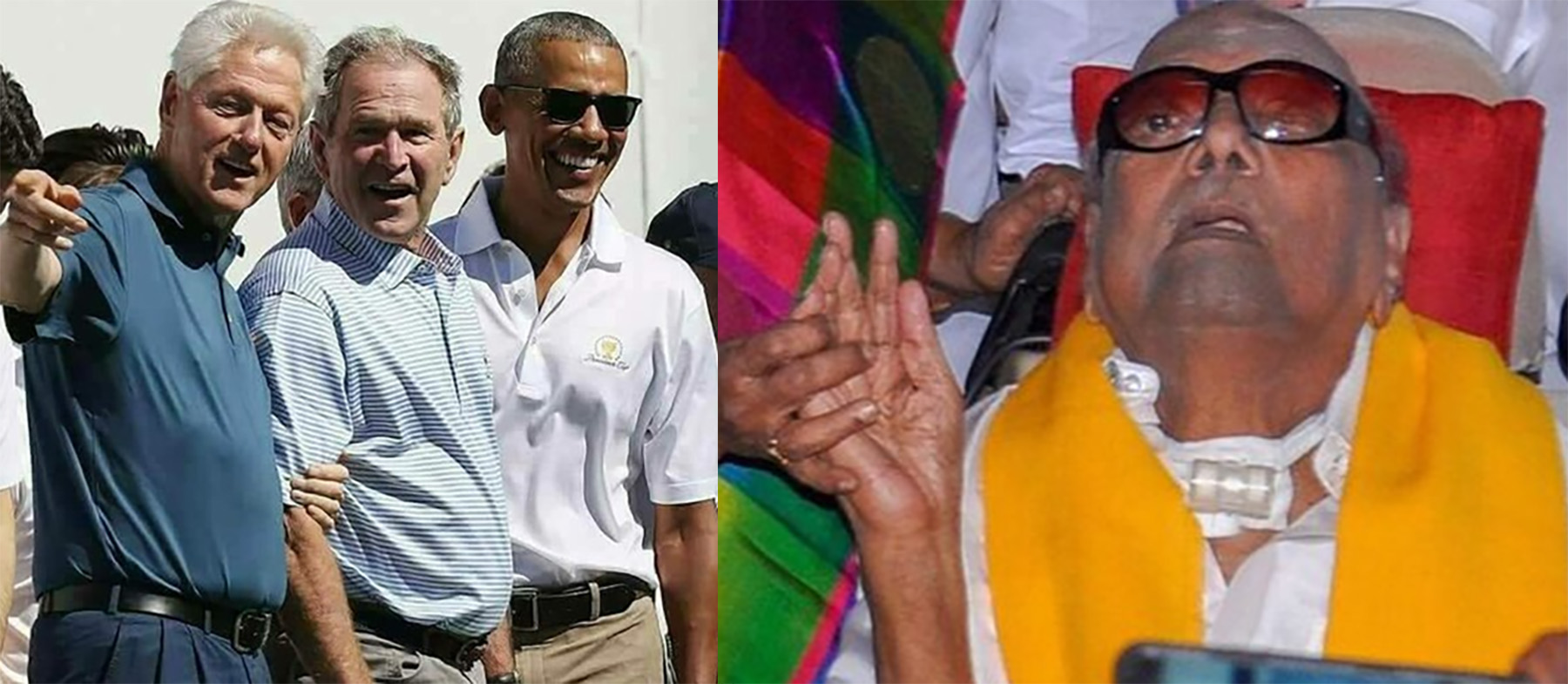
Former American presidents Tamil Nadu ex-CM Karunanidhi
Beyond the Horizon
By Pradeep Kumar
The term democracy first appeared in ancient Greek political and philosophical thought in city-state of Athens during classical antiquity. The word comes from dêmos (common) people and krátos (force/might).
Under Cleisthenes, what is generally held as first example of democracy in 508–507 BC was set up in Athens. Cleisthenes is referred to as father of “Athenian democracy”.
Athenian democracy took the form of a direct democracy, but Roman Republic contributed significantly to many aspects of democracy. India’s Vaishali, capital of Vajjian Confederacy (Vrijji Mahajanapada), was also considered one of the first examples of a republic around 6th century BCE.
Democracy is a form of Govt in which the people have the authority to deliberate and decide legislation (direct democracy), or to choose governing officials to do so (representative democracy). The notion evolved over time considerably while original form was a direct democracy and most common form today is representative democracy.
The term appeared in 5th century BC to denote the political systems then existing in Greek city-state, notably Classical Athens & Roman Republic, to mean “rule of the people”, in contrast to aristocracy (rule of an elite). Western democracy, which existed in antiquity, is generally considered to have originated in city-states. Modern democracies through movements of suffrage appeared in 19th and 20th centuries.
Karl Popper defined democracy contrast either autocracy or absolute monarchy or oligarchy inherited from ancient Greek philosophy.
Iroquois nation in America formed between 1450 and 1600 AD was also a form of democratic society before they came in contact with the Europeans. This indicates that forms of democracy may have been invented in other societies around the world.
20th-century transitions to liberal democracy came as successive “waves of democracy”, resulting in wars, revolutions, decolonization and religious and economic circumstances. Global waves of “democratic regression” reversing democratization occurred in 1920s, 1930s, 1960s and 1970s and 2010s.
The US: Paleo-Indian migrated from Siberia to North American mainland at least 12,000 years ago, and European colonization began in 16th century. The United States emerged from 13 British colonies along the East Coast. Disputes with Great Britain over taxation and political representation led to American Revolution War (1775–1783), facilitated the US as a sovereign nation on July 4, 1776. The U.S. expanded in late 18th century, but dissolution of Soviet Union in 1991 ended the Cold War, leaving the U.S, as the world’s sole superpower.
India: Modern human arrived on Indian subcontinent from Africa no later than 55,000 years ago. However, the British Crown rule began in 1858. But Indian independence movement calling for self-rule began with Sepoy Mutiny in 1857, known as First War of Independence, which continues till 1947. British Empire partitioned India into two independent dominions, a Hindu-majority India and a Muslim-majority Pakistan amid large-scale loss of life and an unprecedented migration.
Former American President Abraham Lincoln once had described democracy as “….that government of the people, by the people, for the people, shall not perish from the earth”.
The United States of America toeing its edifice is considered as best democracy while India as largest democracy in the world. Is it not intriguing?
Proof: After serving as President of the United States, Bill Clinton (42nd, 1993-01), George Bush (43rd, 2001-2009) and Barack Obama (44th, 2009-17) returned to their normal life style after retirement (in pic) to prove the spirit of democracy.
But, India has put democracy in question by turning it into ‘Demeancracy’ as its power-hungry politicians have changed Lincoln’s definition to “off the people, buy the people, far the people”, to serve their vested interests.
Criminalization of Indian politics with money and muscle powers has been its true identity that threatens the root of this time-tested system. The so-called politicians hold the people to ransom for the sake of sticking to power.
Elected Indian politicians enjoy unbelievable perks and perquisites paid to them form tax money of the masses the governments earn.
Former Tamil Nadu chief minister Karunanidhi, 94-year-old, is a glittering example. He can’t stand, speak, take decision and even recognize his family. But, he still continues to occupy seat of Thiruvarur MLA instead of vacating it.
43% MPs with criminal record: Records are enough to prove criminalization of politics as “Of 539 winning candidates as many as 233 MPs or 43% have criminal charges. The BJP has 116 MPs (39%) followed by 29 Congress MPs (57%), 13 JDU (81%), 10 DMK (43%) and nine TMC (41%), a 26% increase as compared to 2014, analysed by Association of Democratic Reforms (ADR), as reported by The Hindu on May 26, 2019 quoting PTI.
The need of the hour is to reinvent democracy: “The representative legitimacy of the representatives of this democracy is in doubt. Democracy is facing many challenges; the worst is nothing could be more tragic than the masses losing faith in their representatives. There is of course a way out for the democracy to reinvent itself to win the confidence of the masses,” former Secretary-General of Lok Sabha Dr. Subhash C. Kashyap had said in an exclusive interview to this editor.
Dr Kashyap, who has authored 100 books in English and Hindi and associated with the Parliament for over 37 years right from Nehru to Mavalankar time, had said: “The need of the hour is fundamental systemic changes, not from democratic form to presidential form, but to regain the faith make the masses the real masters.”
“The British parliamentary system has 12 main characteristics and none is applied to Indian democracy. The first fallacy is that the vulnerable founding fathers of our system accepted it and it continues till date. This means we defied and defaced the western concept of democracy.
“We don’t have a sovereign democratic republic in real sense. The rulers still are masters and ruled are subjects, where as in a sovereign democratic republic, the people are real masters.
“The people rule over them through their representatives who are not true in India as those elected are not their true representatives,” he argued, adding “The slaves like what their masters do, eat and wear, after independence the middle class Indians are taking pride in their British style living and education instead of in mother tongue,” he had said to drive home his point.
Aya Ram Gaya Ram practice in Indian democracy is its greatest drawback.
The Anti-Defection Law: The Tenth Schedule – popularly known as the Anti-Defection Act – was included in the Constitution in 1985 by the Rajiv Gandhi ministry and sets the provisions for disqualification of elected members on the grounds of defection to another political party.
The law was added via 52nd Amendment Act, 1985, soon after Rajiv Govt came to power with a thumping majority in the wake of the assassination of Prime Minister Indira Gandhi. The Congress had won 401 seats in the Lok Sabha.
Grounds for disqualification under Articles 102 (2) and 191 (2): a) If an elected member voluntarily gives up his membership of a political party; b) If he votes or abstains from voting in such house contrary to any direction issued by his political party or anyone authorized to do so, without obtaining prior permission. As a pre-condition for his disqualification, his abstention from voting should not be condoned by his party or the authorized person within 15 days of such incident.
“India sufferers from a serious disease of finding loopholes in the laws and once there is a consensus among various parties amendment to the law will be possible to end the Aya Ram Gaya Ram practice in Indian democracy,” then Lok Sabha Speaker P A Sangma had said.
The loopholes: As per the 1985 Act, a ‘defection’ by one-third of the elected members of a political party was considered a ‘merger’. Such defections were not actionable against. The Dinesh Goswami Committee on Electoral Reforms, the Law Commission in its report on “Reform of Electoral Laws” and the National Commission to Review the Working of the Constitution (NCRWC) all recommended the deletion of the 10th Schedule provision regarding exemption from disqualification in case of a split.
Finally the 91st Constitutional Amendment Act, 2003, introduced by BJP-led NDA Govt, changed this. So now at least two-third members of a party have to be in favour of a “merger” for it to have validity in the eyes of the law. “The merger of the original political party or a member of a house shall be deemed to have taken place if, and only if, not less than two-thirds of the members of the legislature party concerned have agreed to such merger,” states the 10th Schedule.
But loophole still exists. Once a leader is elected on the ticket of a party should not be allowed to change party for entire term. Is two-third members of a party allowed to merge with another party? The process undoubtedly involves tempting the members with undue favouritism, like power and money, contrary to the plebiscite given by the masses. The process of reinventing of democracy, according to me, would require sealing this loophole.


 20

