
Beyond the Horizon
By Pradeep Kumar
India is well known globally for famous yogis, like Maharishi Vashistha, Vishwamitra, Kanada, Pulasya, Atri, Mahayogi Gorakhnath, Srimad Shankaracharya, Bheesma, Kripacharya etc, but the Hermitage of Santa Justa in Spain has come to limelight recently.
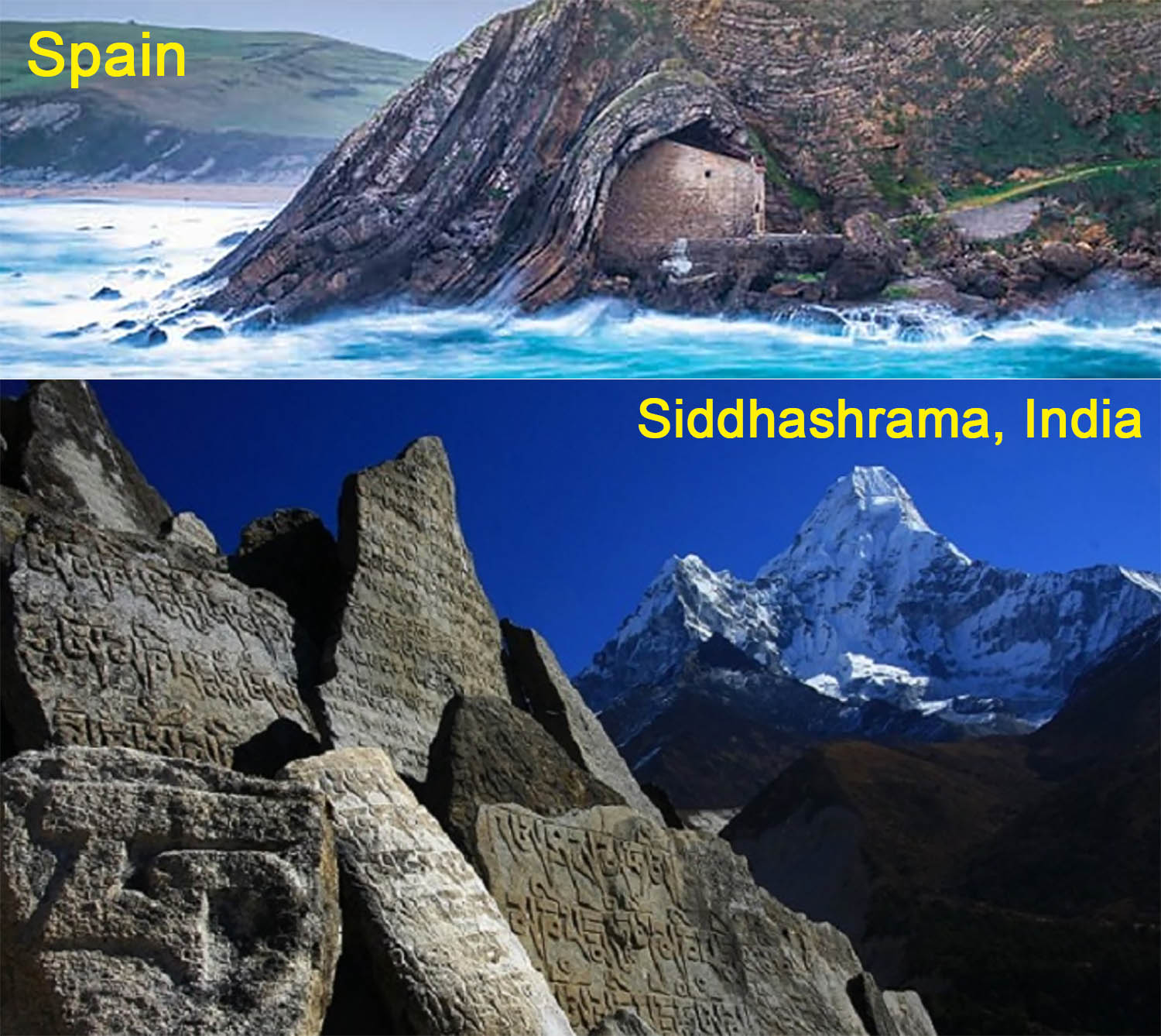
Santa Justa, the long-abandoned living quarters of a religious hermit, who dwelt here in the 8th century. It’s a gem on the Cantabria coastline, located on the beach of Santa Justa, in the municipality of Ubiarco, Santillana del Mar town hall, in a rugged region on north coast of Spain.
It is a semi-excavated construction in the rock of an anticline with two masonry stone walls and roof of a single water tile, all attached to the cliff. One of the first on Cantabriam coast, the remains of Torre de San Telmo stands on the cliff where it is located. It was announced on November 12, 2010 as a property of local interest.
To reach this isolated stone hut, one will have to wait until the frothing waters of Bay of Biscay hit low tide, then traverse a silty path to the structure’s façade. Peering in the windows, one will see a cavernous room adorned with shrines.
Over time it became a focus of pilgrimage in the region, one of the first of the Cantabrian coast. On the cliff on which it stands, the remains of the Tower of San Telmo rise.
Siddhashrama, popularly called Gyangunj, is considered as a mystical hermitage of India, which according to a tradition is located in a secret land deep in the Himalayas, where great yogis, sadhus, yogis and sages who are siddhs live. This place is also revered as the mystical land of Shambhala by Tibetans.
According to another tradition, the Siddhashrama is located in the Tibetan region, nearby Manosarovar Lake in Kailash Mountain. Though any sadhu, sannyasi, yeti, monk and yogi might have known Siddhashram by different names and various cults might have used different sadhana (meditation) methods according to their beliefs.
Siddhashram is considered as the base of spiritual consciousness, heart of divinity and the mortification land of great rishis. Thus, it is assumed as a very scarce divine place. It’s believed by Hindus & Buddhists that it is possible to get divine power to enter this scarce place by doing deep meditation following sadhana path.
It is referred to in many Indian epics, four Vedas, Upanishads and Puranas, including the Rigveda, one of the oldest scripture of human civilization. Siddhashram is considered to be the society for the enlightened people or siddhas. It is also believed that while discharging their divine works in this universe the spiritually empowered yogis remain in constant touch with Siddhashram and they visit it regularly.
Siddha yogis and sanyasis are meditating in this place for thousands of years and it is believed that this place can’t be seen with naked eye and can only be seen after meditation and other spiritual practices, as believed by many. Swami Vishuddhananada Paramahansa first talked of this place in public. He was taken there in his childhood where he meditated for long long years. Many in Hinduism believe that Maharishi Vashistha, Vishwamitra, Kanada, Pulasya, Atri, Mahayogi Gorakhnath, Srimad Shankaracharya, Bheesma, Kripacharya etc can be seen wandering there in physical form and also one can have the privilege of listening to their sermons.
The exact location of this legendary kingdom is unknown as it is believed that Gyanganj artfully and willingly camouflages itself from humans, as well as mapping technologies. Some also believe that Gyanganj exists in a different plane of reality and thus cannot be detected by satellites.
Siddhashrama is mentioned in Ramayana, Mahabharata and the Puranas. In Valkmi’s Ramayana it is said that sage Viswamitra has his hermitage in Siddhashrama and it was the erstwhile hermitage of Vishnu, when he appeared as in Varma Avatar. He takes Rama and Lakshmana to Siddhashrama to exterminate the demons who were disturbing his religious sacrifices. In Narada Purana (Purva,1.25), Siddhashrama is mentioned as the hermitage of sage Suta.
The Ramayana is one of the largest ancient epics in world literature. Scholars’ estimates for the earliest stage of the text range from the 7th to 4th centuries BCE, with later stages extending up to the 3rd century CE. It consists of nearly 24,000 verses interspersed with teachings on the goals of human life.


 20
