- Why not the GoAP honour him posthumously?
By Pradeep Kumar
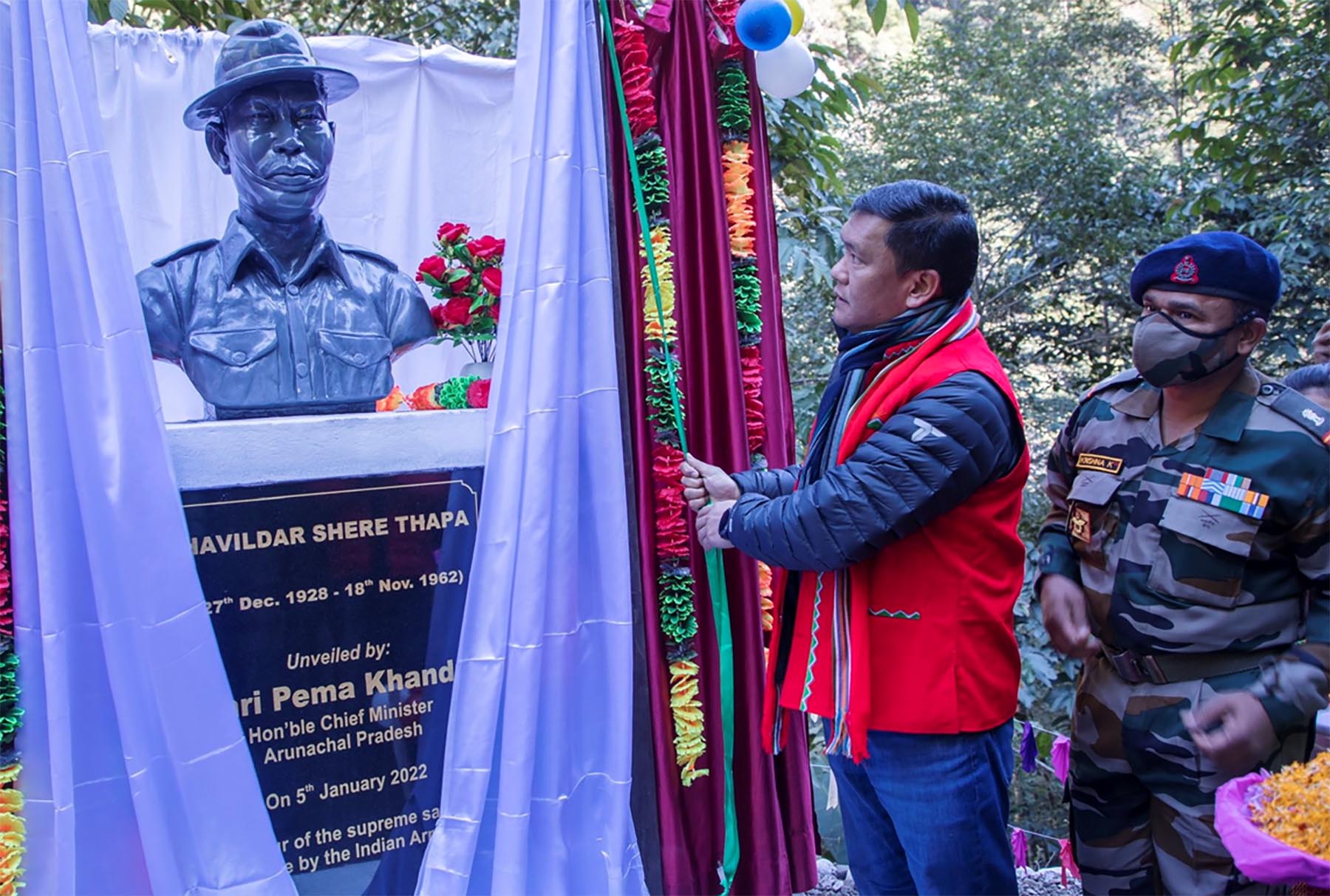
ITANAGAR, Jan 06: Chief Minister Pema Khandu, after unveiling the bust statue of great warrior of 1962 Indo-China war, havildar Shere Thapa on Wednesday, twitted on Facebook: “Little we know about havildar Shere Thapa, who single handedly delayed the waves of assault of Chinese Army for hours during 1962 war. It was at the Rio Bridge in between Taksing and Nacho in Upper Subansiri district that the brave heart laid down his life fighting for the country. Heartiest tribute to late havildar Shere Thapa.”
Interestingly, I was first to bring to limelight about this great hero globally through ANI on 19.10.12 – Forgotten Sino-India War hero Shere Thapa is no less a martyr than Jaswant Singh Rawat.
“Hav Shere Thapa, born in Nepal on 27.12.1928, had served in J and K Regiment Special Force from 27.12.45 to 31.12.56 and became part of Indian Army on 01.01.1957. He qualified in MR-1.ACE-1 and TTT-1 to get promoted as havildar on 01.05.1962. He was part of A Company and appointed as platoon havildar under subedar Sher Bahadur.
“In November 1962, he was deployed in protective patrol in Tama Chung Chung ridge near Rio Bridge in Upper Subhansiri Valley of Arunachal Pradesh covering the track coming from Indo-China border,” his commanding officer 2nd Lt Amar Patil, who retired as colonel, had informed this daily from Pune.
This was highlighted as – Martyr Hav Shere Thapa – unknown chapter of 1962 Indo-China War – in 27.03.21 edition of this daily.
“On 18.11.1962, the Chinese Army (People’s Liberation Army) launched offensive in Subansari Sector of NEFA (Arunachal Pradesh) and contacted the protective patrol at about 3 pm. The protective patrol was established in rocky outcrop area south of confluence of Ngo stream, the main source of Subansiri River dominating steep slippery track from border coming down to Tama Chung Chung ridge.
“As the enemy approached down the slippery slope and came within effective range, subedar Bahadur ordered the patrol to open fire. During the fire fight, Rifleman Inder Singh operating LMG No 1 sustained injuries and havildar Thapa took over the LMG and kept on engaging the enemy effectively.
“After some time, the patrol was running low on ammunition and subedar Bahadur decided to withdraw. Havildar Thapa volunteered to cover withdrawal of the platoon and relentlessly kept on effectively engaging the Chinese. When the platoon was safely away, he decided to extricate himself but succumbed to the onslaught of enemy who were coming over their dead soldiers.
“The Chinese Army buried him on the spot with respect and erected a wooden board as memorial with inscriptions in Chinese praising his bravery and sacrifice. This was unique gesture by enemy very rarely seen in history of warfare. The locals who had witnessed the battle informed that the Chinese had suffered more than 150 casualties including 70 dead with one senior officer. The Chinese radio declared on 19.11.1962 that they had suffered 155 casualties.
“Havildar Thapa died on 18.11.1962 and had wife Dilli, three daughters Dhanisara, Syani and Nurma. Efforts to get their present details have not been successful as Gorkha Records of Kunraghat did not contain address and required details.
“After the unilateral withdrawal of Chinese Army, the locals retrieved remains of havildar Thapa, performed last rites and built a monument for him as they were aware of his fierce fighting. The 56 Inf Div GOC had placed a plaque at the memorial. Since then, the locals have been revering havildar Thapa as the saviour of Subansari districts.
“Arunachal Pradesh people look up to him as a role model and feel agitated that he was not given the well deserved gallantry award by the central Govt where as the Chinese had given him respectful burial and erected a wooden board memorial with Chinese inscription praising his bravery and sacrifice. (The author as second lieutenant was his commanding officer)
It may be recalled that while highlighting – Martyr Army havildar Shere Thapa biography traced – in 01.07.19 edition of this daily, I had mentioned, “Thapa born in Nepal, was enrolled in to Indian Army on 01.01.57 (No 13710603W), served with J&K Special Force. His wife was Dilli (82), daughters were Dhanisara (68), Syani (65) and Nurma (62). Neither his qualification nor his address was available in official record.
All Arunachal Pradesh Gorkha Youth Welfare Association (AAPGYWA) chairman Sonar Chanbir, PA of Deputy Chief Minister Chowna Mein, had assisted in getting the details from official records.
I had managed to get his picture through a senior Army from 2 J&K Rifles. The renovated memorial was inaugurated by Army’s 56 Infantry Division GoC in 2016 by placing a wreath in recognition of his bravely. Though AAPGYWA had pitched in support but still the biography of Thapa remained in mystery.
Moreover, Lok Sabha member Tapir Gao, on being apprised about Thapa and after facilitating a telephonic talk with his commanding officer Col (Retd) Patil by me, had raised about Thapa in Lok Sabha on 25.03.21 and pleaded for conferring gallantry award on him posthumously in recognition of his heroism. He had also called on Defence Minister Rajnath Singh on 25.09.21 with same plea in writing when Singh had assured to study properly for taking a final decision.
If the Centre fails to honour him posthumously, why not the state Govt extends the honour – is a million dollar question?


 20