
By A O News Service
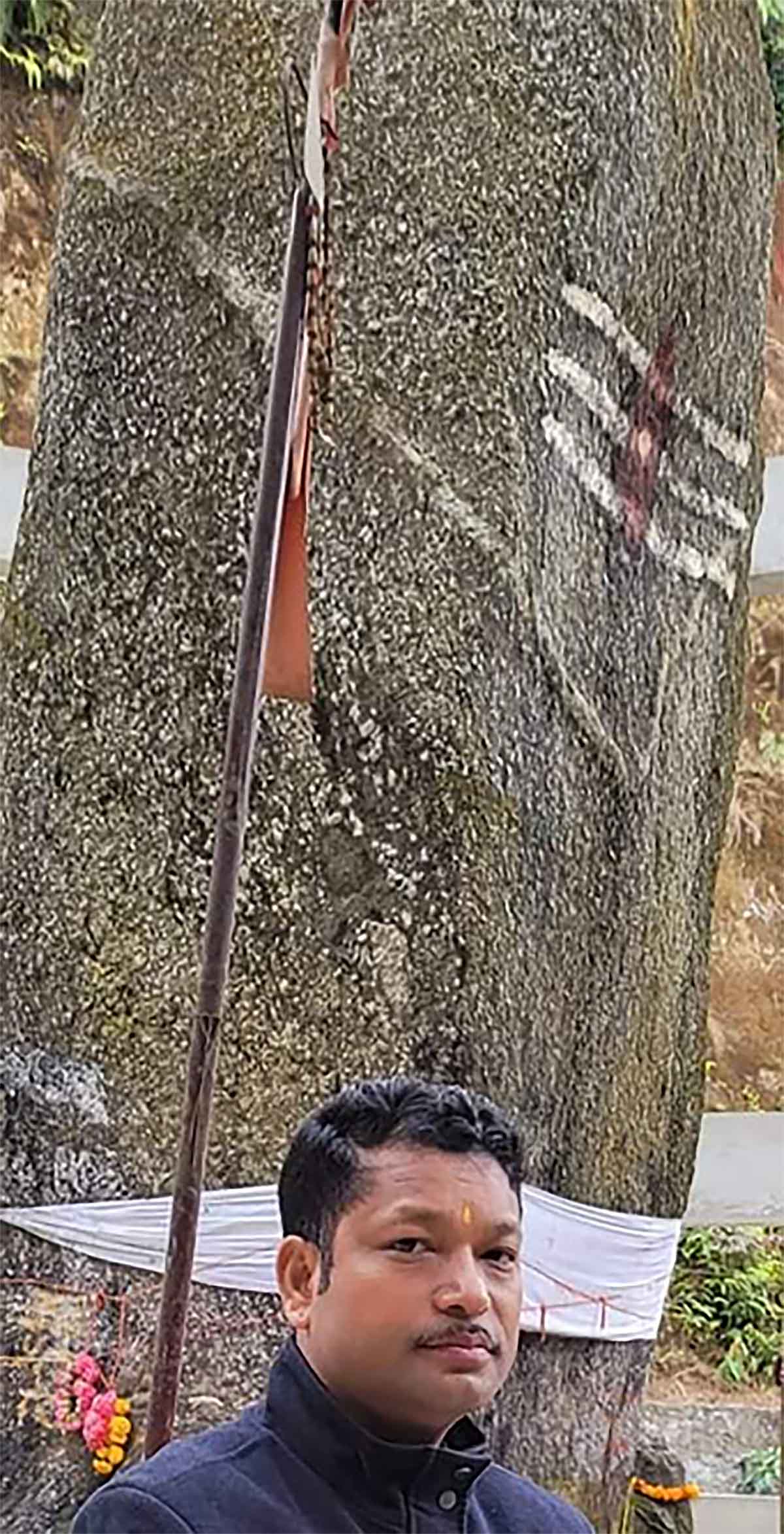
ITANAGAR, Jan 21: Deputy Speaker Tesam Pongte during his visit to Ziro paid obedience to lord Sidheshvar Nath there. The discovery of the tallest Shiv Linga justifies the state as a holy land.
The temple boasts of the lord Shiva lingam and his family. The linga with highest length here is 25-feet in length and 22-feet width, is believed to be the largest in the world.
Wood cutter Prem Subba had discovered the 25-feet tall and 22-feet wide Linga in July 2004. The finding is in tune with Shivapuran (17th chapter of 1893 edition) that the tallest Shiva Linga will appear at a place to be called Lingalaya and later the whole place will be known as Arunachal).
Sivaparvathi Temple at Chenkal in Kerala’s Thiruvananthapuram boasts of the tallest (111.2-feet) Shiva lingam in the world and is the only temple in the world, where devotees can worship 12 Jyothirlingams of Lord Shiva and 32 forms of Lord Ganesha at one place. But it is man-made, while Sidheshvar Nath Linga made of sediment rock is natural or swayambhu. Sedimentary rock formation takes millions of years, The oldest-known sedimentary rocks on Earth – Isua Sequence of southwestern Greenland – is 3.8-billion-year-old.
The swayambhu means self-manifested or self-existing or “‘created by its own accord”. The word is often used to describe a self-manifested image of a deity, which was not made by human hands, instead arisen naturally, or created by nature.
The word etymology of swayambhu is ‘Svayam’, means ‘self’ or ‘on its own’ and ‘bhu’, means ‘to take birth’ or ‘arising’. This is applicable to physical and tangible idols of gods that we see or to intangible yet existing god whom we cannot see. For example, the jyotirlingas are considered swayambhu – the idol of Venkateswara at Tirumula and some others are considered Swayambu, means they are not installed by any person but exist on their own.
The word is also applicable to gods – for example, Vishnu is described as swayambhu in Ramatana (Matsya Purana), Ramayana and Mahabharata while Vedas consider Shiva as swayambhu.


 20
