
By Pradeep Kumar
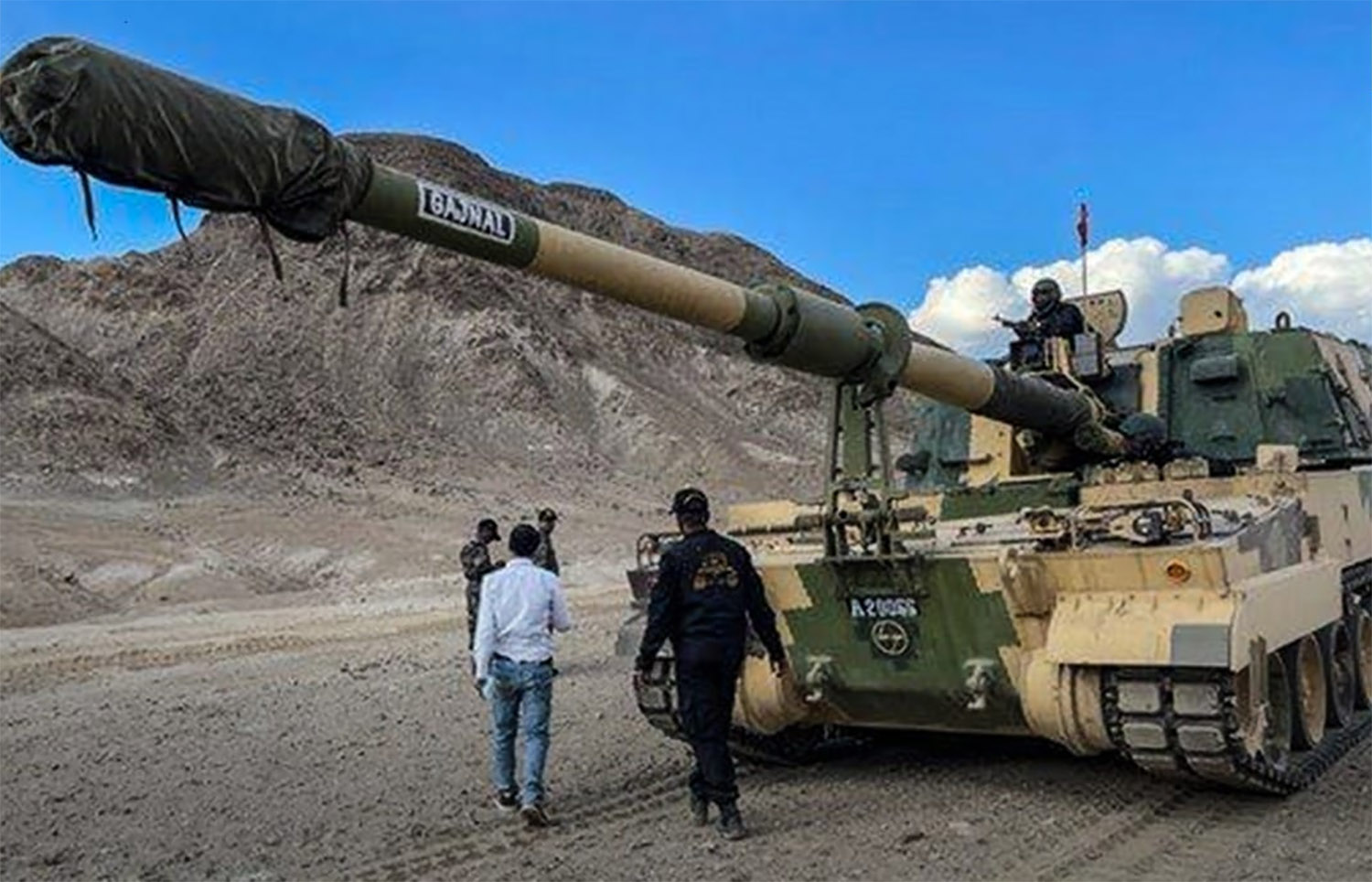
ITANAGAR, Feb 05: Indo-China border tension is refusing to die down, particularly in Galwan Valley in Ladakh where troops of Indian Army and China’s People’s Liberation Army are positioned face to face, Indian Army to deploy K-9 Howtizers in central and eastern sector Line of Actual Control (LAC) of Sikkim and Arunachal Pradesh with China.
The K9 Thunder or howitzer is a South Korean 155 mm self-propelled howitzer designed and developed by Agency for Defense Development and Samsung Aerospace Industries for Republic of Korea Armed Forces and is now manufactured by Hanwha Defese. It operates in groups with the K10 automatic ammunition resupply vehicle variant.
It is fitted with automatic fire control system with internal navigation system and automatic gun laying systems. It takes 30 seconds to prepare to fire at emplacement and 60 seconds from movement. The howitzer can quickly leave its position in order to avoid counter-battery fire. Its maximum range of fire is 30-km with standard HE shell and 40-km with rocket-assisted shell. It has a maximum rate of fire of 6 rounds per minute and is capable of multiple-round simultaneous-impact firing. It can launch 3 shells in 15 seconds, each in different trajectories, so that all shells hit the target at the same time. Sustained rate of fire is 2 rounds per minute.
Beginning on 05.05.20, Chinese and Indian troops engaged in aggressive melee, face-offs, and skirmishes at locations along Sino-Indian border, including near disputed Pangong Lake in Ladakh and the Tibet Autonomous Region (TAR) and near the border between Sikkim and the TAR. Additional clashes also took place at locations in eastern Ladakh along the LAC.
In late May last, Chinese forces objected to Indian road construction in Galwan River Valley. According to Indian sources, melee, fighting on 15/16-06.20 resulted in deaths of 24 Indian soldiers. Media reports stated that soldiers were taken captive on both sides and released in next few days while official sources on both sides denied this.
On 07.09.20, for the first time in 45 years, shots were fired along the LAC, with both sides blaming each other for the firing. Indian media also reported that Indian troops fired warning shots at the PLA on August 30 last.
China and India announced their intention to withdraw forces from the lake area on February 11 last, and commanders met to assess how the operation was going. Partial disengagement from Galwan, Hot Springs, and Gogra occurred in June–July 2020 while complete disengagement from Pangong Lake north and south bank took place in February 2021. Following disengagement at Gogra in August 2021, Indian analysts pointed out that the LAC has shifted westwards at patrol point 17A (PP 17A).
Amid the standoff, India reinforced the region with approximately 12,000 additional workers, who would assist India’s Border Roads Organization in completing the development of Indian infrastructure along the Sino-Indian border.
Experts have postulated that the standoffs are Chinese pre-emptive measures in responding to Darbuk-Shyok-Daulat Begi Oldi (DBO) road infrastructure project in Ladakh. China has also extensively developed its infrastructure in these disputed border regions and is continuing to do so. The revocation of special status of Jammy & Kashmir in August 2019, by Indian Govt has also troubled China.
Months of tension had increased fears that the continued deployment of thousands of troops in the Ladakh region and the Chinese-administered Aksai Chin could lead to an escalating conflict. India and China have been locked in a border dispute for decades and went to war in 1962. The international border 3,488-km long border (Jammu & Kashmir- 1597-km; Himachal Pradesh-200-km; Uttarakhand-345-km, Sikkim-220-km and Arunachal Pradesh-1126-km) is ill-defined.
However, India and China have both maintained that there are enough bilateral mechanisms to resolve the situation. These includes multiple rounds of colonel, brigadier, and major general rank dialogue, special representatives’ meetings,[ meetings of the Working Mechanism for Consultation & Coordination on China-India Border Affairs and meetings and communication between their respective foreign and defense ministers. On January 12 last, the 14th corps-commander-level meeting at Chushul-Moldo border personnel meeting (BPM) point took place.
Following the Galwan Valley skirmish on 15.06.20, Indian started campaigns to boycott Chinese products were. Action on the economic front included cancellation and additional scrutiny of certain contracts with Chinese firms and calls were also made to stop the entry of Chinese companies into strategic markets in India. By November 2020, the Centre had banned over 200 Chinese apps, including apps owned by Alibaba, Tencent, Baidu, Sina and Bytendance.


 20
