
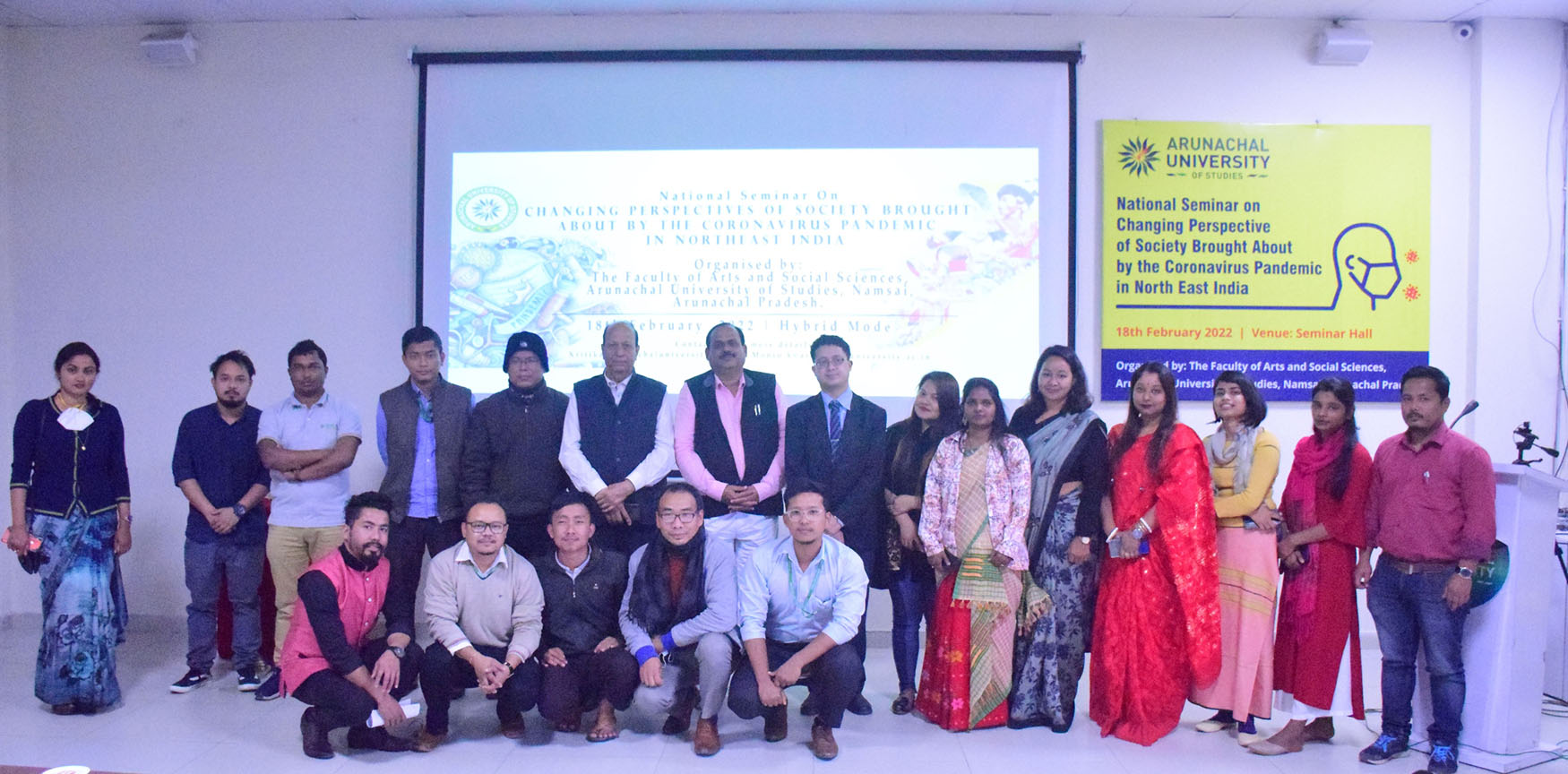
NAMSAI, Feb 18: The faculty of Arts and Social Sciences of Arunachal University of Studies (AUS) Friday organised a seminar on ‘Changing Perspective of Society brought about by the Corona Virus Pandemic in North-East India’.
Leading scholars from different disciplines participated in the seminar, the inaugural session of which was chaired by Vice-Chancellor B Mohan Kumar, in presence of Rupakjyoti Borah, Dean of Arts and Social Science, DS Hernwal, Dean of Education, besides the faculty members and students.
Consultant, Research and Information System for Developing Countries, New Delhi, Dinoj Kumar Upadhyay delivered the keynote address virtually, a press release informed here.
The Corona pandemic has had a profound impact on lives and livelihoods. Many countries have taken unprecedented measures to extend social safety nets, especially among vulnerable groups. Arunachal University of Studies as an institution of excellence inculcating the academic development of students as well as faculties has stressed deliberating upon different aspects of the virus in the North East.
Addressing the gathering, the VC said that lots of discussion and debates are going on around the world regarding the negative and positive impacts of Covid-19.
He added that there is evidence from the ‘Global Human Confined Experiment’ or lockdown, that the pandemic has seen technological advancement, reduced level of pollution being on the positive side, on the other hand, disruption in the agricultural production, the downfall of the economy, loss of employment and reverse migration are some negative impacts.
Upadhyay emphasised on India’s Development Cooperation in South Asia during the pandemic with special reference to North-East India. He noted that India as a developing nation has played a great role in assisting the pandemic hit countries by supplying vaccines to 99 countries and approximately 16 crore doses including, neighbouring countries like Bhutan, Bangladesh, Sri Lanka, Nepal, Myanmar.
He added that the NE region is an inevitable part as it shares borders with many of these aforesaid nations. Thus, focusing on the Act East Policy as well as enlightening about the collective cooperation and developmental values.


 20

