
Ministry of Culture and Sports
Greek Govt & Microsoft ink MoU
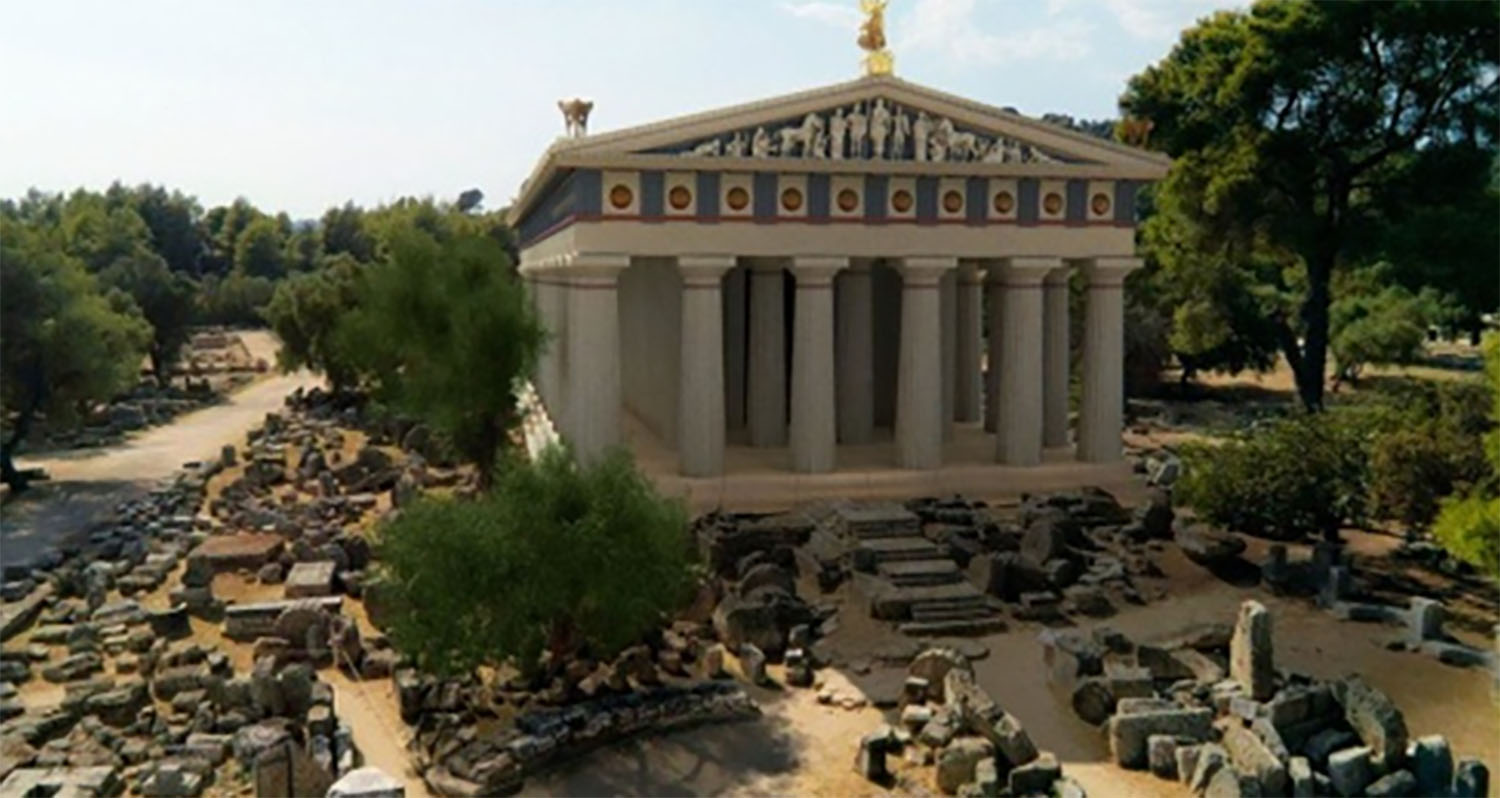
Ancient Olympia is to be digitally preserved, in a new deal between the Greek Govt and Microsoft. The collaboration uses artificial intelligence (AI) to map the site and augmented reality to help restore the original home of Olympic Games. It will allow viewers to explore the area as it stood more than 2,000 years ago. Microsoft has ambitions to rival Facebook with its own plans for the so-called metaverse.
It recently announced Microsoft Teams metaverse for meetings and is keen to transform Minecraft and other games it owns into more immersive 3D worlds.
Its tie-up with the Greek Govt means people can tour the site remotely or in person with an augmented-reality mobile app. At the Olympic Museum in Athens they can use HoloLens headsets to overlay a digital version of the site. Microsoft’s augmented reality smart glasses HoloLens use multiple sensors, advanced optics and holograms, to display information, blend with the real world or simulate a virtual world.
Among 27 monuments to be preserved are original Olympic Stadium, temples of Zeus and Hera, and the workshop of the renowned sculptor Phidias. The buildings are as close as possible to their original forms, including historical timelines of site’s changes over time and depict arte facts, The AI will be used for cultural heritage initiative, while Microsoft partner technology company Iconem, specializing in digitizing historic sites in 3D, using on-the-ground cameras and drones would take hundreds of thousands of images of the site for the AI to process the pictures to create models.
“The cultural implications of this technology are endless. For the first time, visitors from around the world can virtually visit birthplace of democracy, the ancient site of Olympia, and experience history first hand,” said Greek Prime Minister Kyriakos Mitsotakis.
“The project to digitally preserve Ancient Olympia is a stunning achievement in cultural heritage, bringing together humanity and cutting-edge technology to benefit the world and empower coming generations with new ways to explore our past,” Microsoft president Brad Smith said. (Agency)
Beyond the Horizon
By Pradeep Kumar
First Olympia Games were held in 1859 in ancient city square of Athenes. Athletes from Greece and Ottoman Empire took part. Zappas funded the restoration of ancient Panthenaic Stadium to host all Olympic Games in future.
The Games were religious and athletic festivals held every four years at sanctuary of Zeus in Olympia, Greece. Competition was among representatives of several city-states and kingdoms of Ancient Greece. These games featured mainly athletic, but also combat sports, like wrestling and pankration, horse and chariot racing events.
It has been widely written that all conflicts among participating city-states were postponed during the games until over. This cessation of hostilities was known as Olympic peace or truce. This idea is a modern myth because the Greeks never suspended their wars. The truce did allow those religious pilgrims who were travelling to Olympia to pass through warring territories unmolested because they were protected by Zeus.
The origin of Olympics is shrouded in mystery and legend; one of the most popular myths identifies Heracles and his father Zesus as the progenitors of the Games. It was Heracles who first called the Games “Olympic” and set up the custom of holding them every four years. The myth continues that after Heracles with his 12 labourers built the Olympic Stadium as an honour to Zeus.
Following its completion, he walked in a straight line for 200 steps and called this distance a ‘stadion’ (Ancient Greek, stadium or stage in Latin), which later became a unit of distance. The most widely accepted inception date of Ancient Olympics is 776 BC; based on inscriptions, found at Olympia, listing the winners of a footrace held every four years starting in 776 BC. The Ancient Games featured running events, a pentathlon (consisting of a jumping event, discus and javelin throws, a foot race, and wrestling), boxing, wrestling, pancrtayion, equestrian and events. Tradition has it that coroebus, a cook from the city of Elis, was the first Olympic champion.
The Olympics were of fundamental religious importance, featuring sporting events alongside ritual sacrifices honouring both Zeus (whose famous statue by Phidias stood in his temple at Olympia) and Pelops, divine hero and mythical king of Olympia. Pelops was famous for his chariot race with King Oenomaus of Pisatis. The winners of the events were admired and immortalised in poems and statues.
The Games were held every four years, and this period, known as an Olympiad, was used by Greeks as one of their units of time measurement. The Games were part of a cycle known as the Panhellenic Games, which included Pythian Games, Nemean Games, and Isthmian Games.
The Olympic Games reached the height of their success in 6th and 5th centuries BC, but then gradually declined in importance as Romans gained power and influence in Greece. While there is no scholarly consensus as to when the Games officially ended, the most commonly held date is 393 AD, when the emperor Theodosius-I decreed that all pagan cults and practices be eliminated. Another date commonly cited is 426 AD, when his successor, Theodosius-II, ordered the destruction of all Greek temples.
Cost of the Games: The Oxford Olympics Study 2016 found that since 1960 sports-related costs for Summer Games were on average US$5.2 billion and for Winter Games $3.1 billion. These figures do not include wider infrastructure costs, like roads, urban rail and airports, which often cost as much or more than the sports-related costs.
The most expensive Summer Games were Beijing-2008 at US$40–44 billion, and the most expensive Winter Games were Sochi 2014 at US$51 billion. As of 2016, costs per athlete were, on average, US$599,000 for Summer Games and $1.3 million for Winter Games; for London 2012, the cost per athlete was $1.4 million, and the figure was $7.9 million for Sochi 2014.
Where ambitious construction for the 1976 Games in Montreal and the 1980 Games in Moscow had burdened organisers with expenses greatly in excess of revenues, Los Angeles strictly controlled expenses for the 1984 Games by using existing facilities that were paid for by corporate sponsors.
Future risk: Hosting the Games is economically and financially extremely risky. The Games have also had significant negative effects on host communities; for example, the Cetre on Housing Rights and Evictions reports that Olympics displaced more than two million people over two decades, often disproportionately affecting disadvantaged groups.
The 2014 Winter Olympics in Sochi were the most expensive Olympic Games in history, costing in excess of US$50 billion. According to a report by European Bank of Reconstruction & Development that was released at the time of the games, this cost will not boost Russia’s national economy, but may attract business to Sochi and southern Krasnodar region of Russia in future as a result of improved services. But by December 2014, The Guardian stated that Sochi “now feels like a ghost town”, citing the spread-out nature of the stadiums and arenas, the still-unfinished construction, and the overall effects of Russia’s political and economic turmoil.
Furthermore, at least four cities withdrew their bids for 2022 Winter Olympics, citing high costs or lack of local support, resulting in only a two city between Almaty, Kazakhstan and China. Thus in July 2016, The Guardian stated that the biggest threat to the future of the Olympics is that very few cities want to host them. Bidding for 2024 Summer Olympics also became a two-city race between Paris and Los Angeles, so the IOC took unusual step of simultaneously awarding both 2024 Games to Paris and 2028 Games to Los Angeles. Both the bids were praised for planning to use a record-breaking number of existing and temporary facilities.


 20
