
By A O News Service
NAHARLAGUN, Mar 20: Union MoS (External Affairs) Dr. Rajkumar Ranjan Singh advocated that sustainable development goals (SDGs) in North East should be achieved by integrating local knowledge and practices with modern knowledge without harming originality of the region.
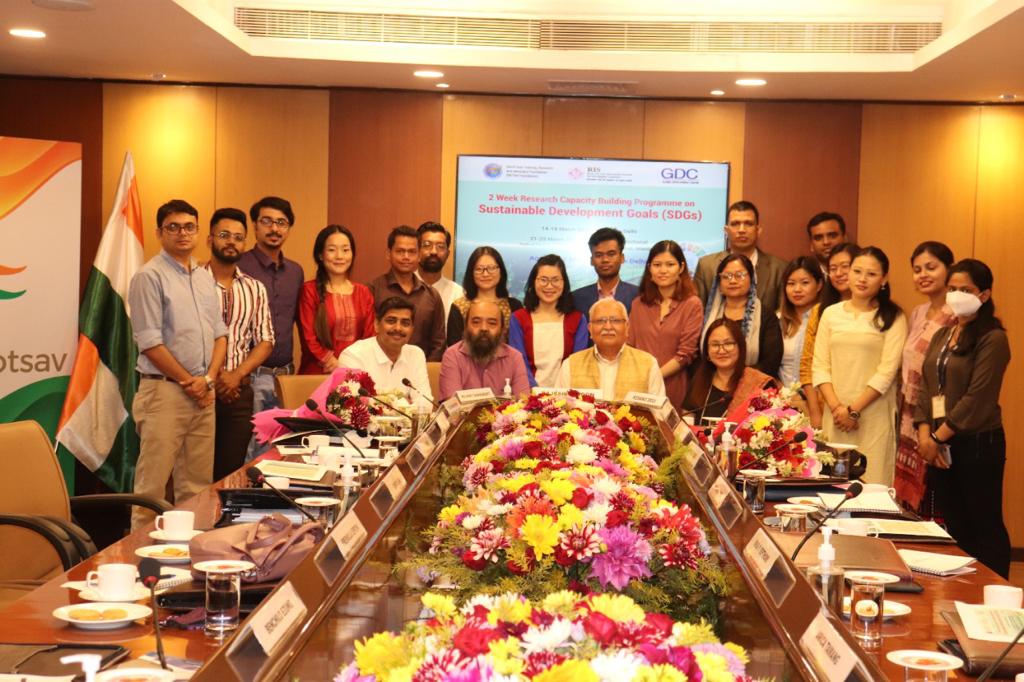
After conduct of first phase of two-week research capacity building programme on SDGs, under the flagship of Research & Information System for Developing Countries (RIS) and North East Training, Research and Advocacy Foundation (NETRA) for NE young research scholar at RIS, New Delhi since March 14 last, Dr. Singh interacted with the 15 research scholars from eight NE states, listened to their queries and suggestions to attain SDGs in NE, Arunachal Pradesh’s RGU (education department) Prof. Kesang Degi, also NETRA Board member informed this daily on Sunday.
NITI AAYOG vice-chairman Dr. Rajeev Kumar, urges all participants to go to ground level to find real facts and data about the NE. He asked to connect with local people and try to understand their needs which will help different policymakers to frame suitable policies for the local people.
FIDC chairman-cum-PRIA president Dr. Rajesh Tandon, in his inaugural address, discussed about localization of SDGs: perspectives from NE. He stressed that SDG visio can be fulfilled when one can connect with indigenous people and work with them to amalgamate indigenous knowledge and modern technique by keeping originality and nature safe to become compatible to each other. He urged the participants to contribute their research work to the people they belong.
RIS visiting fellow, Prof Milindo Chakraborty, in his inaugural address, highlighted significance of SDGs and capacity building programme. He said the importance of collaboration of RIS and NETRA and how they will work hand in hand to achieve all 17 SDGs in NE. He also stressed on localizing SDGs in NE.
RIS senior Prof S. K Mohant and External Affairs Ministry’s joint secretary (policy planning & research) Dr. Sumit Seth also joined the interaction.
RIS Director General Prof Sachin Chaturvedi discussed on “India’s development vooperation: A cross border spectrum” in relation to 17 SDGs. He said that a researchers need to find basic problems existing in their region and try to find out the best possible suitable alternatives. He called for exploring ways to remove the problems associated with the local community and most importantly to find the problems confronting them.
Among the speakers, Mr. RIS fellow Shubhamay Bhahattacharaya discussed on energy security (SDG-7) and essentiality to understand the risk and benefit factor of energy transition from conventional to renewable energy source. He hinted at the need for identification of alternatives specific to NE region.
RIS associate Prof Priyadarshi Dash enlighten the participants about different aspects of financing SDGs and stressed on importance of effectively mobilizing domestic and foreign resources.
By addressing the issues in sustainable health for all (SDG-3), RIS Prof. T.C. James and NIPO very president explained about terms – health for all and sustainable healthcare. He stressed that political commitment, community participation and support of health related sectors are requisites of sustainable health for all.
NIUA Sr. researcher Dr. Purva, in her address, pointed out that it is not simple to align all goals and objectives to global framework. Thus, “we need to get down at city level (SDG-11) and develop these indicators and understand those indicators” she said.
RIS Prof Amitabh Kundu brought out how SDG11 questions present structure of urbanization, as in the present hierarchy settlement everything is concentrated in big cities, which is one major issue discussed in the framework. He stressed on need to have an urban migration strategy and settlement strategy to have a settlement structure that can integrate the whole region.
Expatiating on gender equality (SDG5), RIS Dr. Beena Pandey asserted that the women empowerment is precondition to achieve the targets of several other SDGs, like poverty eradication, inequality, access to good health & education for all, decent work and economic growth among others.
Highlighting roles played by a civil society organization(CSO) in a community or a nation, PRIA director Dr. Kaustuv Bandyopadhyay said the CSOs help reach the services meant for marginalized and underprivileged. He underlined the reason for having partnerships and factors contributing to a successful partnership, including having relatively equivalent power organizations, clearly defined organizational structure, and capacity enhancement of all partners to work with each other.
Tripura University Asst. Prof-cum-NETRA founder Dr. Jayanta Choudhury discussed how to localize SDGs in NE. He stressed the importance of capacity building of different stakeholders, strengthening existing local level institutes and importance of CSOs at different levels to achieve the SDGs by 2030.
All participants joined a global discussion on indigenous people and India organized by RIS. At the end, participants under mentorship of Prof Degi presented their thoughts on issues related to NE. The next phase would be conducted at IGNTU regional centre, Manipur in April next, Prof Degi added.


 20
