Indo-B’desh border sealed by VKV bamboo
By Pradeep Kumar
ITANAGAR, May 11: Arunachal Pradesh Bamboo Resource & Development Agency (APBRDA) has signed an agreement CREDUCE and HPCL under the leadership state Chief Minister Prema Khandu for cultivation and development of bamboo resources in the state to turn it into green growth phase, said its chairman Tungri Effa.
This public-private partnership (PPP) is considered to be the world’s largest bamboo cultivation drive to cover plantation of 100,000 hectares of forest and village land with bamboo, known as ‘green gold’, he told in an exclusive interview to this daily.
“We are proud to be the torchbearer of this exciting new project. It is on line with the vision of Prime Minister Narendra Modi, who has resolved to make India clean and green by 2030. The development and plantation of ‘Green Gold’ would benefit the state while generating large scale employment and keep the people connected to their roots,” Effa said with conviction.
“The yields from this joint venture would last for over 30 years, divided into three phases of 10 years each. The effort is the first among many more to come as all NE states have fertility for bamboo cultivation,” he added.
“Through this agreement, we will be able to cultivate 100 million carbon credits in 10 years, which will be valued at USD 1.5 billion over the same period,” Creanovation Technologies Pvt Ltd MD Shailendra Singh Rao said.
Bamboo plantation and cultivation is an effective carbon sink and an integral nature-based approach to mitigating global warming. Studies have revealed that a one-hectare plantation of bamboo and its products could sequestrate 10,000 kilograms of carbon per hectare per year, making them effective green gold ventures.
This Himalayan state of Arunachal Pradesh is one of the 12 biodiversity hotspots of the world.
The agreement was signed having vision to turn the state.
“Chhak…chhak, the sound of chopping of bamboos, continues to reverberate along the NH, albeit punctuated by the loud noises of numerous passing vehicles. Holding daos in full grip, mostly local women remain busy to earn their day’s livelihood unperturbed by the heavy traffic flow while the commuters pass by giving a nonchalant look at them.
Yeh to paapi pet ka sawaalhai, kyakare sir? – responded a young mother, while continuing her work. I have to toil hard to feed my six-member family. This is our only source of earning, she raised her head to reply,” I wrote in “Chhakchhak reverberates sound of paapi pet ka sawaal” on 22.08.09.
Of 130 varieties of bamboos available in India, the NE region is blessed with 89 varieties, while Arunachal alone boasts of 57 species.
Bamboo depots have become common scenes in vital locations of the Capital Complex with about hundreds of locals eking out their livelihood from this trade. Few bucks are paid for a bamboo, but the buyer hardly knows the labour gone into collecting it from high hills with life risk. This had drawn attention of then state Governor Gen (Retd) JJ Singh, who in his sincerest desire to boost the income of the locals conceived the idea of the bamboo processing centre at Poma. The collaborative enterprise of state’s forest corporation and Poma Village Development Society had intended to add value to the bamboo products.
In fact the ambitious plan National Mission on Bamboo Applications (NMBA) was instrumental in converting defunct Namsai-based Arunachal Plywood Industry Limited (APIL) into a manufacturer of bamboo composite. Much before the Supreme Court put a blanket ban on all timber operations in 1995 with a cascading effect on the economy of many NE states, particularly Arunachal; APIL thorough research since 1972 had found bamboo as a total replacement for timber in all its usages, says APIL CEO Madan Jallan.
The APIL became the first in the country to invent the split bamboo board as well as 100% engineered prefabricated bamboo house/structure (PFH) to meet the nation’s requirements and had developed the indigenous technology with technical support from NMBA.
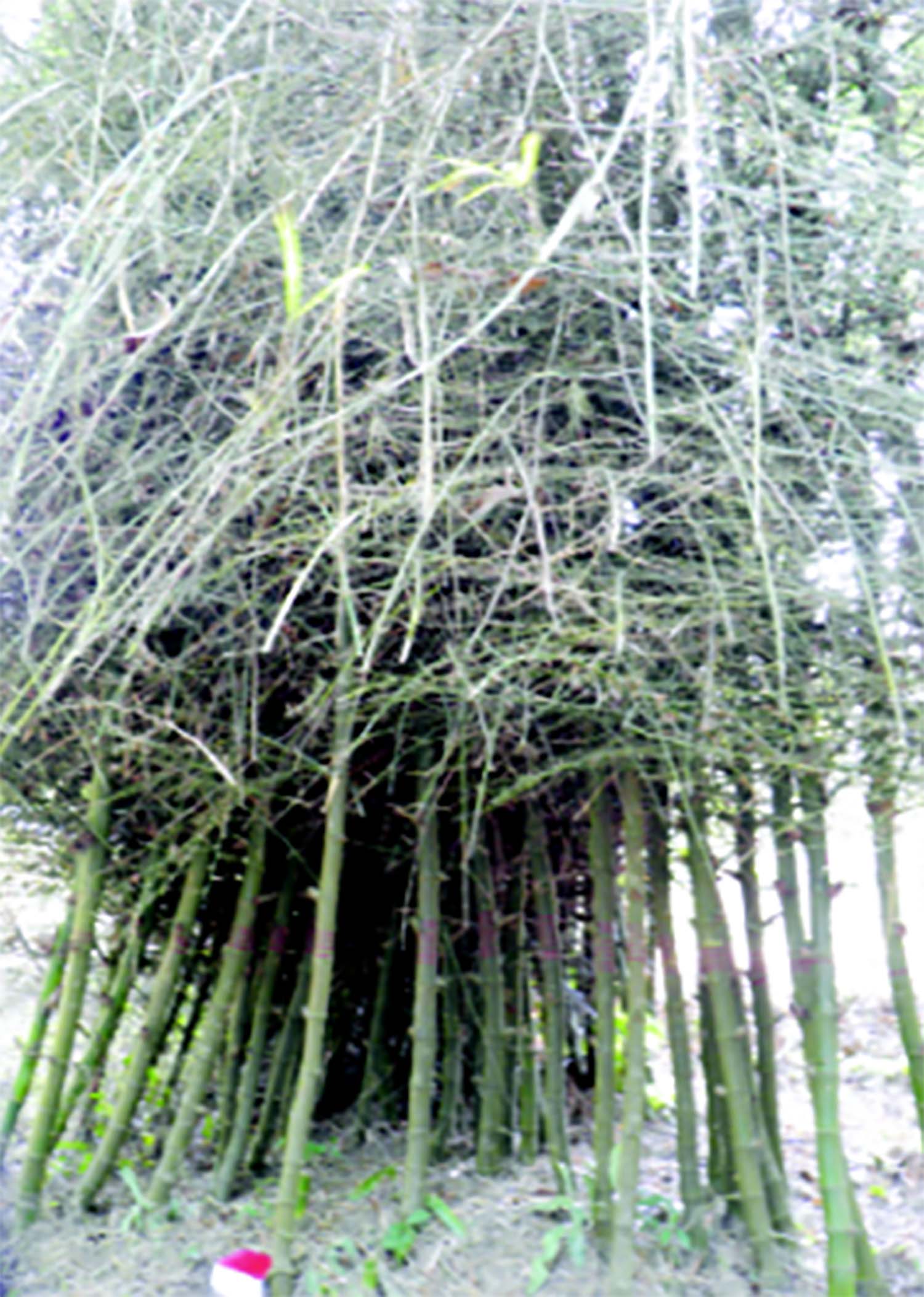
“The Bambusa bamboo from Arunachal Pradesh has sealed a portion of the porous 4,095-km Indo-Bangladesh border to prevent infiltration and insurgents. Total 3,500 seedlings of dense and thorny variety were taken by Indian Army in 2006 from Chessa-based Van Vigyan Kendra (VVK) to plant along the international boundary which has served the purpose, VKV scientist R K Taj had informed, as reported in “Arunachal bamboo seals Indo-B’desh border” on 02.02.12.
The VKV is the only such Botanical Research Institute in NE spread in 8 hectare area in Papum Pare district. But, this editor, while accompanying Parliamentary Secretaries Chow Tewa Mein (Environment & Forest) and Nabam Rebia (Planning & Development), to VKV was happy on being caught in his own quote: “We Arunchalees don’t know what we don’t know”.
The VKV, which boasts of the only cane or rattan garden of the country with 12 varieties, houses many rare and endangered species, including 4,500 flowering plants and 185 plant species.
“Bamboo used in industry to medicines, gift to guitar, as money spinner could change the economy of the NE region, and the above PPP could be the whistle blower.


 20