
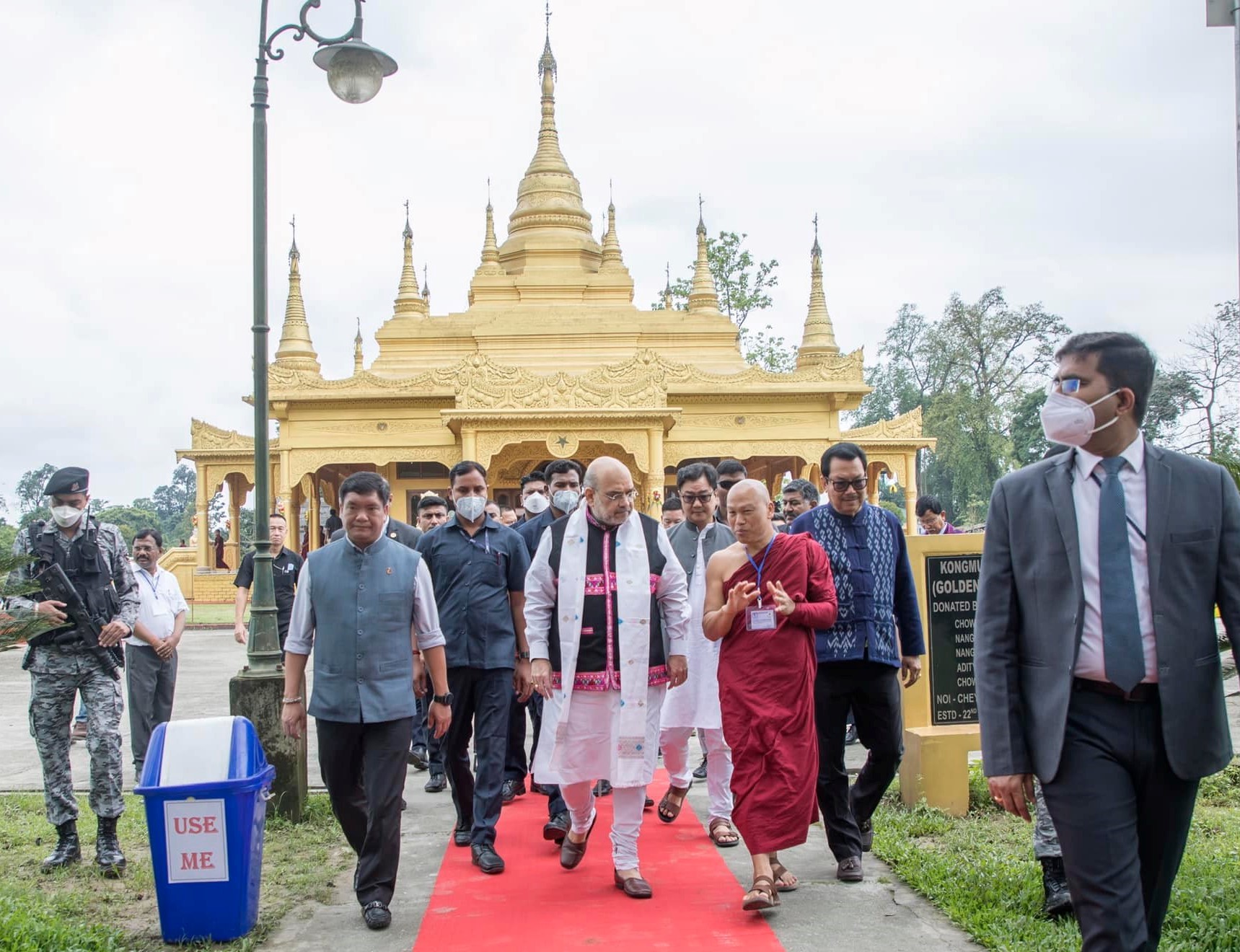
ITANAGAR, May 25: Union Home Minister Amit Shah, who stayed a night in Golden Pagoda complex where blue sky and soft breeze play hide and seek, during leisurely walk had experienced the pollution free air and serenity of the place.
“This is a real place for anyone to visit. I felt refreshed and energized amidst the aura of fragrance. This is also a treasure trove for spirituality, nature lovers and could attract more tourists. We should develop and encourage more such assets as a tourist hotspot”, Shah was quoted by an officer as saying.
Appreciating the surrounding, one of the Delhi dignitaries, said: “We should love nature and stay close to which life is interwoven”.
Such feelings, one can experience at Golden Pagoda here, built magnificently along silently flowing Tengapani River amidst lush green forest. The unspoiled ambience, greenery, fresh air and chirping of birds add natural splendor to this place of Lord Buddha. Morning prayers and chanting of hymns by monks rent the atmosphere.
The Golden Pagoda also known as Kongmu Kham (in Tai-Khamti language) is a Burmese-style Buddhist temple that was opened on 22.02.10. Spread in a 20 hectare complex in Namsai district, it was designed by World Tripiṭaka Foundation as first international Tripiṭaka centre in India built by present Deputy Chief Minister and local MLA Chowna Mein and his better half Nang Sati with an expenditure of Rs three.
Tengapani river flowing nearby is a story of two brothers to rule the area whereas Lord Buddha, the then Prince of Lumbini, expanded his kingdom through the spirit of humanity which is the need of the hour with the world facing threat from numerous quarters, particularly terrorists.
Described as an architectural wonder, the Golden Pagoda is uniquely built in the Myanmarese style and has a flavour of different religious styles. One takes six steps to cross the corridor supported by six pillars from four directions to have a glimpse of Lord Buddha, a model of the Kala Buddha of Nalanda archive. Interestingly, the statue, meditating on a lotus and facing north, is over five feet tall. It is unique as the entire pagoda has 13 gold painted stupas atop it but the statue is meditating looking downward, oblivious to the rich surroundings.
His divine posture is a message to today’s humanity embroiled in maya that spirituality leads to a state of paramananda (ultimate bliss) beyond worldly attachments. The white marble floor all around the pagoda reflects the purity of the human soul for which the colour white stands. The bases of all the pillars are made of white marbles, signifying that any superstructure needs purity of mind and thought.
“A stupa is a structure built to engrave the remains of saintly persons. But in the context of Buddhism a stupa presents the whole teachings of the Buddha. Buddhism is based on the threefold teaching known as Sila, Samadhi and Pragna.
While emperor Ashoka had built 84,000 stupas, most of which do not exist anymore, the Dalai Lama and Fuji guru of Nichiren sect of Japan are credited with building the modern-age stupas.
Just a walk in the woods or a stroll on the pristine greenery in the morning can awaken the innermost feelings of happiness and peace, and environmental psychology has gone a long way to prove this fact. (With inputs from our Namsai correspondent)


 20

