

Rafale aircraft of IAF patrolling in Ladhak in response to Chinese aircraft on 08.07.22
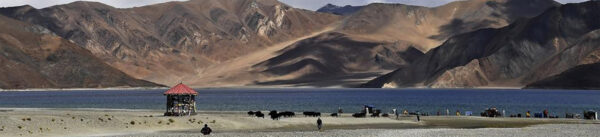
Pangong Lake in Leh district of Ladakh bordering India and China: File pic
Beyond the Horizon
By Pradeep Kumar
The People’s Republic of China (PRC) since the last few decades has shown its aggressive “land grabbing” strategy in many parts of the world. China enacted a law on 01.01.22 to protect its 22,000-km long land border that it shares with 14 countries, including India, Russia, North Korea and Bhutan, amid the ongoing standoff with India along the Line of Actual Control (LAC), according to state-run media.
The term “land grabbing” was initially used by the non-governmental organization GRAIN to explain events of privatization, dispossession and ownership concentration in the form of Foreign Direct Investment (FDI) in agriculture.
“Land grabs”, a phrase used for any property theft of a comparatively huge amount of land have been controversial throughout the world, primarily in Africa, wherever colonial powers such as France and Britain grabbed almost the whole African mainland. Experts claim that in 21st century, the PRC has turned into a neocolonial power. As per a Chinese scholar Jean-Marc F. Blanchard, “the common characteristics of China’s ties with several nations now have a close similarity to the European colonial powers’ associations with African and Middle Eastern nations that existed in 19th and 20th century”.
China is known to have border disputes with India, Japan (since 1945), Taiwan, Philippines, Indonesia, Vietnam, Japan, Pakistan, South Korea, North Korea, Singapore, Brunei, Nepal, Bhutan, Laos, Mongolia and Myanmar.
India and China share 3,488-km border, whose terminology has changed repeatedly. It is called “international border” in common language, but military use the term “Line off Actual Control.”
The British India Govt had demarcated border of both nations signed by Great Britain, China and Tibet, known as 1914 Simla Convention, which China never accepted, particularly after seceding Tibet in 1959.
1993 agreement: How exactly the 1993 LAC came about and what propelled India to sign upon a line without delineating or demarcating it? Interestingly, the details are mentioned in the book, Choices, written by former national security advisor Shivshankar Menon, the originator and most vocal supporter of 1993 agreement. Even in 1992-93, Menon had the reputation of being a China expert in Indian Foreign Service, having spent nearly eight years in that country over two postings.
Then Prime Minister P.V. Narasimha Rao was the second head of government after Rajiv Gandhi to visit China after diplomatic ties were restored, and it was felt that his visit should be a success even grander than that of Gandhi’s. Foreign secretary J.N. Dixit had consulted China expert Menon, who proposed that India and China sign a peace agreement by accepting the existing military positions on the disputed border without prejudice to each other’s stated positions. The line, marking existing military positions, could be called the “Line of Peace or Tranquility” (LoP or LoT).
The Chinese found the proposal interesting. However, they insisted on calling the peace line the “Line of Active Control” (LoAC). Menon writes, “It seemed very important to China that Indian negotiators accept the term ‘LoAC’ at the beginning of the negotiation.” The term was later changed to “Line of Actual Control” (LAC), the phrase that Zhou had used in his official letter to first Priem Minister Jawaharlal Nehru in November 1959.
Oblivious to the fact that the term LAC had deep military connotation, Indian side, believing the Chinese attach importance to traditional terms, accepted the Chinese suggestion. Indian diplomats felt that name of the line didn’t matter much since “India had inserted a provision that both sides would mutually agree on and clarify the LAC wherever necessary in the draft of the agreement.”
The LAC is technically binding for both nations by maintaining status quo. But, why China uses shrewd diplomacy through its “dog’s tail” policy with the intention to grab land aggressively – is a million dollar question? Bejing mandarins alone could reply!


 20
