
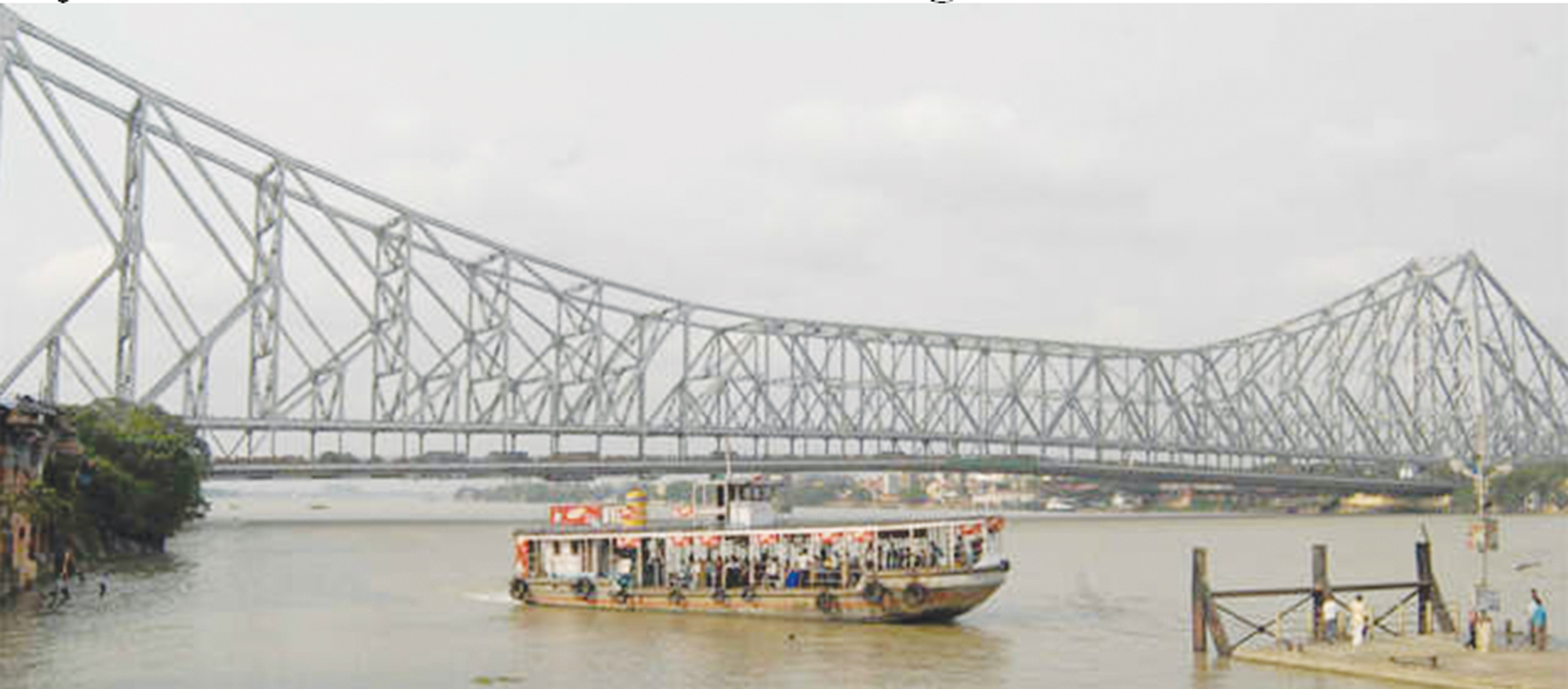
The Howrah Bridge, a balanced cantilever bridge over Hooghly River in West Bengal, commissioned in 1943, is an engineering marvel. It was originally named the New Howrah Bridge, as it had replaced an existing pontoon bridge that linked Howrah and Kolkata (Calcutta) cities.
On 14.06.65, it was renamed Rabindra Setu after great Bengali poet and first Indian Nobel Laureate Rabindranath Tagore, but still popularly known as the Howrah Bridge.
The bridge is one of four on Hooghly River and is a famous symbol of Calcutta, the City of Joy. The other bridges are Vidyasagar Setu or 2nd Hooghly Bridge, Vivekananda Setu and new one, Nivedita Setu.
It weathers the storms of Bay of Bengal region, carrying a daily traffic of approximately 1 lakh vehicles and possibly more than 1.5 lakh pedestrians, making it the busiest cantilever bridge in the world. The third-longest cantilever bridge then, is the 5th longest bridge of its type in the world now.
In 1862, the Govt of Bengal asked East India Company chief engineer George Turnbull to study the feasibility of bridging the Hooghly River. He had recently established company’s rail terminus in Howrah. He reported on 19.03.1862 with large-scale drawings and estimates that the foundations for a bridge at Calcutta would be at a considerable depth and cost because of the depth of the mud there.
The impediment to shipping would be considerable. A good place for the bridge was at Pulta Ghat “about a dozen miles north of Calcutta” where a “bed of stiff clay existed at no great depth under the river bed”.
A suspended-girder bridge of five spans of 401 feet (122 m) and two spans 200 feet (61 m) would be ideal.
In view of the increasing traffic across Hooghly River, a committee was appointed in 1855–56 to review alternatives for build a bridge. The plan was shelved in 1859–60, to be revived in 1868, when it was decided that a bridge should be built and a newly appointed trust vested to manage it. The Kolkata Port Trust (KoPT) was founded in 1870 and then state Legislative department of the Bengal Govt passed the Howrah Bridge Act in1871 under the Bengal Act IX of 1871, empowering the lieutenant-governor to have the bridge built with Govt capital under the aegis of the Port Commissioners.
Eventually a contract was signed with Sir Bradford Leslie to build a pontoon bridge. Different parts of the bridge were constructed in England and shipped to Calcutta, where they were assembled. The assembling period was fraught with problems. The bridge was considerably damaged by the great cyclone on 20.03.1874. A steamer named Egeria broke from her moorings and collided head-on with the bridge, sinking three pontoons and damaging nearly 200 feet of the bridge.
The bridge – 1528 ft long, 62 ft wide and 7-foot wide pavements on either side – was complete in 1874 with a total cost of ₹2.2 million and opened to traffic on 17.10.1874. Initially the bridge was periodically unfastened to allow steamers and other marine vehicles to pass through. Before 1906, the bridge used to be undone for the passage of vessels during daytime only. Since June 1874 it started opening at night for all vessels except ocean steamers, which were required to pass through during daytime.
From 19.08.1879, the bridge was illuminated by electric lamp-posts, powered by the dynamo at the Mullick Ghat Pumping Station. As the bridge could not handle the rapidly increasing load, the Port Commissioners started planning a new improved bridge in 1905.
New bridge plans: In 1906, the Port Commission appointed a committee headed by East India Railway CE R.S. Highet and Calcutta Corporation, CE W.B. MacCabe. They submitted a report stating that bullock carts formed the 8/13th of vehicular traffic (as on 27.08.1906, heaviest day’s traffic observed in the port of Commissioners 16 days’ Census of the vehicular traffic across the existing bridge). (To continue)


 20