
Beyond the Horizon
By Pradeep Kumar
The age of human civilization has been hunting modern researchers, archeologists and scientists despite applying various methods, including paleographical analysis of inscription & carbon dating as definite answer still is in question.
It is proved that civilizations, first appeared in Mesopotamia (what is now Iraq) and later in Egypt, thrived in Indus Valley by about 2500 BCE, in China by about 1500 BCE and in Central America Civilizations ultimately developed on every continent except Antarctica.
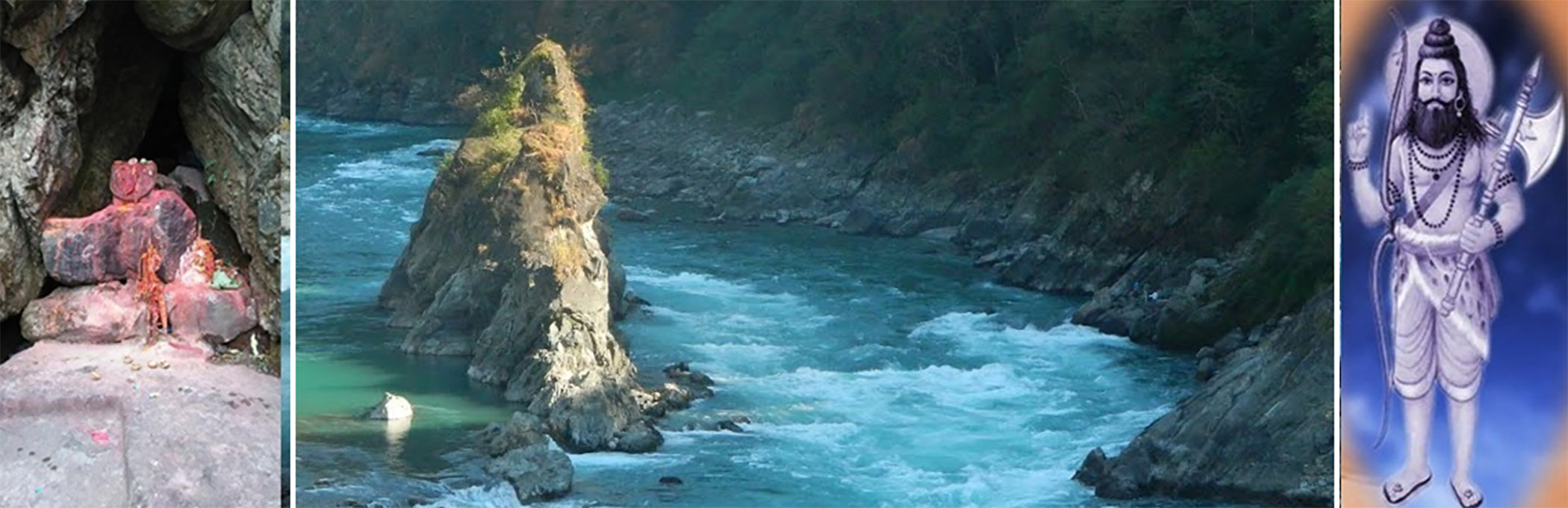
But, Arunachal Pradesh boasts of oldest shrine of Hinduism – Parashuram Kund. According to legend, Lord Parashuram, on the orders of his father Rishi Jamadagni, beheaded his mother Renuka with his axe. The axe got stuck to his hand for his heinous sin. His father pleased with his obedience restored his mother to be back to life but the axe still remained stuck to his hand. On the advice of eminent saints, he reached Lohit River and took a dip in water and the axe soon got detached. The kund since then is famous Parashuram Kund. It attracts thousands of pilgrims on Makar Sankranti for a holy dip in the sacred kund which is believed to wash away one’s sins. There is a mythological story behind this beautiful place as told by the local people. Regrettably, 1950 Assam had shaken entire NE and the kund was completely covered. A very strong current is now flowing over the original site of the kund but massive boulders have in a mysterious way embedded themselves in a circular formation in the river bed thus forming another kund in place of the old.
Lord Parshuram was born in Treta Yuga, the second of four yugas (world ages) in Hinduism, preceded by Krita (Satya) Yuga and followed by Dvapara Yuga, according to scriptures. The Kali Yuga is the fourth and worst of the four yugas. Thus, Lord Parshuram, an immortal being, is now 21,65,122-year-old as per Yuga Cycle.
There are four yugas (i.e. Krita (Satya), Treta, Dvapara and Kali) in Hindu cosmology. The Satya Yuga lasted for about 17,28,000 years, Treta Yuga (12,96,000 years), Dvapara Yuga (8,64,000 years) and present Kali Yuga of 4,32,000 years, beginning in 3,102 BCE, roughly 5,122 years have passed till 2021. Each cycle, as per Manu Sanghita, witnesses gradual decline of wisdom, knowledge, intellect, life span, physical and spiritual strength of humankind to reduce the period by one-fourth.
Similarly, Dwarka, ancient kingdom of Lord Krishna dating back 3100 BCE as referred in epic Mahabharata, was found by a team led by noted maritime archaeologist Dr S R Rao, through extensive search (1984-88) had discovered it submerged beneath 70-feet in Arabian Sea on the right bank of Gomto River on the mouth of Gulf of Kutch.
While the ruins of Bhismnaakgar or Sadhayapuri or Svadhayapuri in Dibang Valley district, proves that Krisna had eloped princess Rukmini, daughter of King Bhismaknagar. The ruins dated between 11th-15th centuries prove that Bhismaknagar was political centre of Chutia Kingdom and king Lakṣmīnārāyaṇa had ruled in 15th century as per brick inscription.
Ita Fort built with bricks in Arunachal Pradesh capital is believed to be built by Chutia kings in 14th or 15th century.
The Buddhist belt of Tawang boasts of many a monasteries and stupas, but and 93-feet tall Gorsam Chorten (stupa) with 186-feet base occupies a special place as it is entry-less and opens once in every 12 years for the believers to pay their obeisance. Located about 92 Km from Tawang built by Lama Prathar of Zemithang’s Kharman village in 13th Century A.D., it is famous for Khathing festival & Shanken festival to showcase great Buddhist traditions by lighting 84,000 candles for world peace symbolizing the same number of stupas built by Ashoka during his lifetime.
The richly adorned Tawang Monastery or Gaden Namgyal Lhatse, the spiritual wonder of India, part of Tawang-Bomdila tourist circuit, founded by Merak Lama Lodre Gyamtso in 1860-61 AD, is famous for a 28-foot-tall golden statue of Lord Buddha sitting peacefully draws devotes from far and wide to seek blessings who are welcome by a 925-feet long &10X20-feet tall entrance door.
While India is the only place in the world where the followers of Vajrayana and Hinayans cults live, Arunachal is a land of both the believers.
The ‘Land of the Rising Sun’ is a glittering example of peaceful coexistence where tourism will flourish in times to come, benefiting India in general and Arunachal in particular.
However, the latest addition if discovery of 8000-yr-old ancient temple n Saudi Arabia’s archeological ruins. The Saudi Heritage Commission discovered an 8000-year-old archaeological site in Al-Faw, south-west of Riyadh, Saudi Arabia. A Saudi-led multinational team of archaeologists used cutting-edge technology to conduct a thorough survey of the site. According to the Saudi Press Agency, the study used high-quality aerial photography, guided drone footage using ground control points, a topographic survey, remote sensing, ground-penetrating radar, laser scanning, geophysical survey, extensive walkover surveys and sondages throughout the site (SPA).
The remains of a stone temple and parts of an altar were among many discoveries at the site, with clear indications that a life of ceremonies, worship and rituals was once integral to the lives of Al-Faw locals. The rock-cut temple is located on the outskirts of Mount Tuwaiq, also known as Khashem Qaryah, east of Al-Faw.
The new technology also enabled the detection of 8,000-year-old Neolithic human settlements, as well as 2,807 graves from various periods scattered throughout the site and documented and classified into six groups. The ground was covered in devotional inscriptions that revealed the religious beliefs of the Al-Faw people. An inscription in Jabal Lahaq sanctuary invoking the god Kahal, the deity of Al-Faw, by W H B L T (Wahb Allat) from the family of M L H T (Malha), Guerra residents (in city of Al-Jarha).
Besides cultural riches, the site confirms the existence of a complex, aesthetic and well-planned city with foundations of four monumental buildings, corner towers, internal plans and open-air courtyards. The archaeological study also uncovered an intricate irrigation system that included canals, water cisterns and hundreds of pits in the world’s most arid lands and harsh desert environments.
For past 40 years, the archaeological area of Al-Faw has been the focus of archaeological research and all findings had been published in seven book volumes. There was previous mention of cultural life at Al-Faw, citing residential and market areas, temples and tombs, but new discoveries are far more comprehensive. More importantly, the discoveries show that a culture of temples, rituals and idol worship predated the monolithic, non-idol worshipers, anti-temple practices of Islam that exist there today. These discoveries may also call into question the widely held belief that the Islamic conquest of Arabia civilized its desert people.


 20
