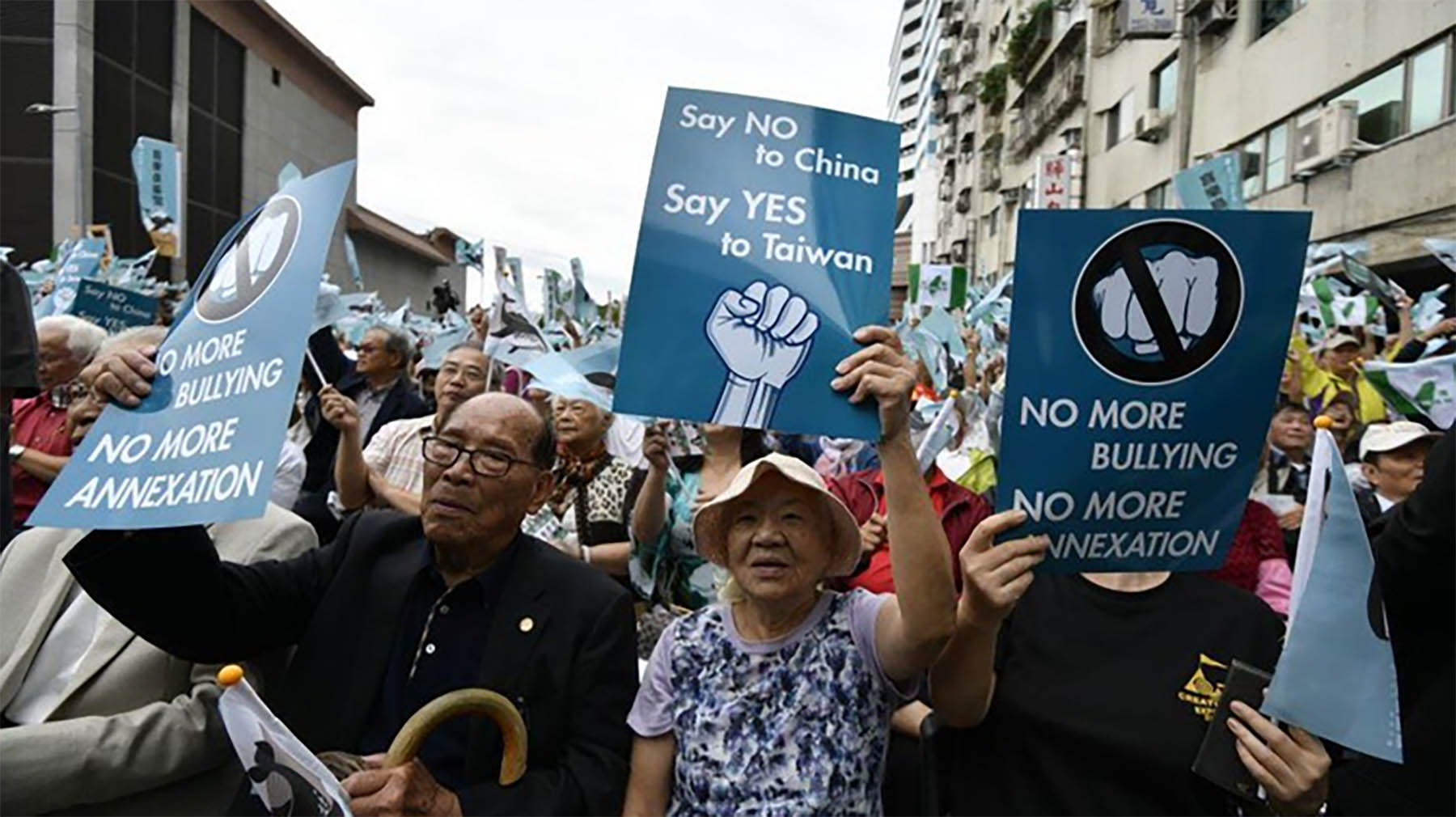
- Taiwan island a separate nation: Taiwanese
Beyond the Horizon
By Pradeep Kumar
Taiwan world’s No 1 contact chip maker
Taiwan is world’s largest contact chip maker. The island’s most valuable company Taiwan Semiconductor Manufacturing Co (TSMC) produces some of the world’s most advanced chips for Apple, Qualcomm & Nvidia. Thus, Taiwan dominates global industry for semiconductors, critical components used in everything from smartphones and medical devices to cars and fighter jets.
It accounts for 64% of semiconductor manufacturing revenue, according to TrendForce, with industry leader TSMC alone taking up more than half of the total pie. For the most advanced semiconductors, Taiwan accounts for 92 %
South Korea, the next biggest producer, controls less than 1/5th of the market, according to a report by Boston Consulting.
Beijing’s latest apparent attempt at economic coercion, however, conspicuously left Taiwan’s most valuable export of all untouched: semiconductors.
That is most likely because China depends on Taiwan’s exports of the critical components almost as much as the island does itself. For Beijing, targeting Taiwan’s semiconductor industry would be at the cost of inflicting significant harm on itself.
Significance: In pursuit of an accurate estimation, ChinaPower built a new dataset for SCS using common shipping routes, automatic identification system (AIS) data, and bilateral trade flows. This approach relied on calculating a summation of all bilateral trade flowing through the SCS. ChinaPower found that an estimated $3.4 trillion trade passed through the SCS in 2016, a sizeable proportion of international trade, but 36% smaller than original $5.3 trillion.
For many of world’s largest economies, the SCS is an essential maritime crossroads for trade. Over 64% of China’s maritime trade transited through waterway in 2016, while nearly 42% of Japan’s maritime trade passed through it then. The United States is less reliant on SCS with just over 14% of its maritime trade passing through the region.
Chinese exercises in the SCS in last month, and the strong US response, show these disputed waters will not soon be calm. While the focus has largely been on military manoeuvres, competition in legal positions has also been heating up. Last year, both the United States and Australia risked China’s wrath by officially stating that China’s claims in the South China Sea are unlawful. Other claimants were pleased by this change of policy, but none voiced it prominently.
The issue, however, is not that China flagrantly violates international law – it is that it does so while simultaneously creating a veneer of legal legitimacy for its position.
The conventional wisdom is that China claims sovereignty over “virtually all SCS islands and their adjacent waters. Its claims are “sweeping” and more expansive than those of any other rival claimant. In 2009, Dai Bingguo, then a top Chinese official, first referred to the South China Sea as a “core interest”, a term often used for Taiwan, Xinjiang and Tibet. While China has not been specific about the extent of its claims, it uses a “nine-dash line” which “swoops down past Vietnam and the Philippines, and towards Indonesia, encompassing virtually all of the South China Sea”, to delineate its claims.
On the surface, it appears that Chinese leaders are relying on a historical argument to buttress their claims – China traces its interaction with the South China Sea back to the Western Han Dynasty. Thus, Beijing’s narrative about its claims begins as early as the 2nd century BCE, when Chinese people sailed in the South China Sea and discovered some of the region’s land features.
But this is not actually how China lays claim to 90% of the SCS China’s abuse and misapplication of international law is a bit more complex. There are four levels that build on one another.
First, China claims it has the same rights as archipelagic states, those countries mainly made up of islands. One of the benefits of archipelagic status is that the waters between islands are considered internal waters, like rivers inside a country. Other countries have no right to transit these waters without permission. This archipelagic status is conferred through the UN, and only 22 nations claim it.
China is undeniably a continental country, but nevertheless, it drew straight baselines around the Paracel Islands and claimed the waters between the islands to be internal waters. Beijing has not done this explicitly for the Spratly islands area, but its reaction to the activities of other countries suggests that is its interpretation. My discussions with Chinese strategists reveal that China will likely explicitly draw baselines to claim internal waters between the Spratly Islands once it has the military capabilities in place to enforce it. (This is not an easy task, as the Spratlys’ sea zone is 12 times that of the Paracels, covering 160,000 to 180,000 square kilometres of water.)
While international law may support position of the US and Australia on legal behaviour within the exclusive economic zones (EEZs), countries need to work harder to solidify this norm more broadly.
China then claims a 12 nautical mile (nm) territorial sea from Paracel baseline, not from the individual islands, and in the Spratlys from many features that under international law are not awarded this right, such as artificial islands. Moreover, China’s interpretation of territorial sea is that it has the exclusive right to make, apply and execute its own laws in that space without foreign interference. But according to UNCLOS, all ships, civilian or military, enjoy the right of innocent passage through other states’ territorial seas. Moreover, the contiguous zone is considered part of international waters and states do not have the right to limit navigation or exercise any control for security purposes.
Lastly, China claims 200 nm from the end of the territorial sea as its EEZ, where it claims to have the right to regulate military activity. The US insists that freedom of navigation of military vessels is a universally established and accepted practice enshrined in international law – in other words, states do not have the right to limit navigation or exercise any control for security purposes in EEZs. Australia shares this view, but not all countries accept this interpretation. Argentina, Brazil, India, Indonesia, Iran, Malaysia, the Maldives, Oman and Vietnam agree with China that warships have no automatic right of innocent passage in their territorial seas. Twenty other developing countries (including Brazil, India, Malaysia and Vietnam) insist that military activities such as close-in surveillance and reconnaissance by a country in another country’s EEZ infringe on coastal states’ security interests and therefore are not protected under freedom of navigation.
In other words, while international law may support the position of the US and Australia on legal behaviour within the EEZs, countries need to work harder to solidify this norm more broadly.
Through these three positions alone on internal waters, territorial seas and EEZs, China lays claim to approximately 80% of the South China Sea. Then China uses the nine-dash line to cover the remaining territory and provide redundancy by claiming “historic waters” – i.e., that China has historically controlled this maritime environment – again, a view that has no basis in international law. (Concludes)


 20