
Beyond the Horizon
By Pradeep Kumar
The common man is likely to suffer more as Gujarat Cooperative Milk Marketing Federation (GCMMF), which markets milk and its products under Amul brand, has hiked milk prices by Rs 2 per litre (PL) from August 17.
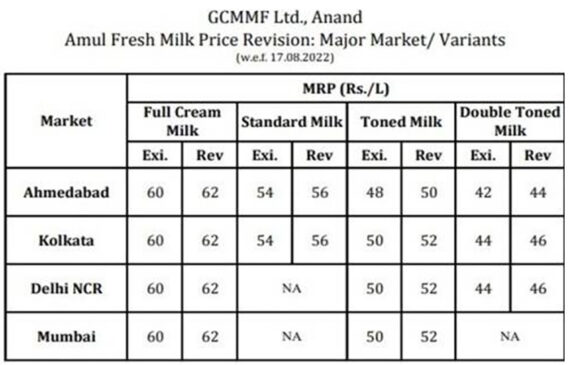
City-wise new rates: With Rs 2 hike, full cream milk Amul Gold in Ahmedabad, Delhi NCR, Kolkata and Mumbai metro markets will cost Rs 62 PL, while toned milk Amul Taaza will be sold at Rs 50 P. For Amul Shakti, customers have to pay Rs 56 PL.
The GCMMF attributed price hike to rise in cost of energy, packaging, logistics, cattle feeding cost. Cattle food cost has increased by 20% in comparison to 2021. So Amul and other dairies’ members of the Federation have increased procurement rate by 8% to 9% to meet farmers’ expenses. Amul passes 80 paise of each rupee recovered from its customers to farmers/pastoralists.
Mother Dairy, one of the leading milk suppliers in Delhi-NCR, also announced that it is ‘compelled’ to raise its liquid milk prices by Rs 2 PL wef August 17. Full cream milk, earlier sold at Rs 59, will be sold at Rs 61 tomorrow onwards.
The price of toned milk will increase to Rs 51 and that of double toned milk will rise to Rs 43 PL. Cow milk price has also been hiked to Rs 53 PL.
Milk, a nutrient-rich liquid food containing protein and lactose, is primary source of nutrients for young mammals (including breastfed human infants) before they are able to digest solid food.
Early-lactation milk, which is called colostrums, contains antibodies that strengthen the immune system, and thus reduces the risk of many diseases. But, when lactating mothers fail to feed their newborns, cow milk serves as alternative.
As an agricultural product, dairy milk is collected from farm animals. In 2011, dairy farms produced around 730 million tones of milk from 260 million dairy cows. India is the world’s largest producer of milk and the leading exporter of skimmed milk powder, but it exports few other milk products too. Because there is an ever-increasing demand for dairy products within India, it could eventually become a net importer of dairy products. However, New Zealand, Germany and the Netherlands are the largest exporters of milk products.
More than six billion people worldwide consume milk and milk products, and between 750 and 900 million people live in dairy-farming households.
Bengaluru, India’s IT capital or Silicon Valley, gets Nandini brand toned and full-cream milk for only Rs 38 and Rs 46 PL respectively of Karnataka Cooperative Milk Producers’ Federation (KMF), the cheapest in India.
Former Karnataka chief minister BS Yediyurappa in 2008 had started offering incentive to farmers to sell milk at Rs 2-PL through the KMF-affiliated dairy unions. In August 2013, Siddaramaiah Govt had unveiled Ksheera Bhagya scheme to serve 150-ml glass of free milk daily to some 64 lakh children in Gov/Govt-aided schools and another 40 lakh in pre-school anganwadi centres, initially for three working days and extended to five days week from July 2017. In November 2019, when Yediyurappa was back in powder, it was increased again to Rs 6/ PL.
The scheme’s impact can be seen in the table. In 2007-08, before its launch, the KMF unions procured an average 30.25 lakh kg per day (LKPD) of milk. By 2018-19, when spending on the scheme crossed Rs 1,460 crore, this had gone up nearly 2.5 times to 74.80 LKPD.
The scheme had 1,043 crore budget in 2019-20 besides Rs 1,459 crore incentive for the producers. Btu, the scheme was discontinued post COVID-19 pandemic due to fund crunch.
But the city where milk is the least expensive in India is
Difference between ‘toned’ and ‘full-cream’ milk: Milk has water and solids, which includes both fat and non-fat (basically proteins, sugar, vitamins, and minerals). Toned milk contains minimum 3% fat and 8.5% solids-not-fat (SNF), while correspondingly higher at 6% and 9% for full-cream milk. In between these are ‘double-toned’ (1.5% fat and 9% SNF) and ‘standardized’ (4.5% and 8.5%) milk.
Procurement has continued to rise, even with a slashing of outlay. KMF’s average milk procurement, at 81.66 LKPD in 2021-22, was next only to GCMMF’s 263.66 LKPD, making it the country’s second largest dairy concern.
While the price incentive scheme has given a huge stimulus to dairying in Karnataka, KMF’s milk sales haven’t, however, kept pace with soaring procurement. The cooperative does not have the processing infrastructure, nationwide marketing network or brand power of ‘Amul’ that GCMMF has built over several decades.
KMF’s website shows its average sale volumes, inclusive of curd and UHT (ultra-heat treated/long-life) milk, at 49.7 lakh litres per day in 2021-22. That was well below its procurement of 81.7 LKPD (one litre of milk weighs about 1.03 kg).
A perverse outcome of KMF’s inability to absorb all the surplus milk collected by its unions is that what was intended as an incentive scheme for rural producers has ended up delivering a freebie to relatively prosperous urban folk.
Karnataka’s farmers may be getting an extra Rs 6-per-litre for the milk they are pouring to dairy societies. But Bengaluru consumers are benefiting even more — paying Rs 14/PL less for toned milk than those in Delhi or Mumbai.
Rajasthan had began a similar scheme in February 2019, with a producer subsidy of Rs 2/PL that has since been enhanced to Rs 5/PL. Its implementation has been patchy unlike in Karnataka. The broad consensus among economists is that producer price support induces over-production in crops (and in countries/states) where these are extended. A better alternative is general income support, whether per-acre or per-farmer, that is crop agnostic and not market-distorting. (With agency inputs)


 20

