
Beyond the Horizon
By Pradeep Kumar
“There are estimated 3.1 trillion trees on our planet—that’s 422 trees per person. If we count all the leaves on all those trees and take a look at what they do collectively to the air around us, the effect—and I do not exaggerate—is stunning. I’ve got a video from NASA. When you see it, I think your jaw is going to drop—just a little.
“It tracks the flow of carbon dioxide across the planet over 12 months, starting in January. Most of the action takes place in the Northern Hemisphere because that’s where most of the land is, and so that’s where most of the trees are. The biggest temperate forests are in Canada, Siberia, and Scandinavia”, Robert Krulwich writes for National Geographic on 09.03.16.
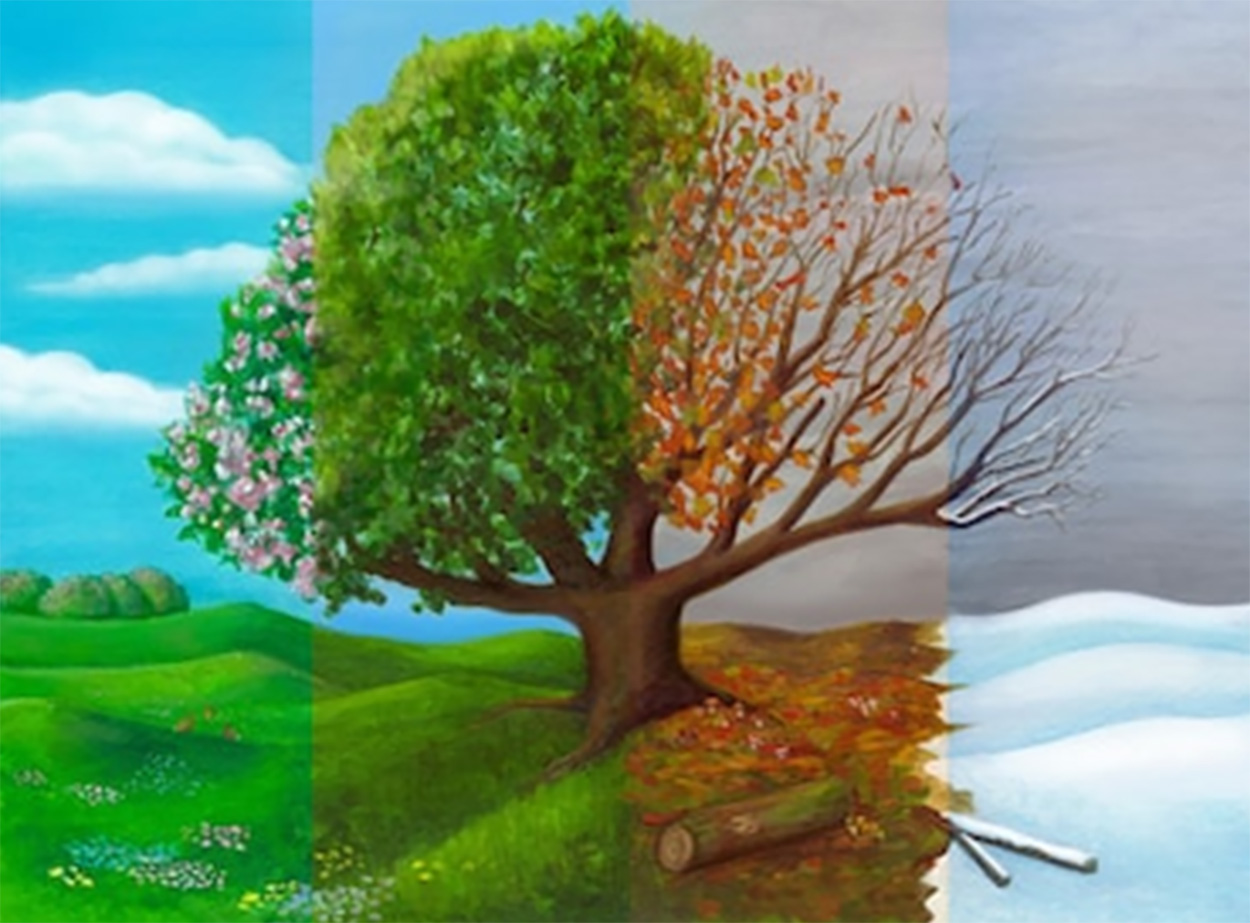
The trees absorb air. Their leaves gobble carbon dioxide, spread to branches and trunks and with help from the sun release oxygen. Come winter, the leaves fall off, trees go bare. Without leaves, trees go quiet. Any extra CO2 is more likely to hang in the atmosphere—until June. But, in June trillions upon trillions of leaves grow and start breathing to literally cleaning the sky. The world’s northern forests become a giant vacuum cleaner, scouring the air, sucking down the CO2 till around November.
When leaves fall, the situation reverses but grows again maintaining a fantastic dance for the life to survive globally. It starts, as I said, with 3.1 trillion trees. That’s the latest census, published in science journal Nature by Yale’s Thomas Crowther, a Climate and Energy Institute postdoctoral fellow. If he’s right, there are more trees on Earth than there are stars in the Milky Way.
Now imagine how many leaves might be on all those trees. It’s a very large number. The University of Washington tried to come up with a leaf count for a “mature oak,” but oaks are so variable that they could only give us a range: 200,000 to half a million leaves per tree.
Look closely at any oak leaf or any leaf (or the surface of any green plant, even a blade of grass) with a magnifying glass. You’ll find little breathing tubes called stomata. That’s “mouth” in Greek, because, like mouths, they’re openings that allow outside air in.
I think of them more like lungs, often with squeezable openings. That’s where the carbon dioxide gets in and the oxygen slips out. Photographer Robert Dash used a scanning electron microscope to magnify the surface of an actual oak leaf 150 times (below), and all those little cheerio-like openings you see here?
“There are so, so many of them! On, say, a square millimeter of leaf—that’s one thousandth of a square inch—you might find a hundred to a thousand little lungs. If we multiply all those leafy lungs times all those leaves times all those trees and add grasses into the bargain, we’re talking about an unimaginably vast planetary breathing system—a giant green machine that pulls enormous quantities of carbon dioxide out of the air, especially in the warmer months,” that’s what a NASA video shows: We can see the Green Machine turning on, then, a few months later, turning off. When it’s on, when the leaves are out, those ugly, poisonous-looking swirls of orange and red vanish from the sky. The machine works. And this happens every year. It’s as though the Earth itself has lungs.
But for all of its lung power, CO2 concentrations keep building in our atmosphere. We’re apparently pouring so much CO2 into the sky that the trees can’t keep up.
Twelve thousand years ago, the Yale study says, there were twice as many trees on Earth. Apparently, we need their help. We need more trees..
To see A graphic of George Washington University on ‘which nation pouring the most carbon dioxide into the sky’ shows that China, the U.S., India and Russia are the biggest contributors.
Ben Pruchnie, Getty
Trees, meanwhile, aren’t the only CO2 removers on the planet. Oceans suck carbon dioxide as well. Animals eat carbon, die, and sink to the bottom of the sea. The White Cliffs of Dover are made from the skeletons of carbon-rich animals. Chalk is basically carbon storage.
——————————————————————————–
Arunachal role vital to
check global warming
Every adult person inhales oxygen 12 to 20 times per minute and exhales carbon dioxide into the atmosphere. But, hardly few realize the importance of trees which convert carbon dioxide into oxygen for all living beings to survive on the earth.
It is commonly believed that humans can survive in maximum temperature of 42.3°C and higher temperature may denature proteins and cause irreparable damage to brain. But, life on earth is at threat as average global temperature has increased by a little more than 1°C since 1880. Earth’s global average surface temperature in 2020 was the hottest year on record, according to NASA.
This increase in earth’s average temperature is called global warming. More or less all records of the earth have the same opinion now that human activities, like discharge of green house gases from smokestacks, vehicles and burning forests are primary causes, according to climate specialists.
Arunachal Pradesh, the richest biodiversity hotspot in the world, with over 50,000 sq km of moderate to very dense forests, is equivalent to 550 million cubic metre growing stock or living assets (equivalent to 2000 million metric tons of carbon dioxide) that serves as one of the major ‘carbon sinks’ or ‘lungs’ of the globe, according to State Forest Research Institute director-cum-Arunachal Pradesh Biodiversity Board member-secretary P Subramanyam. He had said while taking part in the DDK’s 6th Arunachal Ki Awaaj episode on ‘Creativity in conservation’ with SFRI scientist Dr G Murtem, WII scientist Silawati Monlai and Arunachal Pradesh Gaon Bura Welfare Association president Nabam Epo on 16.05.2012 with this editor as anchor.
The state’s forests accounted 1/3rd of habitat area, which have been identified as part of a vast area of continuous forests (65,730 km2) including forests in Myanmar, China and Bhutan) known as ‘Intact forest landscape’. Arunachal Pradesh boasts of highest diversity with 200 species of mammals and 750 species of birds in India.
The state used to get poor fund allocation from the Centre based on population criteria. Thus, the Centre had granted green bonus first time after then chief minister Gegong Apang (state’s longest serving CM) had projected state’s living assets serving as lungs of the earth followed by his successor Dorjee Khandu on 16.06.09 claiming the 1996 Supreme Court ban on felling of trees deprived his state of its prime revenue source. In August 2012, then CM Nabam Tuki on 08.08.12 had also sought green bonus which was reiterated by present Deputy Chief Minister Chowna Mein during a conclave of Himalayan states at Mussoorie on 28.07.19, which was inaugurated by then union Finance Minister Nirmala Sitharaman.
When Arunachal is considered a major ‘carbon sinks’ of the world, every Arunachalees have a vital role to play in protecting the lush green cover of this Himalayan state.


 20

